Senate approves $161M for schools
Topeka ? The Kansas Senate on Thursday approved a bipartisan $161 million school finance package that was quickly shredded by House Republicans.
“This delays the progress of this session horrifically,” Senate Democratic Leader Anthony Hensley of Topeka said.
But House Speaker Doug Mays, R-Topeka, blamed House Democrats for poisoning the atmosphere.
During the House Education Committee meeting, Democratic members walked out once it became apparent that the Senate bill was being gutted.
“That’s a little bit childish,” Mays said. The full House will consider the legislation today.
The bill includes $11.4 million in new state funds, although House Republicans said it was sure to grow during debate. It also would limit school finance lawsuits and contains local tax increase options that have already been rejected by the Kansas Supreme Court.
Tensions have been high since lawmakers returned Wednesday for the first special legislative session in 16 years.
The overtime session was called by Gov. Kathleen Sebelius after the Kansas Supreme Court ordered the Legislature to increase school funding.
On Thursday, the Senate approved a plan over the protests of conservative Republicans who said lawmakers were succumbing to an unconstitutional order by the court.
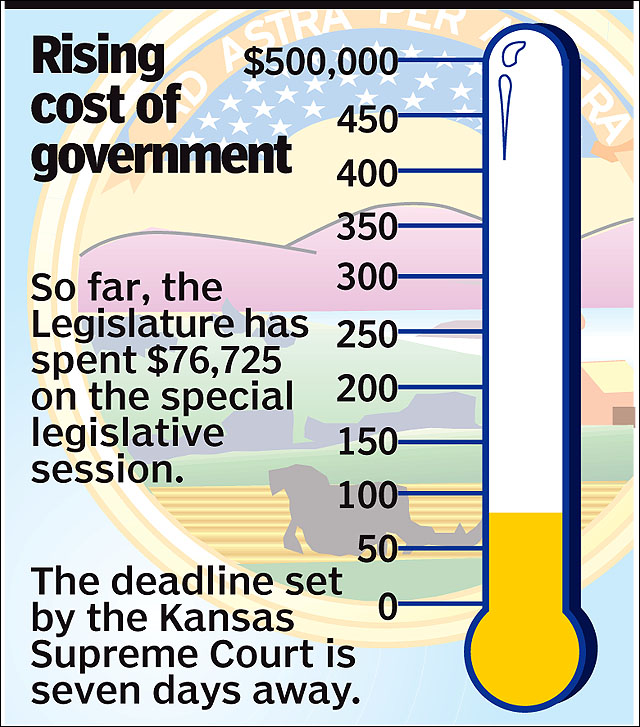
The measure was approved by the Senate 25-14.
All 10 Democrats voted for the bill, while the 30 Republican senators were almost evenly split. One Republican senator was absent.
Both Lawrence senators, Roger Pine, a Republican, and Marci Francisco, a Democrat, voted for the funding. The Lawrence school district would see an increase of $4.6 million under the proposal.
Included in the $161 million price tag is $27.4 million in property tax relief for low-wealth school districts.
Pine said he disagreed with the court’s order, but believed the appropriation was needed by schools. He also said the measure represented a fair compromise between the various special interests of schools.
“It’s one of the few times I have seen enough agreement between large and small schools districts which were able to support it,” he said. “That’s not an easy thing to do.”
Francisco described the legislation “as good as any bill we are going to pass.”
Sebelius issued a statement supporting the bill and applauding the Senate.
“They’ve set a cooperative and productive tone for the remainder of this education special session, and I join the people of Kansas in counting on members of the House to finish the job,” she said.
The Senate also voted 39-0 to prohibit the court from shutting down schools as a possible remedy to the lawsuit. The measure also would transfer responsibility for distribution of school funds from the State Board of Education to the Legislature. Supporters said that would prevent the court from shutting off school funding.
On the House side, the $11.4 million proposal included two provisions that would allow local property tax increases that could be used for teacher salaries and non-mandated school activities.
The court set aside similar proposals in its June 3 ruling.
As education lobbyists sifted through the bill, they said there were many questionable measures.
Val DeFever, spokeswoman for Schools for Quality Education, said one part of the House Education Committee bill would have the State Board of Education consolidate school districts.
“This will be the death knell for many local communities in rural Kansas,” she said.
City Government

Developer seeks incentive from City of Lawrence to build 131 units of housing near Wakarusa and Queens

Lawrence city leaders will consider whether to keep Community Building open, make 2 other rec centers free to access
A STAR Bond application raises questions for city leaders about Costco and housing west of the SLT

Soccer gear honoring Lawrence history’s all-star team is now on sale as part of city’s public art exhibition
To honor public servants, Lawrence’s July 4 celebration will have a whole gallery of their photos on display; submissions open now