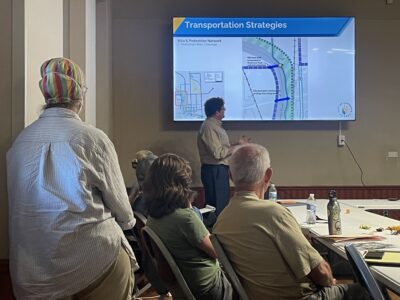
City still hopeful of holding line on taxes
Road repairs prompt discussion of increase, but little support shown
City commissioners on Wednesday stood behind their goal of not increasing property taxes as part of the 2006 budget, even as they received $20 million worth of bad news about the city’s streets.
But some chinks in their no-new-taxes armor began to emerge during the latest round of budget hearings. Mayor Boog Highberger listed three areas – new funding for street maintenance, capital improvement projects and a countywide biosciences effort – as needs great enough that he would consider increasing property taxes.
By the end of the meeting, though, Highberger’s bandwagon was still largely empty.
“My goal is to make sure that we don’t need a tax increase,” said City Commissioner Mike Amyx. “That was my goal when I started this, and that probably will be my recommendation to the end.”
But a new report from the city’s Public Works Department will make the goal more difficult. Chuck Soules, director of Public Works, said his department had completed about 70 percent of the city’s 307 miles of streets. He said the inspections determined that $19.2 million in maintenance was needed to prevent the streets from deteriorating to a point where they needed complete rebuilding. The city currently spends about $3 million per year for street maintenance.
“To make any progress on this backlog, we’re going to have to find some additional funding,” Soules said.
Soules presented a plan that would allow the city to complete about $9 million worth of repaving projects over a five-year period, but it would require a mill levy increase of 4.95 mills. For a 10-year program, the mill levy increase dropped to 2.47 mills and to 1.65 mills for a 15-year program.
A mill is $1 in property tax for every $1,000 of assessed valuation. For the owner of a $180,000 home, a 4.95 mill increase would result in a $102.46 increase in taxes for the year.
Fund balances
City Commissioner Mike Rundle said he wasn’t convinced a property tax increase was needed. He said the commission needed to seriously discuss how much money the city keeps in fund balances, which are funds left over from the previous year’s budget to help pay for expenses during the first few months of the new year. The money is usually necessary to help fill a gap in revenue while city officials await tax payments, and to provide a cushion for unexpected expenses or drops in revenues.
Rundle, though, said the city’s fund balances were excessive. Ed Mullins, the city’s director of finance, said the fund balance for the city’s general fund was approximately $13 million last year, or about 31 percent of the general fund’s total. Rundle said governments routinely keep their fund balances in the 15 percent range.
Rundle said he would like to reduce the fund balances closer to that 15 percent level, creating a one-time infusion of $6 million to $7 million in funding that could be used for roads, homeless services or other pressing needs in the budget.
“When you really look at our budget, I think the lack of revenues is being overstated,” Rundle said. “If we would have spent some of those extra dollars on road maintenance, we wouldn’t be in the situation we are today.”
Other commissioners said they were willing to look at decreasing the fund balances, as long as the new money was only spent on one-time expenses. Staff members said reducing fund balances would restrict the city’s flexibility.
“It would make it more difficult to react to slumps in the economy without taking drastic measures,” Mullins said.
Other considerations
In other budget news:
¢ Commissioners disagreed whether a proposed $345,000 per year countywide biosciences effort merited a tax increase. Highberger said the effort, which would create a new position of biosciences development and build two new biosciences labs – was worth a tax increase, if needed.
“I’m willing to consider a mill levy increase to fund this because I think it could have some pretty immediate payoffs,” Highberger said. “And if we don’t take advantage of this opportunity, I think it is one that will disappear.”
Amyx said he was generally supportive of the effort, but said it may be more appropriately funded from the county’s budget since it would be a countywide effort.
¢ Commissioners delayed deciding how much money to devote to capital improvement projects, which include big ticket items such as new roads, bridges, parks and city buildings. Highberger said he would support a quarter mill increase to give the city the ability to immediately tackle projects such as renovating the Carnegie Library at Ninth and Vermont streets, improving the intersection at 19th and Louisiana streets, and widening the northern portions of Kasold Drive. Amyx said he wanted city commissioners to consider putting much of the city’s capital improvements budget on hold for a year to give the city a chance to spend the money on street maintenance.
City Manager Mike Wildgen is expected to present a recommended budget to commissioners next week. Commissioners will have a month to review and change the budget before giving it final approval in early August.
City Government
Developer seeks incentive from City of Lawrence to build 131 units of housing near Wakarusa and Queens

Lawrence city leaders will consider whether to keep Community Building open, make 2 other rec centers free to access
A STAR Bond application raises questions for city leaders about Costco and housing west of the SLT

Soccer gear honoring Lawrence history’s all-star team is now on sale as part of city’s public art exhibition
To honor public servants, Lawrence’s July 4 celebration will have a whole gallery of their photos on display; submissions open now