CDC investigates obesity problem
Charleston, W. Va. ? West Virginia, a state with one of the worst obesity problems in the country, has called in the big guns for help. For the first time, federal disease investigators in Atlanta are studying obesity, just as they would investigate the rapid spread of an infectious disease.
“We didn’t suddenly realize we have this problem,” state health official Keri Kennedy said Friday. “But we are facing a severe health crisis and this is a new way of looking at it.”
West Virginia is consistently among the top three states in the nation for obesity, according to the Centers for Disease Control and Prevention and the state Bureau of Public Health. In 2002, the latest data available, 28 percent of West Virginians were considered obese.
In Kansas, 21 percent of adults were obese in 2002, ranking 19th in the nation.
The extra weight can lead to high blood pressure, diabetes, arthritis, some cancers and other problems. West Virginia leads the nation in high blood pressure and is fourth in diabetes.
Three CDC investigators teamed with Kennedy and two other state health officials for three weeks. The teams visited schools, businesses, restaurants, grocery stores, parks and communities. Gilmer County with its 7,160 residents was chosen as the rural site and Clarksburg with 16,743 residents was the urban site.
“People grew up on gravy and biscuits and they think they still need it, but they don’t do the exercise they once did to work it off anymore,” said Rose Clark, a health coordinator at United Hospital Center in Clarksburg. The hospital began offering gastric bypass surgery last year, Clark said.
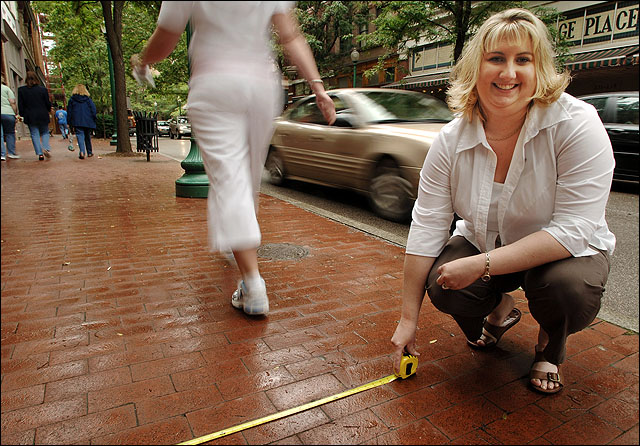
Keri Kennedy, with the West Virginia Physical Activity and Nutrition Program, worked with investigators from the Centers for Disease Control and Prevention to assess the state's environmental opportunities for physical activity and good dietary habits. The investigators looked at recreational opportunities, including whether communities had sidewalks and street lights for walking at night.
Obesity, defined as having a body-mass index above 30, also is spreading among West Virginia’s children. Nearly 43 percent of 5,887 children screened in a coronary artery risk project from 1999 to 2002 were considered overweight and more than 25 percent were obese.
At schools, investigators wanted to know about physical education programs and food offerings, such as how many servings of fruits and vegetables were available daily.
At businesses, they asked about policies that encourage exercise.
The investigators also looked at recreational opportunities and whether towns had sidewalks and street lights for walking at night.
The CDC is analyzing the West Virginia data and should provide information to state officials in August that will be used to develop a kit communities can use to assess their environments, Kennedy said.
National

Man pleads guilty to killing a top Minnesota Democrat and her husband
New tornadoes outside Chicago as severe storms pummel the Midwest

Feds won’t seek death penalty in plea deal with man accused of killing top Minnesota Democrat

NASA unveils astronauts to test tech for future moon landing
Social Security’ fund faces shortfall one year earlier than expected
WASHINGTON (AP) — Social Security 's retirement trust fund is projected to face a funding shortfall in 2032, a ...