Lawmakers deadlock on school finance
Amendment on judicial power appears unlikely, some now say
Topeka ? State lawmakers Saturday broke a court-ordered deadline to increase school funding but kept their special legislative session alive.
The Legislature adjourned around 3:30 a.m. today and was scheduled to return at 11 a.m. for a round of crucial votes.
The Kansas Supreme Court ordered lawmakers to increase school funding by $143 million by Friday. Court spokesman Ron Keefover has scheduled a news conference at 2 p.m. today to announce the court’s “next step in this litigation.”
It is likely the Legislature will still be meeting at that time.
“The legislative process is working,” House Speaker Doug Mays, R-Topeka, said.
But Friday and early today, the first special session since 1989 seemed on the verge of collapse.
The sticking point is that Republicans, who hold significant majorities in the House and Senate, want to advance to voters a proposed constitutional amendment that would prevent the state Supreme Court from ordering the Legislature to make appropriations. They say the court overstepped its authority in the school finance order.
“This is about principle, fundamental issues. We’re drawing a line in the sand,” Mays said. “If we’re not now, we’re headed for a serious constitutional crisis.”
But Republicans need Democratic help to get the necessary two-thirds majorities in the House and Senate to be able to approve the amendment and put it on the ballot.
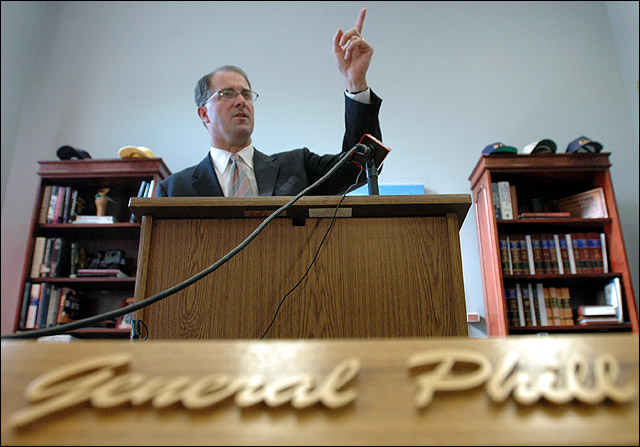
Kansas Atty. Gen. Phill Kline drives home a point during a press conference in his Topeka office. Kline said he would try to avoid the closure of schools.
Democrats and moderate Republicans have refused. Some said the court was within its rights to order an appropriation because the Republican-led Legislature ignored an earlier school finance decision from the court.
Others said the court may have overstepped its authority, but that they wanted to wait a few months to study the issue more before changing the constitution.
“This moves into the area of impairing the ability of courts to correct people’s problems,” McKinney said.
Throughout the day, legislative leaders met in back rooms and with Gov. Kathleen Sebelius.
At one point, Democrats and moderate Republicans tried to reverse a decision by Mays that had bottled up a bi-partisan school finance plan. But that failed 59-63.
By the end of deliberations today, House Republican leaders were demanding that a $148.5 million school finance package be linked to approval in the House and Senate of the constitutional amendment.
Senate education leaders balked at linking the funding with the amendment. “We can’t hold our children hostage to that,” state Sen. Jean Schodorf, R-Wichita, said.
Most of the day was spent with lawmakers “at ease” because there was nothing to debate or vote on. Legislators played cards and Scrabble in the halls or took long dinner breaks.
Earlier in the day, the Kansas Supreme Court rejected a request from Atty. Gen. Phill Kline to give the Legislature more time to work on school finance during the special legislative session.
“Unbounded delay in this case is unacceptable,” the court said in its order.
Kline held a news conference shortly after the decision saying he would try to avoid the closure of schools by getting the State Board of Education to certify an annual appropriation of schools instead of month-by-month appropriations.
He said that could be legally done before the state Supreme Court issues its remedy in the case.
Although, he added, he didn’t know if the court would try to cut off funding to schools.
“I can’t predict exactly all the various remedies the court might use,” he said.
The special session started June 22 in response to the court’s June 3 order to increase school funding.
The court had previously said the school finance law that supports 465,000 students was unconstitutionally underfunded, and had rejected a Republican plan passed during the regular session as too small and unfair to low-wealth school districts.
It gave the Legislature until Friday to increase funding to resolve a lawsuit filed in 1999 by parents and students in poor school districts.
To find out more about the state’s decision, check back with ljworld.com throughout the day for continuing updates.
City Government
Developer seeks incentive from City of Lawrence to build 131 units of housing near Wakarusa and Queens

Lawrence city leaders will consider whether to keep Community Building open, make 2 other rec centers free to access
A STAR Bond application raises questions for city leaders about Costco and housing west of the SLT

Soccer gear honoring Lawrence history’s all-star team is now on sale as part of city’s public art exhibition
To honor public servants, Lawrence’s July 4 celebration will have a whole gallery of their photos on display; submissions open now