Transcript of chat with Jim Carpenter, candidate for Lawrence City Commission
Moderator: Welcome to our online chat with Jim Carpenter, candidate for Lawrence City Commission.
The chat took place at 1:30 p.m. on Monday, Feb. 21 and is now closed, but you can read the full transcript on this page.
Moderator: Welcome to our chat today with Jim Carpenter. We have several questions that have been submitted, so we’ll go ahead and get started.
Jim Carpenter: Hello. Thank you for the opportunity to answer to your questions.
Jill, Lawrence: What is your position on expanding the Lawrence Public Library?
Jim Carpenter: The community has clearly outgrown the current library. I strongly support proceeding with a site plan study for the library expansion, although I would like to see it remain close to its current location. There’s a great deal of library use by people who go to the public swimming pool, and it’s easy for teens to get to after school now. I hope to see an increased children and teens’ area, increased meeting space, and more Internet terminals in any future plans. It’s my hope that we can enter into creative partnerships with other agencies and the county in efforts to build a facility that supports regional needs.
Sarah, Lawrence: In your opinion, is the South Iowa area overgrown, or is there room for additional retail businesses? Do you think Lawrence would benefit from additional growth of that area?
Jim Carpenter: I believe that past planning practices that have permitted such retail growth along south Iowa have been detrimental to our downtown businesses. We are seeing a rise in traffic problems in that part of our city because of this. Before I would approve any additional retail space in that part of the city, I would like the city to adopt the practice of an economic impact review of new large retail areas to determine the true economic impact on our existing local businesses and on existing city infrastructure.
Eric, Lawrence: Jim,
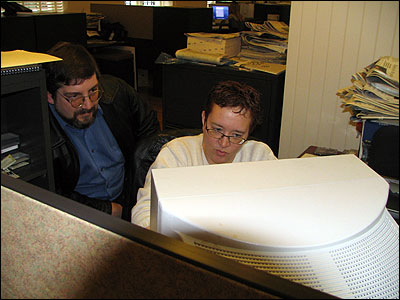
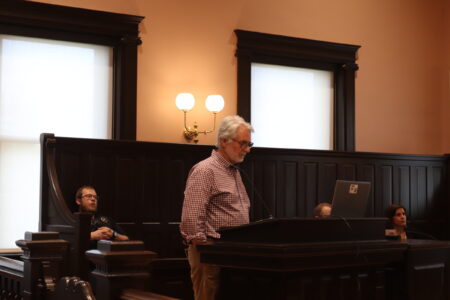
Paula Schumacher types while City Commission candidate Jim Carpenter answers questions provided by LJWorld.com readers in an online chat Monday afternoon.
Do you have any ideas for improving public transportation in Lawrence (or in the KC-Topeka corridor)? How about encouraging car pooling, bicycling, or walking (e.g., incentives/disincentives)? Thank you.
Jim Carpenter: Yes. First, we need to coordinate routes between the KU bus system and the T. We also need to examine our fixed route system to make sure that it meets current and future demands for public transport. I would encourage efforts to look into the possibility of permitting students to ride the bus for free (such as is done in Gainsville, Fla.). This would have the effect of introducing our young people to public transportation and hopefully they would continue using it when they reach driving age.
I support regional efforts with surrounding communities to investigate the possibility of mass transportation to facilitate commuter traffic both to and from the KC and Topeka areas.
I am currently working with the Burroughs Creek Area Plan Committee to bring the East side Rail To Trail project to fruition. It is my hope that this will be a major step in providing walking and bicycle trails throughout the city.
Finally, I will work to ensure that any new housing developments are built in such a way to promote the ease of bike and pedestrian traffic and have connections to the public transportation system.
 Today’s chat transcripts Today’s chat transcripts Jim Carpenter Mike AmyxUpcoming chats Ask Sue Hack a question Ask Doug Holiday a questionEarlier chat transcripts David Schauner Tom Bracciano George Grieb David Holroyd Greg Robinson Jim Carpenter Mike AmyxUpcoming chats Ask Sue Hack a question Ask Doug Holiday a questionEarlier chat transcripts David Schauner Tom Bracciano George Grieb David Holroyd Greg Robinson |
Samuel, Lawrence: What is the long-term goal of the fixing the streets in Lawrence? Patching over the huge potholes every time it rains is not satisfactory, I think we really need to look at taking out some bonds and doing some major street repair.
Jim Carpenter: The current condition of our streets are evidence of short-sighted planning by the city in the past. When I moved to Lawrence 12 years ago, Wakarusa was a gravel road — and is quickly becoming that way again.
In order to save funds, the city sometime in the past adopted a policy to build our roads directly on a clay undersurface without a gravel underbase. This results in a large number of potholes after every freeze-thaw cycle. Simply patching these holes is an inadequate solution. We are faced with the difficult situation of simply re-paving the roads with inadequate substructure on a fairly regular basis, or finding the funds to rebuild the roads properly when they need repair. When and how we will find the funds for this is truly a difficult question.
What we can do, as has started with the current commission, is ensure that all future roads are constructed with an adequate base and with materials that will permit a longer life span. This will have the benefit of reducing our long-term costs of repairing our roads.
Lisa, Lawrence: How do you feel about the city code regarding the requirement to not allow more than three unrelated persons to live in a house that is zoned for single family use? If you do believe it has merit, then would you be opposed to expanding the requirement so that it includes properties other than single family residential. If you do not agree with the current code, would you be willing to look at changing or modifying it?
Jim Carpenter: I support this city policy as I feel it is of great benefit to all our neighborhoods. I would support extending this policy to include other residential zoning types. When working with the Barker Neighborhood Assoc. in negotiations with the Peridian Group over the design for The Woods on 19th Street, we included as a requirement in the planned unit development that the city policy apply to those single family homes. Since then, through LAN, we have encouraged this requirement to be included in all single family PUDs.
Richard – Lawrence: What would be the highlights of locating light industrial in SE Lawrence?
Jim Carpenter: Richard, I imagine you are referring to the SE Area Plan currently under review by the city commission. As you know, the planning commission voted that a large portion of this area be set aside for office/business park and light industrial development.
This has benefits to the Lawrence community in several ways. Transportation 2025 identifies this region as becoming a major transportation hub on the east side of Lawrence, which one day may have a southern bypass to connect to U.S. Highway 59 and a northern connection across the Kaw to the turnpike. It is close to our current business park and will allow for expansion as the ECO2 committee identifies other suitable industrial locations around the town. It is easy to extend existing city infrastructure into this area to make it readily available for new and expanding businesses. Finally, this will provide us with the opportunity of attracting well-paying jobs that will permit those who live in Lawrence to work in Lawrence, and those who work in Lawrence to afford a home in Lawrence.
David, Lawrence: The city of Columbia, Mo., our rivals to the east, recently legalized medicinal pot. What is your stance regarding marijuana. And is there any chance we could legalize it here?
Moderator: Just a clarification: Columbia didn’t legalize medicinal marijuana. In November, Columbia voters approved two marijuana-related ballot resolutions. One made marijuana the lowest priority for local police and required anyone caught with small amounts of the drug to be fined instead of arrested. The other said patients who used marijuana with a doctor’s recommendation should not be arrested or punished in any way, or, if that part of the law was found invalid, should be punished by no more than a $50 fine.
Jim Carpenter: I would not encourage the city to adopt any stance contrary to state or federal law as to the legalization of marijuana. However, I would like to further examine the Columbia resolutions to determine if such resolutions might be possible in Lawrence, and hear public comment — especially for the medical use of marijuana.
Drew, Lawrence: It seems to me that it is the community’s liberal reputation regarding social welfare that makes Lawrence a logical destination for homeless people, and indeed, there exist many organizations throughout the community intent on helping those with very little. While I believe these institutions, and the moral qualities upon which they’re based, to be an asset, others (specifically some small business owners) view them as perpetuating the problem of homelessness. Do you believe it would help the community (as a whole — including its homeless members) to adopt a more strict, less charitable policy toward the homeless? What, if any, programs currently exist to not only provide food, shelter, and meals to the homeless, but to help them re-establish themselves as productive members of the community? Would you support the expansion of these programs? If programs like these do no exist, would you support their instantiation? Thank you.
Jim Carpenter: The city has had a task force looking into the issues of homelessness over the past year. I follow their progress and agree that the recommendations in their draft report are reasonable starting points for the city to confront this problem. There are many reasons for homelessness and how we address the problem of these least fortunate members of our community reflects upon us all.
I support efforts to help those who are homeless and are able to acquire and maintain jobs within our community. It should always be our goal to help people become self sufficient.
Some, however, because of mental or physical health reasons, will never be able to do this. Our approach must be flexible enough to also meet their basic needs. One of these needs is periodic in-patient mental health treatment. The next commission will have to work with Bert Nash, LMH, and other social services within the community to identify the exact needs of this in-patient facility and work together to find a means to fund it.
Several downtown merchants have voiced concerns about illegal behavior of some who are homeless. It is my understanding from speaking with the mental health professionals in town that these individuals represent a very small percentage of those who call themselves homeless and we should not confuse these criminal behaviors with the problem of homelessness. Many in the homeless community express the same concern about these behaviors that the local business owners do. Working together, we can find a solution to this problem that doesn’t further stigmatize the homeless.
Anne – Lawrence: Your position on the smoking ban is refreshing and to be admired … it is not wishy-washy. It’s too bad others do not speak with such clarification. On matters of health where do you stand on the eastern portion of a citywide hike and bike trail?
Moderator: Could you also tell us here about your position on the smoking ban? Thanks.
Jim Carpenter: I strongly support the current smoking ban and can see no reason to vote it down or modify it. With a degree in biology and environmental studies, and after review of the medical testimony submitted in support of this ban, I believe that the smoking ban is in the best interests of us all.
In spite of a year-long task force study and numerous opportunities for public comment, many still felt that their voices were not heard in the final decision to pass this ban. We can learn from this. When we have such controversial issues before the city commission in the future, we should initiate a series of town hall meetings to discuss all aspects of proposed social change — including their impact on businesses. One downtown business owner directly impacted by this ban has informed me that daytime sales have dropped at his business, but evening alcohol sales have increased for a general improvement in business since the ban was implemented. This is largely attributed to the availability of outside seating. I would support efforts to support outside seating for businesses affected by this ban that don’t already have it. And, should we find that food sales that food sales at any impacted business falls below the 50 percent threshold currently required for a liquor license, we review that policy to ensure we don’t run a local business out of business simply because of this ban.
As stated in an answer to a previous question, I am on the Burroughs Creek Area Plan Committee directly involved in creating the Rail to Trail on the east side of town. I do strongly support efforts to increase pedestrian and bicycle use throughout our community and see that as an important health issue as well.
Chris, Lawrence: Would you agree to some kind of compromise on the ban of setting off fireworks in city limits?
Jim Carpenter: I did not support the enactment of the fireworks ban. I’ve personally enjoyed setting off fireworks from a young age. However, this issue was decided after due deliberation by a prior commission and passed for reasons of public safety. Absent evidence that the community has suffered some large harm from this ban, or a substantial citizen demand to revisit the issue, I would be hard-pressed to find reason to modify or overturn it, even if I would like to shoot off fireworks in my own yard on the Fourth of July.
Moderator: We’ll take one final question after this, because we’re running out of time.
Mike, Lawrence: Will you receive an endorsement from Howard Dean when he is in Lawrence?
Jim Carpenter: I didn’t know that Howard Dean was planning to endorse city commission candidates. I will be present when he is in town, but have no idea if I will meet him — much less get his endorsement. The city commission race is non-partisan, as you know. However, backing from a nationally known figure would be hard to turn down.
Linda, Lawrence: Mr. Carpenter, I am a bit confused. I have visited with many residents in the Barker neighborhood and they tell me that they did not want a roundabout at 19th and Barker. So, who was behind the roundabout installation? Thanks.
Jim Carpenter: The city presented only two options to the Barker Neighborhood for improvements to the 19th & Barker intersection. These were 1) left-turn lanes in all directions with a traffic light and 2) a roundabout.
After a series of five meetings between the city traffic engineer and the neighborhood, the neighbors reached consensus that 1) we didn’t want any improvements made and 2) since that wasn’t an option, we would opt for a roundabout. The final plan took less property from fewer landowners in the neighborhood and preserved the neighborhood laundromat, which may have been threatened if the roads had been widened.
Although some were unhappy that we were forced into this position, most whom I’ve spoken with agree that this particular roundabout has helped with the flow of traffic through our neighborhood.
Whether roundabouts are an appropriate means of retrofitting problem intersections must be addressed on a case-by-case basis. We must examine the impact on traffic flow through the neighborhood, pedestrian safety, cost, and reasonableness given the needs of emergency services and school bus traffic. Roundabouts can be made to address these issues if sufficient land area is available. If it is not, we could cause more problems than we solve. Any discussion of roundabout placement must always include those who live closest to them.
Jim Carpenter: Thank you for the opportunity to answer your questions. Don’t forget to vote next Tuesday and on April 5.
Moderator: We’d like to thank Mr. Carpenter for taking part in today’s chat and we’d like to thank all of our readers who submitted questions.
Our next chat will be at 2:45 p.m. with Mike Amyx, a former mayor and county commissioner who is among the nine candidates running in the March 1 city commission primary.
City Government
Developer seeks incentive from City of Lawrence to build 131 units of housing near Wakarusa and Queens

Lawrence city leaders will consider whether to keep Community Building open, make 2 other rec centers free to access
A STAR Bond application raises questions for city leaders about Costco and housing west of the SLT

Soccer gear honoring Lawrence history’s all-star team is now on sale as part of city’s public art exhibition
To honor public servants, Lawrence’s July 4 celebration will have a whole gallery of their photos on display; submissions open now