Hidden twist found along family’s roots
Great-grandfather's shooting has ties to free state battle
Baldwin ? Harold Bailey, known as a talented storyteller, loved to talk about his grandfather being shot by William Quantrill’s men on their way to burn Lawrence in 1863.
When Walt Bailey, his son, heard the tale, he remembered the old expression: Never let the truth get in the way of a good story.
It wasn’t until three years ago Walt Bailey discovered the documents that revealed the true but still harrowing story of the great-grandfather almost killed by pro-slavery men, though not Quantrill’s gang. And not in 1863, but in 1856.
As it turned out, the truth didn’t block a good story after all.
Now, Bailey, an art professor at Baker University, has built an exhibit melding photography and his great-grandparent’s words in a way he hopes inspires others to investigate their own family histories.
“It’s intended to do something to tease people, to get them to wonder what their family stories are,” Bailey said. “My contention is my ancestors are not special — they were ordinary people. I believe all of us have stories as interesting as the ones I’m trying to tell.”
Early research
Bailey started researching his family’s history in 1980 and became especially interested in John Baillie — the great-grandfather who his father said was shot by Quantrill — and his wife, Barbara. As the story goes, the family name was later changed to “Bailey” to take the “lie” out of the name.
Using records such as U.S. Census reports and British sailing records, he determined John Baillie was a whaler who sailed out of Dundee, Scotland, in 1836; that Barbara Baillie was born in Scotland and came to the United States in 1845; that the couple lived in Pittsburgh by 1848; that they left Pennsylvania and they were living near Pleasant Grove, in Douglas County, by 1855.
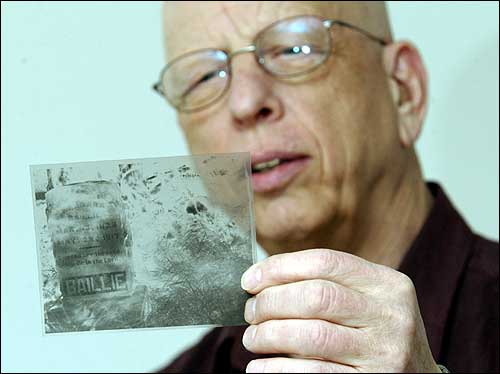
Baker University Art professor Walt Bailey looks at a negative he shot for his project using a 4x5 camera.
“The more I did research,” Bailey said, “the more interesting it got.”
But he still didn’t know anything about his father’s Quantrill story, which seemed the most interesting of all.
In his own words
That changed in 2002, with a trip to the Kansas State Historical Society Library in Topeka.
He came across a testimony written by John Baillie that was part of the federal government’s offer to compensate early-day residents who claimed they had suffered enough hardships while settling the West that they deserved compensation from the federal government.

 Photo Gallery
 6News video: Art professor unfolds history of family through exhibit
 Claims of Citizens of Kansas transcript (Word document)
The story, according to the 1857 testimony:
On June 10, 1856, John Baillie was headed from his homestead to Little Santa Fe for provisions. Little Santa Fe, along the Santa Fe Trail, was near the current 122nd Street and State Line Road in Kansas City, Mo.
He was stopped near Bull Creek, in Johnson County, by a handful of men who asked who he was and what he was doing. They invited him to stay the night.
The next morning, his horses were gone. Three men told him they’d walk with him to help find his horses.
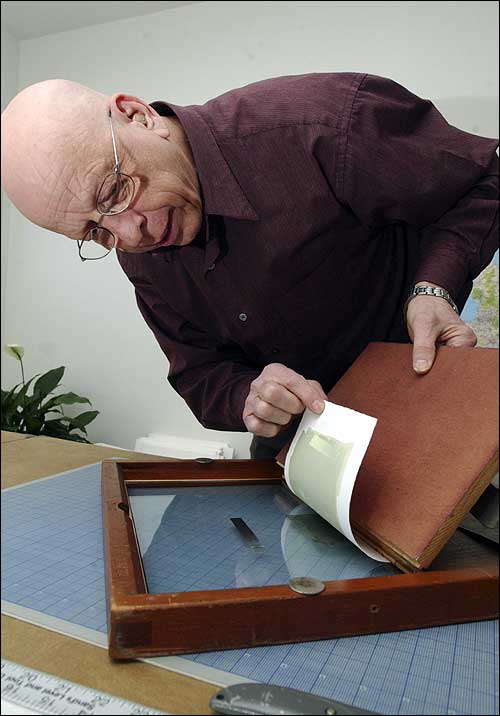
Baker University art professor Walt Bailey checks the exposure on his cyanotype, an old photographic printing process. Bailey is assembling a photography project outlining part of his family history. The project will be exhibited at Baker University starting Tuesday.
Eventually, the group was accosted by the pro-slavery F. M. Coleman, whose murder of free-state advocate Charles W. Dow a year earlier had sparked the Wakarusa War in southern Douglas County.
Coleman instructed Baillie he wasn’t to tell anyone about the pro-slavery men in Johnson County when he returned to Pleasant Grove. But John Foreman, another pro-slavery advocate, had other ideas.
“Soon as Coleman left, Foreman said he was going to shoot me,” Baillie testified. “I asked what for. (He) said he was afraid to let me go, that it was a hard case for them to let me go. I said you will shoot a better man than yourself.”
Baillie was ordered to give up his money, but when someone asked for his shirt, he said he replied: “My shirt is mine as long as I live.”
He was ordered to march six steps, ordered to stop and was shot in the left shoulder. The musket ball lodged in his chest, where it remained at the time of the testimony.
When one of the men attempted to strike him in the head with the butt end of a gun, Baillie grabbed the gun, pulled himself to his feet and hit the man in the face.
He then hid in the grass. It took him three days hiding from pro-slavery men to get to Blue Mound, near present-day Baldwin, for medical treatment.
| “Caledonia to Kansas: Part I,” an interactive exhibit of text and photographs by Walt Bailey, opens Tuesday in the Holt-Russell Gallery at Baker University in Baldwin.The exhibition is open from 7:30 p.m. to 9 p.m. Tuesday, and then from 1 p.m. to 4 p.m. Monday through Friday.Bailey will have a gallery talk at 2 p.m. Feb. 27. |
Baillie asked the federal government for $6,220.40 for his hardships, including “permanent bodily injuries to myself,” 16 acres of corn, two horses and a comb and brush.
“I never dreamed I’d find that testimony anywhere,” Bailey said. “It’s wonderful. I’m just so sorry I didn’t discover it before my father died (in 2001). It was a better story than the one he was telling.”
Telling the story
It was a good enough story Bailey wanted to share it.
He photographed sites important to his great-grandparents’ story, traveling to Scotland, Pittsburgh and throughout northeastern Kansas.
The result is a combination of photographs — many taken with antique cameras common in the time of his great-grandparents — and words from John Baillie’s testimony and memoirs of Barbara Baillie. Photo subjects include a boat in Scotland and native Kansas grasses.
He calls the exhibition “Caledonia to Kansas: Part I” in hopes of adding to the project later. He still wants to learn when and where his great-grandparents met and were married, and when and how his great-grandfather arrived in the United States.
“He’s obviously driven by a passion,” said Rand Ziegler, the Baker University administrator who oversees faculty development. “We talk a lot on this campus about lifelong learning. He’s a good model for someone who’s interested in lifelong learning so when he use that rhetoric on campus, it’s not just rhetoric.”
City Government
Developer seeks incentive from City of Lawrence to build 131 units of housing near Wakarusa and Queens

Lawrence city leaders will consider whether to keep Community Building open, make 2 other rec centers free to access
A STAR Bond application raises questions for city leaders about Costco and housing west of the SLT
Soccer gear honoring Lawrence history’s all-star team is now on sale as part of city’s public art exhibition
To honor public servants, Lawrence’s July 4 celebration will have a whole gallery of their photos on display; submissions open now