Chat transcript: Les Hannon and mapping Lawrence’s future
Welcome to our online chat with Les Hannon about mapping Lawrence’s future.
The chat took place on Monday, December 12, at 3:15 PM and is now closed, but you can read the full transcript on this page.
Moderator: Welcome to our chat today with Les Hannon, a retired project engineer, who is here to discuss a plan he’s been showing around to city leaders concerning how Lawrence could grow over the next 25 years and accommodate a population of 140,000.
You can read about the plan Les has developed at http://www.ljworld.com/future
We have several questions already lined up, so we’ll go ahead and get started.
Les Hannon: Thank you for inviting me.
Robert, Lawrence: In your article you mention the need to have additional connections to the South Lawrence Trafficway, such as Peterson Rd and the Farmers Turnpike. However, you don’t mention connecting Bob Billings Parkway (15th.Street) to the Trafficway.
I believe connecting this street to the Traffiway should be the first step. This would remove more traffic (KU events & commuters) from the newly expanded 6th. Street. than either of the other two roads.
What do you think?
Les Hannon: That’s an obvious connection that I just didn’t mention. I took that this will be an automatic connection.
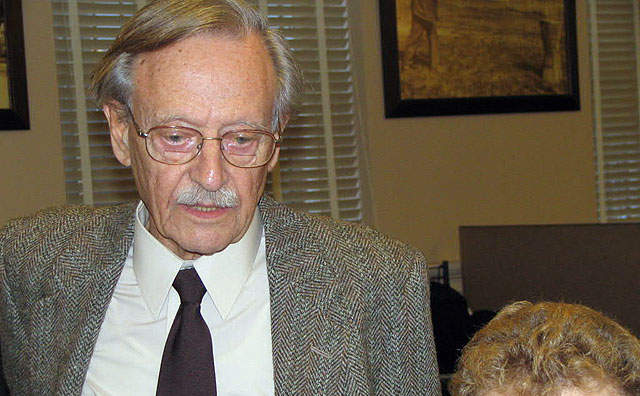
Les Hannon, retired project engineer, discusses with online readers plans concerning how Lawrence could grow over the next 25 years and accommodate a population of 140,000.
I believe that there should be no traffic lights or level crossings at the SLT. All connections should be over or under with ramps, so that traffic flow is not impeded on the SLT once it is completed.
Les Hannon: As a planner, I believe the SLT should be completed soon, certainly in the next five years. As a planner, I believe it should be on the 32nd Street route. Especially to avoid messing up the proposed “greenbelt” and Central Park.
Kevin, Lawrence: What do you think needs to be done to get the SLT completed? How would the $1.5M that has just become available be best spent?
Les Hannon: We should be using the $1.5 million for preliminary planning now to get the four-lane east leg started. Following that, we should plan for the extra two lanes on the western leg so that it is four lanes right through.
Donald, Lawrence: Can you name the city leaders you’ve pitched your ideas?
Les Hannon: First, I spoke Journal-World management about my ideas. Then I spoke to land-plan engineering, that was Phil Struble and Tim Herndon, to Mark Buhler and Doug Stephens of Stephens Real Estate, Kathy Clausing at LMH, LaVerne Squire at the Chamber of Commerce, Chuck Warner and Lynn Sheely at the US Bank, Roxanne Miller of the Kansas Land Trust, David Schauner, Mike Amyx and Boog Highberger of the city commission, and Charles Jones of the county.
Suzy, Lawrence: Are you getting or do you expect to be paid for planning Lawrence’s future, or, are you doing all of this out of the goodness of your heart?
Les Hannon: So far, I have done this as a freebie. But if things were to move further and we need to set up a task force, and if I were asked to participate in that task force, I would like to be considered for some recompense for my time. I have already spent many hours working on this project, and my wife keeps yelling at me for giving away everything for free.
Sean, Lawrence: Someone has proposed a building similar to our downtown -but on a much smaller scale, on the western edge of Lawrence. Do you think something like this will hurt the downtown or help the downtown more than a new Wal-mart?
Les Hannon: I think downtown and the surrounding core area are essential to the ongoing vitality and ambience of Lawrence. This should be at the top of our long-term strategy list to protect, enhance, develop, and promote this area. If we do this, it doesn’t matter how big Lawrence grows. And grow it will. So I don’t believe it will be hurt by other buildings going up south, west, north, or east.
Terry Lawrence: Do you think we can keep our downtown so vibrant and still get as big as surrounding metro areas, with their attendant mega-malls? And what is your opinion on the advisability and chances of finishing the last leg of the by-pass. Will that road help or hurt people who want to see Lawrence survive and thrive? Finally, will you give us your opinion on whether the proposed Wal-Mart on 6th street was/is a good idea or not.
Les Hannon: What I would suggest is that we take care not to have what I would call “mega-malls,” but an open regional shopping area. For example, where the SLT and Sixth Street cross. If Wal-Mart wants to build there, so be it.
Darren from Lawrence: I would like the freedom to be able to walk with my kids to a park nearby without having to dodge a lot of traffic. Driving to the park can take a big chunk of the day which makes it less appealing to go because of out busy schedule. How can we plan for more pedestrian friendly access to parks so I can let my children go play at a moments notice without too much fear for their lives?
Les Hannon: Lawrence is very blessed by the number of local parks throughout the city. At the same time, I believe strongly that the green-belt Central Park will provide a wonderful center for all kinds of activities which can be easily reached by our network of arterial roads north/south and east/west to give ready access to this, what I would hope, very attractive area.
Malcolm / Lawrence: You’ve been here seven years longer than I have so you have likely given this more thought: as the city annexes property with plans for managed growth, how does the concept of ‘districting’ play into holding on to this region’s valued diversity?
Les Hannon: As Lawrence grows, inevitably there must be a lot of annexation. I believe that the Strategic Long-Range Planning Task Force should be multi-jurisdictional, that is, it must represent the city, the county, and the school district. There must be input from all kinds of people in the Lawrence area which the task force (hopefully non-political) will ponder and come up with the final objectives.
Chuck, Lawrence: I appreciate Mr. Hannon’s incite, especially his call for a greenspace belt along the Wakarusa (given the floodplain there, it probably wouldn’t make a lot of sense to build there anyway). I am concerned that his plan basically opens the door for sprawl. If Lawrence is really going to grow into a large town, I think we should really look into expanded mass transit development, promoting mixed-use development, and in general preventing the kind of suburban stuff you see over in Johnson County. The town should grow, but why should we become Johnson County West anymore than we are now??
Les Hannon: Lawrence is going to grow. By 2030, it will be 50% larger than it is today, give or take. Within the following 25 years, by around 2055, we can expect to have in the order of 200,000 people in the Lawrence area.
I believe that if we do it right now, to develop a good long-range infrastructure for roads and all major utilities, we can keep a good grasp on managing the growth while at the same time protecting the viability of our core area.
Louis, Lecompton: I live near the Scenic River Road. Eventually, Lawrence and Lecompton will meet up in some fashion. What would be the long range plan for this area, just north of the I-70 Lecompton interchange? I would like to see the green space
extended north along 10 highway and hook up with
the River Road all the way to Lecompton. I think there is a great possibility for hiking and biking
trails.
Les Hannon: For four years, my wife and I lived in Lecompton on Diagonal Road. We feel that Lecompton is an important vicinity in its own right and needs to be protected as an entity, even though it may eventually may come within the overall Lawrence growth pattern. The green area that could be made available in Lecompton should certainly be part of the overall vicinity’s long-range thinking. But I honestly have not taken this into consideration at this time.
Kyle, Lawrence: Les, your idea sounds good, and aligns fairly well with the city’s current water/wastewater master plans and floodplain development issues associated with the Wakarusa Valley. What do you see as potential roadblocks to development of Lawrence in the future? Also, in addition to development to the south, what issues would you identify for developing around Clinton Lake? Do you think the city planning can control the developers better? Finally, would you have any interest in replacing Mrs. Finger as the City’s Planning Director?
Les Hannon: I believe that the most logical place to put a new long-term wastewater treatment plant is at the western end of the Wakarusa. That is, in the present southwest corner of Lawrence. I am aware that the prevailing winds are from the southwest, but any good modern treatment plant can be designed to overcome any problems that might occur.
This plant should basically service north, west, and south development areas but be interlinked with the current 8th Street facility. Once this interlink is up and running, then some of the major overhauls of the existing plant can be put in hand.
The new facility should be designed in such a way that it can be built in stages, first for 40 years, then on out from there, with sufficient land dedicated at the start.
Regarding Linda Finger, I have great respect for her abilities as a civic planner. I would have no desire to replace her in that position.
Les Hannon: Regarding developers: If we can plan a strategic infrastructure showing where all major arterial roads would go, and including tie-ins with I-70, the SLT, K-10, and the new Highway 59 south to I-35, we can set the pattern within which developers are free to plan their ideas for residential, industrial, commercial and any other appropriate facilities.
Dave, Perry Lake: Question #1 — There is a regional planning group in the KC area that includes the KS counties of Johnson, Miami, Wyandotte, Leavenworth, and the eastern half of Douglas. Do you see the need to expand MARC or for the creation of a separate regional planning group for other Kansas counties that are experiencing growth pressures? In particular, Douglas, Franklin, Shawnee, Jefferson, Osage and Jackson counties.
Les Hannon: There has been considerable discussion about tie-ins to the various Kansas City areas, and also to Topeka. This includes such things as the possibility of light-rail transport, rapid-bus transport, and so on. A lot of people who live in Lawrence work in these two metro areas. The ideas are under sound consideration by the transportation people concerned.
Any way we can simplify commuting is sound thinking, but it should in no way impact on the very strong desire to keep Lawrence its own entity. Hands off us.
Jean, Lawrence: I tend to feel that raised medians seem to be a fad of sorts because they always eventually get torn out. I also feel that roundabouts should be used for larger intersections as opposed to smaller intersections like in Lawrence. Do you think their high costs are justifiable?
Les Hannon: Any time we build new arterial roads I believe they should have either grass medians or turning lanes. In effect, making them what is virtually five lanes wide. Any time you experience night driving in snowy or wet weather, the need for a median becomes very clear.
As far as medians are concerned, there is always the possibility that precast concrete tunnels three feet underground with easy access can provide a easy-to-get-at infrastructure for wastewater lines, potable water lines, gas, power, any other lines that you want to consider, which can be accessed easily without tearing up the roads and upsetting traffic.
Les Hannon: As far as roundabouts are concerned, I grew up with them overseas. I found they worked very well for all levels of traffic, major and minor roads, because people knew what they were doing and could drive accordingly.
Here, our problem is that people do not know how to use them, and therefore they curse and swear at them and say that they are a blight. This is a pity, because if the roundabout are designed properly and people are taught how to use them properly, as happens in many other countries in the world, they work very well.
John, Lawrence: Regarding westward extension of Peterson Road Option 1, can the concern of disrupting the water shed be addressed via a bridge or something, this concern only covers approximately ¼ of a mile correct?
Les Hannon: Regarding the expansion and extension of Peterson Road, I believe it should be the main east/west road north of Sixth Street from North Iowa at the east end to and across the SLT and going further west until it eventually connects up with Highway 40.
Because of the land ownerships and variations in topography, this may not be a dead straight arterial road. But the east/west line should be followed as closely as practical.
Jason, DC/Lawrence: Les, you mention that you have spoken with RoxAnne Miller of the Kansas Land Trust, and I am glad to hear it. Moreover, your plan for the “Central Park” of the Wakarusa is similar to plans put forth by the Sierra Club, KLT and other area environmental organizations for an “Emerald Necklace” greenbelt that would also follow the Wakarusa, with the obvious difference between the plans being that the Haskell Wetlands would serve as the “Emerald Necklace”‘s center piece. Given the obvious community disagreement over paving the wetlands for a highway, why doesn’t the development community give a little on the 32nd street alignment, push it south of the river, and make this controversy go away?! (you say yourself that either route is essentially equal)
Les Hannon: In practice, I realize that there are two possibilities for the SLT: the 32nd Street route, and going south of the Wakarusa. In actuality, I believe the 32nd Street route makes much more sense from a strictly planning and engineering logic. Further, where the south of the Wakarusa route would require two crossings of the river, I believe it would also take away a great deal from the concept of the greenbelt.
Sean, Lawrence: What is your opinion of the “Smart Growth” theory as it pertains to city planning? Also, do you know of any “smart growth” cities with an affordable cost of living?
Les Hannon: I’m not sure that I really understand the “Smart Growth” concept. So I don’t wish to comment on it any further.
Eileen – Lawrence: Can we get the city of Lawrence to consider inviting Costco to build a store here? Costco is a very admirable company that treats its workers well and gets high marks in other areas.
I’ve wondered how Lawrence, a progressive town that is very careful about what businesses come here, allowed a Walmart to come to town. Walmart has some of the worst-for-America practices of all the big box stores. (The environmentally friendly building Walmart likes to cite does not come close to making up for the human rights and worker violations Walmart is responsible for.) A Costco could provide Lawrence with an alternative that is much better: higher worker wages, competitive prices, better environmental practices, more products made in the U.S. How would we get the city to consider a Costco in Lawrence? The nearest one is 35 miles away.
See BuyBlue.org for more on Costco’s superior policies compared to most other big box stores.
Les Hannon: Regarding Costco, my wife and I shop there frequently in Overland Park. My understanding is that Costco normally will not consider setting up one of their outlets under a certain number of population in a city or area. I think Lawrence is still a bit on the small side for that consideration.
Jason, DC/Lawrence: Les, just a personal note to say hello from your former BZA colleague — I am joining my (now) fiance for a few years out here in DC, but we look forward to moving back to the area eventually. I am happy to see you throwing yourself and your expertise into these issues more publicly. Your ideas seem very sensible, and I hope they can overcome some of the reluctance on all sides! Cheers, Jason Fizell
Les Hannon: Thanks, Jason. Good to hear from you. As you can see, we are having some fun with some strategic planning ideas. Look forward to welcoming you back to Lawrence in the not-to-distant future.
Parker, Tecumseh: What are your thoughts on New Urbanism? I live in the suburbs now and love the idea of being able to walk to shops and work instead of a 20 minute car ride anywhere.
Les Hannon: Regarding New Urbanism, I can understand your desire to minimize “commuting.” I think the best we can do in Lawrence is to have as good access as we can on arterial roads throughout the city so that people have reasonably-ready access with a relatively small amount of travel.
Jimmy, Lawrence: Don’t cities in the United States historically always grow west?
Les Hannon: In days gone by, when we had a lot of “smokestack” industries, usually the prevailing winds were from the west. So the industry would be on the east side of the town or city. That would mean that logical growth for living would be west.
Today, in a city like Lawrence, that question does not arise, and where we put industry is more dependent on convenience to transportation and all kinds of utilities. If that happens to be on the east, growth will go more to the west, but I do not know of any reason why this should happen today.
Moderator: That will be our last question for today. I’d like to thank Les for participating in today’s chat and sharing some of his insight and wisdom about planning.
I’d also like to thank all of our readers for their questions.
Les Hannon: I really appreciate all the questions that have come in, and hope that my comments have been helpful.
Moderator: Thanks Les.
We’ll continue our “Mapping the Future” series tonight at 6 p.m. and 10 p.m. on Sunflower Broadband’s cable Channel 6.
And be sure to pick up a copy of the Journal-World for more stories in this series on Tuesday.
You can find J-W and 6News stories, plus interactive maps, historical photos and documents online at http://www.ljworld.com/future.
City Government
Developer seeks incentive from City of Lawrence to build 131 units of housing near Wakarusa and Queens

Lawrence city leaders will consider whether to keep Community Building open, make 2 other rec centers free to access
A STAR Bond application raises questions for city leaders about Costco and housing west of the SLT
Soccer gear honoring Lawrence history’s all-star team is now on sale as part of city’s public art exhibition
To honor public servants, Lawrence’s July 4 celebration will have a whole gallery of their photos on display; submissions open now