‘Aunt Jemima’ continues after 100 years
St. Joseph, Mo. ? She was the first living trademark, and her product ushered in the era of convenience for American households.
And it all began in St. Joseph.
Though Aunt Jemima has undergone several transformations since the invention of her famous pancake flour, former Quaker workers haven’t forgotten her beginnings here.
“It was a good pancake mix,” said Carole Filley, who worked at Quaker for more than 30 years. “I can remember at one point in time when they started messing around with the recipe; I don’t think it was as good after that as it was before.”
Using hard winter wheat, corn flour, phosphates, bicarbonate soda and salt, Chris Rutt, a St. Joseph Gazette writer and entrepreneur, created the formula in his kitchen in 1889.
It was a successful formula, but the product had no identity. The inspiration would soon follow after Rutt attended a vaudeville show in St. Joseph where he heard “Aunt Jemima,” sung by a performer clad in an apron and bandanna headband, according to the Afro-American Almanac.
The song was such a hit that Rutt decided to link the popularity to his product by naming the pancake mix Aunt Jemima.
After Pearl Milling Company, which had been producing the flour, fell into financial trouble, R.T. Davis purchased the company in 1892.
“I guess he developed the initial recipe and R.T. Davis bought it from him, perfected it and so it became like a self-rising pancake,” says Roy Fortner, former Quaker employee who with his wife, Peggy, collects Aunt Jemima memorabilia.
A copy of the original recipe hangs on display at the Patee House Museum.
Following the sale of Pearl Milling, R.T. Davis improved the recipe and kicked the marketing into high gear, hiring Nancy Green, a St. Joseph woman and former slave, to portray the legendary black woman.
“At the 1893 World’s Fair is where they introduced her,” says Gary Chilcote, director of the Patee House Museum.
Speaking in a Southern drawl, Green and some 40 other Aunt Jemimas gave away samples at fairs, grocery stores and other public gatherings until the mid-1960s.
To add to the mystique of the new product, legends and campaigns were spun, including one story about how Aunt Jemima revived a group of shipwrecked survivors with her flapjacks.
Working at Quaker, Janice Harris always enjoyed Aunt Jemima products and recipes. That fondness eventually turned into a collection of her own and spurred friend and former Quaker employee Carole Filley to also begin collecting Aunt Jemima memorabilia.
The two collect anything and everything Aunt Jemima, including the premiums packaged inside the boxes or those that could be sent for by mail.
“That is what is fun collecting because there were so many things,” Roy Fortner says. “Each individual plant would issue its own premiums, and so there was no centralized list as to what was out there.”
An Aunt Jemima recipe book in the Fortners’ collection lists hints for making better cakes. An introduction by the baker herself reads, “And when you hear (as I know you will), ‘Oh what a wonderful homemade cake,’ remember it really is your cake, for you baked it.”
Quaker employees also created their own recipes using the pancake mix, including one used during maintenance workers’ fish frys, Peggy Fortner remembers.
“The men at Quaker would use the Aunt Jemima Corn Meal for a fish fry,” she says. “They would half and half it with the pancake mix.”
During morel season, Harris fries the mushrooms with water, pancake mix and oil.
“You soak your mushrooms in salt water; I soak them overnight,” she says.
After they’re washed and drained, she says, coat the mushrooms with pancake mix and fry in Crisco or peanut oil.
In later years, the portrayal of Aunt Jemima was deemed politically incorrect and prompted several makeovers, the last of which was in 1989.
Though many new products now feature her face, the image of Aunt Jemima today is quite different from the earlier Aunt Jemimas. But her warm eyes and bright smile remain.
Food
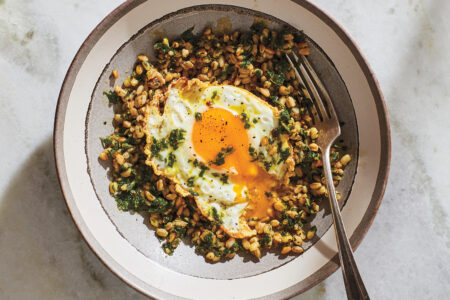
David Tamarkin’s recipe for Greens, Grains and Fried Egg works for any meal
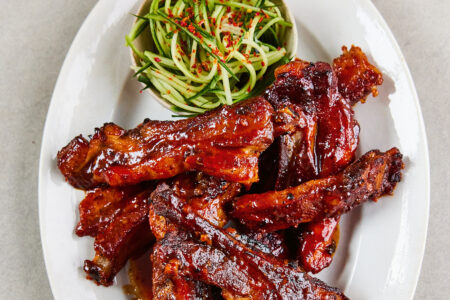
Slow-cooked, sticky-glazed pork ribs go with cucumber slaw in Sam Way’s recipe
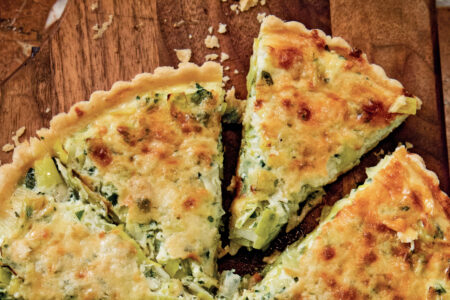
This quiche just might make you love leeks