Few people are now conditioned to stand the heat
Ryan Helmer can’t imagine what it would be like to live without air conditioning.
“There would have been a lot of restless nights,” said Helmer, 27, of Lawrence. “I’d sell my soul to get air conditioning – or hang out at Wal-Mart all day.”
But there was a time, just two generations ago, when Douglas County District Court was in session on blazing hot, humid summer days and windows were open and fans were buzzing.
That’s the way it was not only in court but in offices throughout the old courthouse at 1100 Mass. – and probably in most of the offices and stores throughout Lawrence.
“When people knew it was going to be hot and there was no air conditioner, you opened a window and just dealt with it,” said Bill Bell, the county’s building maintenance director.
When Don Fambrough played football for Kansas University in the 1940s, it didn’t matter how hot it was during practice, there were no water breaks.
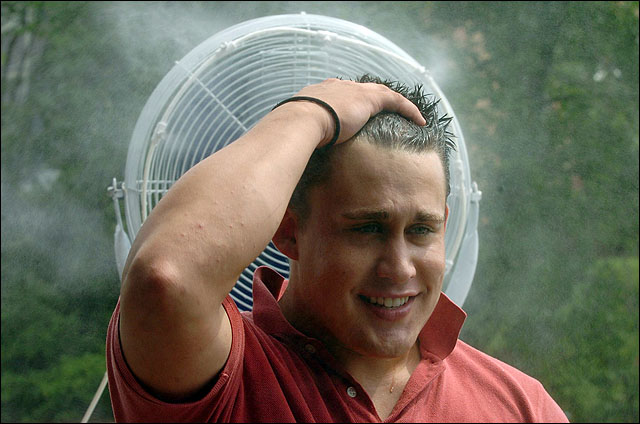
Thomas Graves, 21, a Kansas University junior from Overland Park, cools off at The Crossing, 618 W. 12th St., after classes Aug. 19. He and others were cooling off with the help of a fan that had water running in front of it.
“After practice, the coaches would follow us up to the dressing room and make sure we’d take one swallow of water, rinse our mouths out and spit it out,” Fambrough recalled. “After a shower, then we could drink more.”
Fambrough, who went on to become the Jayhawks’ head football coach from 1971 to 1974, said that while his teams were allowed to have breaks, drinking a lot of water still wasn’t encouraged.
“Everything has changed, now,” said Fambrough, who also coached the team during a second stint from 1979 to 1982 and who still watches many of KU’s practice sessions.
“I’m out there every day watching them, and they work really hard, but I tell you, there are always people watching them with water bottles,” Fambrough said. “They are well taken care of.”
Spoiled by air conditioning
Today, when court is in session in the Douglas County Judicial and Law Enforcement Center located just east of the old courthouse, judges, attorneys and jurors work in air-conditioned splendor. In fact, there are no windows in the courtrooms to open. The center was built in the late 1970s on the basis that there will always be air conditioning, Bell said.
“This is going to be the hottest day of the year. Boy, you’d think they’d at least air condition these places.”
– Actor Jack Warden, as a juror opening a window in the 1957 movie “12 Angry Men.”
Air conditioning dominates people’s lives today because it is difficult to find a home, car, office or store without it. More schools are becoming air-conditioned. People are spoiled to the point that many of them don’t know how to properly deal with the heat, said Dr. Michael Kennedy, a family physician and assistant dean for rural health education at the University of Kansas Medical Center in Kansas City, Kan.
“I think the big reason people don’t handle the heat as well is because they seem to have forgotten some of the common sense things we need to do to manage ourselves in the heat,” Kennedy said.
The simplest and most important thing to do is stay hydrated.
“People used to just drink water to prevent heat-related injuries,” Kennedy said. “We’ve kind of gotten away from that.”
Kennedy is not a fan of sports drinks, which he said are overrated.
“They tend to have twice as much sugar and half as much salt as we need,” he said. “That’s why there is a market for Pedialyte (a formula to replace lost fluids in infants and children); it just doesn’t taste as good because there isn’t a lot of sugar.”
And speaking of salt, jars of salt tablets were once commonly found in locker rooms for athletes to dip into following practices. They aren’t necessary, Kennedy said.
“You have so much sodium in your system and in your diet that it really doesn’t help,” he said of salt tablets.
Body adjusts
Because there is so much air conditioning, people don’t get as acclimated to being out in the heat, Kennedy said.
“People aren’t willing to sit around in their homes and sweat,” he said.
Acclimating to the heat means the kidneys, brain and other body organs make adjustments, Kennedy said. The brain, for example, has a diuretic hormone that adjusts the water balance over time, and kidneys tend to hold on to electrolytes a little bit more, he said.
One of the reasons the elderly are so susceptible to overheating is because their body’s acclimation processes are blunted, especially if they are taking medications, Kennedy said.
Just like other people were, football players 40 or more years ago were more acclimated to the heat and that may be why they were able to do without water during practices, Kennedy said. He also thinks, however, that heat-related deaths among football players are not necessarily more numerous today, just more publicized.
Fambrough noted that football practices when he played didn’t start as early in the summer as they do now. And players are much bigger now, with linemen weighing 300 pounds or more, while the biggest players on his 1970s KU teams were at least 50 pounds lighter, he said.
“Those 300-pound kids, you got to water them down like an old horse or something,” Fambrough said. “It’s just a different type of athlete. They’re bigger, they’re stronger and they just require more attention.”
Sue Neustifter went to work in the Douglas County Register of Deeds office in 1959, when office windows were open and several years before window air conditioners, and later central air, were installed.
“I was raised without air conditioning,” said Neustifter, who served as register of deeds from 1972 until she retired in 2002. “I’m the type of person that can’t take the cold but I can take the heat.”
And just because people were more acclimated to heat before air conditioning, that acclimation didn’t come easily, according to Bell.
“I can remember sleeping on the concrete floor of the basement with a fan on me and a wet sheet, just trying to get to sleep,” he said.
City Government

Developer seeks incentive from City of Lawrence to build 131 units of housing near Wakarusa and Queens

Lawrence city leaders will consider whether to keep Community Building open, make 2 other rec centers free to access

A STAR Bond application raises questions for city leaders about Costco and housing west of the SLT

Soccer gear honoring Lawrence history’s all-star team is now on sale as part of city’s public art exhibition
To honor public servants, Lawrence’s July 4 celebration will have a whole gallery of their photos on display; submissions open now