Area farmers welcome August’s rains
Month 2nd wettest on record
Douglas County farmer Norman Leary’s fields are so drenched it’s difficult for him to check the progress of his soybean crop.
He must stand at the edge of the fields to gauge how the beans are doing.
“I can’t get out to the field to see much. It’s too muddy. I think we’ve had more rain the latter part of this August than I’ve ever seen,” said Leary, who has been farming for 50 years.
As of Friday, Lawrence Municipal Airport had a rain total of 9.6 inches for August. That makes it the second wettest August on record, according to the National Weather Service in Topeka. August 1895 was the rainiest, with 12.3 inches of precipitation.
But all the moisture has helped this year’s soybean crop, said Bill Wood, agriculture agent for the Douglas County Research and Extension office.
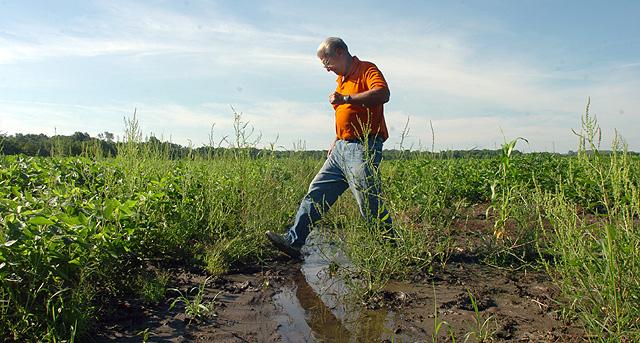
Norman Leary steps across a stream of water flowing in a soybean field in Douglas County. The recent rains have helped this year's soybean crop, but was too late to save others, such as corn. Farmers now need 20 to 30 days of warm, dry weather, with wind, to help the soybean crop.
Smiles have replaced the frowns he saw on farmers’ faces earlier this month when the weather was dry. Crops were in critical shape, he said, and the rain has been a blessing.
“But it’s almost getting to be too much of a blessing,” Wood said.
Leary said he was glad for now.
“Some said that if we didn’t get the rain when we did it was going to be bad news,” he said. “The soybeans needed this moisture.”
Last year, most crops had a bin-buster year. The state had record corn and soybean yields.
“But these are not your typical Augusts,” Wood said. “I’m not sure what’s going on. You have people speculating about global warming and cooling and different atmosphere. But if we all live long enough, we see years that are unusual, weatherwise.”
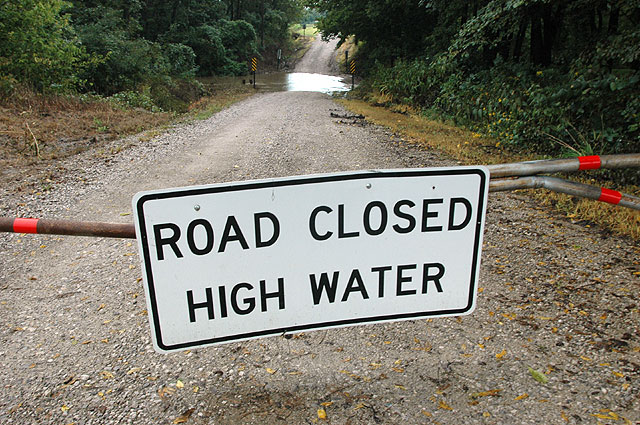
This road closed sign blocks traffic Friday morning as recent rains filled area streams and caused some rural road closures.
Wood and others said that while the rain helped, they expected average yields this year. It also appears the rain is a little too late for some crops, including corn.
“There will be some individual farmers who it helped, but not many,” said Eddie Wells, deputy director of Kansas Agricultural Statistical Office.
Farmers now need about 20 to 30 days of warm, dry weather, with wind, to help the soybean crop, Wood said.
Based on weather reports, it looks like that dry weather is on the way. Harvest should begin soon. But the fields need to dry out, Leary said.
“I think everyone is a little anxious to get started,” he said.
City Government
Developer seeks incentive from City of Lawrence to build 131 units of housing near Wakarusa and Queens

Lawrence city leaders will consider whether to keep Community Building open, make 2 other rec centers free to access
A STAR Bond application raises questions for city leaders about Costco and housing west of the SLT

Soccer gear honoring Lawrence history’s all-star team is now on sale as part of city’s public art exhibition
To honor public servants, Lawrence’s July 4 celebration will have a whole gallery of their photos on display; submissions open now