Petition process can force government’s hand
Gathering signatures to get issue on ballot rare, but documents good gauge of public sentiment
In June 1994, Bob Lemon got tired of higher taxes.
So the retired Lawrence police officer decided to fight a then new Douglas County Commission decision to blow off the statutory budget lid on levied property taxes.
“I just got fed up, so I started the petition,” said Lemon, who lives west of Lawrence. “It was a lot of work. It wasn’t easy.”
Lemon said he gathered more than enough signatures required by law and turned them into the Douglas County Clerk, who certified the petition. A report in the Journal-World from Aug. 9, 1994, said Lemon and 50 supporters helped gather 1,201 signatures.
Instead of putting the mill levy cap on the ballot, commissioners reversed their stance on the issue and kept the tax lid in place.
Lemon was victorious, which is rare today.
The Bill of Rights of both the U.S. and Kansas Constitutions protect the right to petition the government for a redress of grievances. But strict Kansas guidelines for using official petitions have limited the number recently in Douglas County. A 1998 protest petition in Baldwin is Douglas County’s most recent.
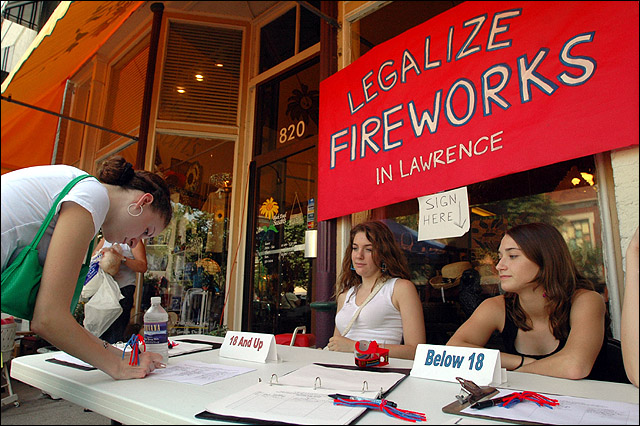
Janie Heim of Lawrence signs a petition to legalize fireworks. Signatures were collected last month during the Downtown Sidewalk Sale.
The Baldwin group in 1998 had a petition validated against extra funding for recreation. The protest was successful as voters shot down the extra funding.
“We get probably two calls per month with questions on how to start a petition,” said Douglas County Clerk Jamie Shew. “A lot don’t come to fruition. They think it’s just standing on a street corner, but they find out there’s a lot more involved with it.”
The process of starting a petition without knowing the breadth of support for an issue in the community can be risky.
In 1997, a group in the Lawrence school district tried to circulate a petition to recall three board members because of a claimed violation of the Kansas Open Meetings Act. But the petition failed to garner enough signatures, Shew said.
Unofficial petitions
But the power of a group of residents united through their signatures continues to be an active aspect of local and state government via unofficial petitions.
In what lately has been the more popular path, a group hot about an issue can gamble and bypass the official process. The petitioners can try to show public opinion to a governing body rather than seeking a place for it on the ballot.

- Students launch petition for fireworks change (07-12-05)
- Potential challenger to Brownback submits petition (08-03-04)
- Wal-Mart foes petition City Hall (10-17-02)
- Baldwin voters reject spending for recreation (08-05-98)
- County reneges tax lid decision (08-09-94)
- Petition could force vote on county tax lid (08-02-94)
- Petition in works for tax lid (07-09-94)
- Ex-police officer pushes for county vote on budget lid (06-15-94)
Chris Paradies, 16, and a junior at Lawrence High School, and some friends sought signatures in support of scrapping the city’s fireworks ban at the Lawrence Sidewalk Sale last month.
He said they collected more than 900 signatures that day – 500 from those older than 18 and 420 of those from registered voters.
They have followed the guidelines as if the petition were official just to raise the credibility, Paradies said, and he hopes to get more signatures in the near future before presenting them to the commission.
As a high school student, he is getting the academic side of civics from first-hand experience. The unofficial petition against the city’s smoking ban in 2004 inspired him and his friends, he said.
“That’s what’s good about our country. If we feel the need that something needs to be changed, we can act and speak our minds,” Paradies said.
Social experience
It appears the legal battle about a superstore in northwest Lawrence between the city and Wal-Mart will go to trial. Martha Perala was a part of the controversy in the early days in 2002, collecting signatures for a petition to the Lawrence-Douglas County Planning Commission against a new Wal-Mart Supercenter on west Sixth Street near Free State High School.
“The people in my neighborhood were well educated, and it was just fun talking with them. I really think it is effective. I would do it again,” Perala said.
Petition process
How to do an official petition:
¢ Before circulation, the petition form – with specified statute number cited – must be submitted to the county or district attorney or county counselor for an opinion on legality.
¢ If approved, the group has 180 days after the first signature to submit the petition. Each circulator must sign a notarized affidavit swearing the circulator personally witnessed his or her signature.
¢ The election officer will then check for a sufficient number of signatures by registered voters.
¢ The number of signatures needed for all petitions varies with size of jurisdiction, and valid signatures are only from registered voters within the specific jurisdiction.
– Source: Douglas County Clerk
While she called it part of a grassroots effort, Perala said the experience of circulating the petition taught her much about local politics. She said she looks forward to seeing how the legal situation plays out and called it part of how the system works. Perala also said she has now become a Realtor because of the experience.
“My children learned more watching mom do that than they would learn watching television,” Perala said.
‘It ought to be difficult’
As a county clerk, Shew advised education on the petition process before hitting the streets. Also, gather more signatures than required to avoid possible frustration later. Some of the signatures may not be valid.
“We always recommend trying to get 5 percent more than what the needed number of signatures would be,” Shew said.
And as one who has had success with an official petition, Lemon said, he thought the process shouldn’t be simple and that unofficial petitions should not be used because they cannot obligate a governing body to take action.
“I think it ought to be difficult or people would be doing petitions every day of the week,” he said.
City Government

Developer seeks incentive from City of Lawrence to build 131 units of housing near Wakarusa and Queens

Lawrence city leaders will consider whether to keep Community Building open, make 2 other rec centers free to access
A STAR Bond application raises questions for city leaders about Costco and housing west of the SLT
Soccer gear honoring Lawrence history’s all-star team is now on sale as part of city’s public art exhibition
To honor public servants, Lawrence’s July 4 celebration will have a whole gallery of their photos on display; submissions open now