Advertisement

Archive for Friday, August 12, 2005

Hall that replaced houses to open

Neighbors say parking will be scarce for all

August 12, 2005

Advertisement

After years of debate, several demolished houses and tarnished town-gown relations, Dennis E. Rieger Scholarship Hall will open its doors to its first batch of Kansas University students on Sunday.

The opening of the hall, at 1323 Ohio, in some ways represents the end of an era that strained relations between KU and the surrounding Oread neighborhood. But neighbors, who initially were worried about the aesthetic impact of the hall, remain concerned that parking will become even more scarce in the blocks surrounding the hall.

"I think not only is it a disservice to the neighborhood in not adequately planning for the parking, but I think it's a disservice to the students," said Debbie Milks, who lives at 945 Ohio. "It seems to me to be unrealistic to expect even freshmen not to have cars."

The $3 million hall, which will house 50 women, was funded by a gift from Roger and Annette Rieger, of Seattle, in memory of Roger's brother, Dennis, a KU alumnus who died of complications of diabetes.
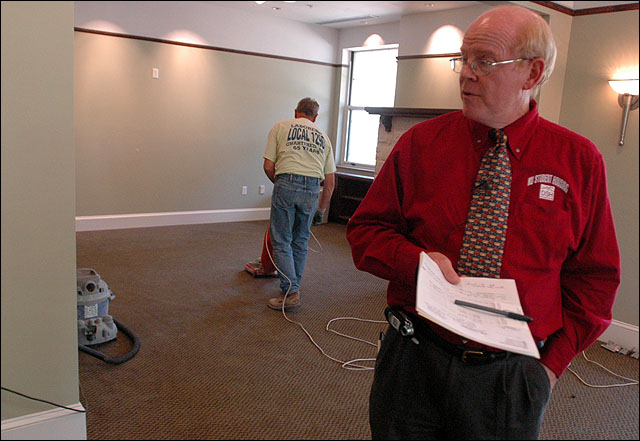
Ken Stoner, director of student housing, gives a tour of Rieger Scholarship Hall as workmen complete the finishing touches to the scholarship hall.

Ken Stoner, director of student housing, gives a tour of Rieger Scholarship Hall as workmen complete the finishing touches to the scholarship hall.

The hall is KU's 11th scholarship hall. The halls offer reduced rates compared with residence halls because students are required to work eight hours a week performing hall chores.

Plans call for another hall in the northern half of the 1300 block of Ohio to house 50 men, though no time frame or donor has been identified for that project.

The new halls have residents of the Oread Neighborhood concerned about parking.

Ken Stoner, director of student housing, said residents of the hall were directed to park in the parking garage attached to the Kansas Union. He said because there were 127 living units on the block previously, there would actually be fewer students living there than there once were.

"We really significantly reduced the load," he said.

But James Dunn, president of the Oread Neighborhood Assn., said he expected students to hunt for closer places to park than at the union.

"That big garage by the union is a block away, and it's up a hill," he said. "If I lived in that scholarship hall, I'd be looking around for street parking, too."

KU and some neighborhood residents have been at odds over the project since it was proposed about five years ago. The two historic advisory boards affiliated with the city and KU deadlocked in October 2001 over whether KU could demolish three century-old houses on the block where Rieger Hall now stands.

Approval was necessary because the houses were near two buildings on the National Register of Historic Places, the Usher House at 1425 Tenn. and Spooner Hall at KU. Former Gov. Bill Graves finally ruled KU could demolish the houses, and they were knocked down in October 2002.
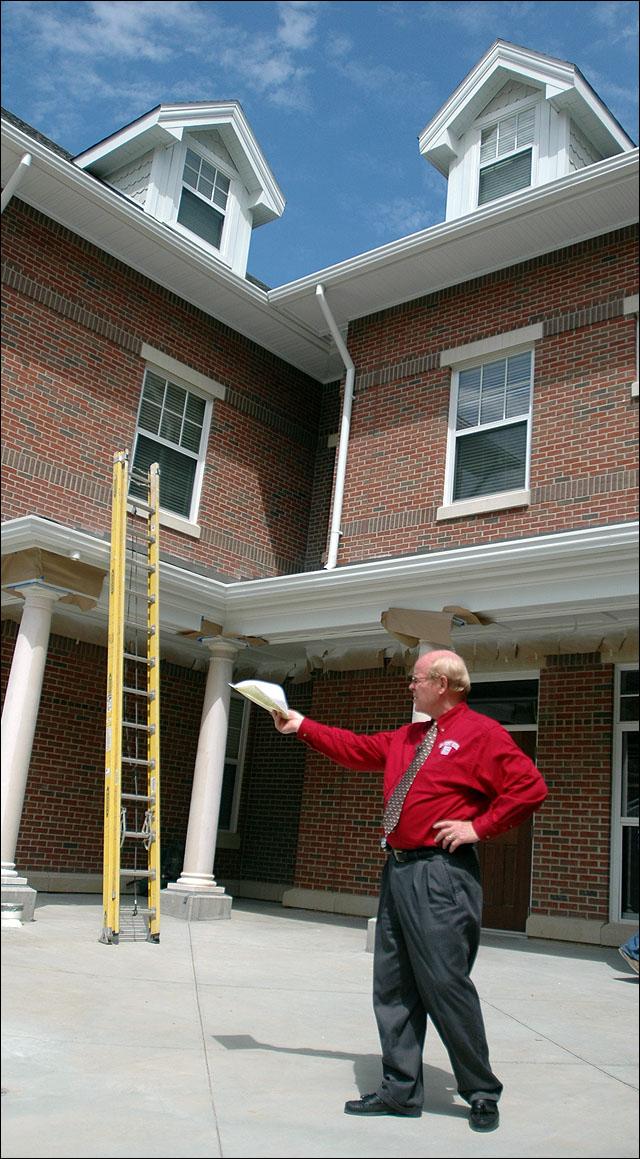
Ken Stoner, director of student housing, gives a tour of the outside of Rieger Scholarship Hall.

Ken Stoner, director of student housing, gives a tour of the outside of Rieger Scholarship Hall.

KU also demolished two apartment buildings there and allowed one of the houses to be moved.

Stoner said he thought the finished building - which was designed with input from a community advisory committee - "fits very well" with the surrounding community. He said little details, such as gabled roofs and railing from the top of former Old Fraser Hall, which now is a fence north of the hall, help give the hall character.

He also said a technologically advanced heating and cooling system would reduce noise in the neighborhood. The system pumps glycol 400 feet below the ground to either heat it or cool it, depending on the time of year. The solution then heats or cools air circulated through the hall.

"All I've heard is positive," he said. "I've not had a complaint on this building since construction started."

But Greg Hickam, a former president of the Oread Neighborhood Assn. who previously lived in one of the houses torn down by KU, said he remained opposed to the hall - and to KU's development in the neighborhood.

"I don't think there's any question it's had what I regard as a negative impact on the neighborhood," Hickam said. "It disrupts the residential flow of the neighborhood. As a setting for the scholarship hall in and of itself, I'm sure it's a nice place. I just hope it represents the final intrusion by KU into the Oread neighborhood."

Comments

LJWorld.com doesn’t necessarily condone the comments here, nor does it review every post. Read our full policy. Also, read about banned accounts and harassing comments.

  1. neopolss (anonymous) says…

    Like the houses in that area aren't run over by student rentals to begin with. It definately isn't the "quiet little neighborhood" it is made out to be. Give me a break.

  2. mseybold (anonymous) says…

    If neighbors are concerned with too many cars in the neighborhood they should ask the city to charge for curb parking in all of Oread.

  3. megorama (anonymous) says…

    Lawrence, as we know it, wouldn't exist without KU.

  4. dlstrohm (anonymous) says…

    Anyone who decided to live that close to the university and was actually surprised by something like this is an idiot. If you don't like the University, move. It isn't like you didn't know it was there when you moved to this town...its only been here for 140 years. I guess if you've lived here that long, then you have my sympathies. Otherwise, recognize the fact that you live in a town economically supported entirely by KU. Do you honestly believe Mass St. would be anything worth arguing over if the money from students and parents didn't come in? If you want Lawrence without KU, check out Eudora.

  5. aidan (anonymous) says…

    I think we are forgetting the most important part of this equation. The scholarship halls are a wonderful opportunity for men and women of high academic prowess and often lower financial resources to attend a very good university. The scholarship halls are less expensive for the students than any of the dorms, and they offer a structured and supportive atmosphere, as well as a great social environment, for approximately 500 academically gifted students. They were started by Elizabeth Miller Watkins (donor of Watkins and Miller halls, the Chancellor's residence, the former Watkins house for nurses, the Campanille, and probably many other facilities) who is one of the single largest donors to the unversity in its history, especially considering the era of her donations. EM Watkins was unable to finish college because of her family's financial hardship, and she wanted to prevent the same fate for as many young, gifted KU students as possible.

  6. kippykans (anonymous) says…

    I lived in the Schol Halls 92-95. At least back then most of us didn't have cars. One of the main reasons we lived there was affordability. Also they are right next to campus and except for Watkins and Miller food was provided so you didn't need to leave campus. There are going to be a lot less cars than when the apartments were there. I also hope that in 10 years students haven't gotten so lazy that they won't walk from the Union parking garage down the hill if needed.

  7. Dani (anonymous) says…

    If I'm remembering my history right, Lawrence was founding in 1854 and KU was founded in 1864 so Lawrence was Lawrence sans KU for a mere 10 years. I think those who say that Lawrence isn't Lawrence without KU might be on to something.

    Plus, why would you live in a college town if you don't like the college?

  8. delta77 (anonymous) says…

    The Oread folks are just mad that their neighborhood near the University has largely turned into a slum. But they are too nearsighted to realize that much of it is their own doing. Rather than allow developers to replace run-down buildings with attractive homes that fit in with the neighborhood, they have allowed many houses to become boarded-up eyesores, havens for the homeless and drug users, rather than livable residences.

  9. Godot (anonymous) says…

    Proposed new rule: KU freshmen and sophomores must live on campus and cannot have cars. Result: Traffic is reduced in the Oread neighborhood and the city in general; students resort to studying and being invovled in campus activities to fill their extra free time; parents save money; public transit system gains more riders; downtown becomes a shopping destination as well as a party destination for students; DUI's decrease; out-of-town parents are less likely to purchase a house for the kid and roommates to live in, later turning it into a rental property; rental properties that once housed undergrads are returned to owner-occupied status, increasing the availability of entry-level housing. That's just for starters.

  10. dlstrohm (anonymous) says…

    Response to proposed new rule: KU then has to expend 3x the amount on building new university housing, resulting in expansion of the university and construction for about 10 years that will give Lawrence residents more to complain about. State taxes rise on everyone statewide to pay for new housing. Lawrence residents complain more, as do people across the state. Housing prices across the board drop, lowering property tax income to the city and results in huge losses on home sales and a decreased demand for houses. The city raises costs of public transportation in order to meet the increase in needs, and students buy cars anyway because they are just as cost-effective. DUI's remain the same, parking is still a problem, taxes are up, Lawrence residents are complaining, and no one goes to Mass because they have to walk so house parties jump. Fact is, if you don't like KU, you never will, and KU isn't going anywhere so move or quit complaining. That's just for starters.

  11. mseybold (anonymous) says…

    response to the response to the new rule: The guy who suggested raising the cost of public transportation gets fired. Because in reality there are HALF the number of cars on the streets because freshman and sophomores are car-less. Those who do have cars don't have to cruise around for some place to park because the streets aren't as congested. Public transport ridership skyrockets because the bus routes become more effecient. And the T/KU on wheels finally are carrying their full capacity (because right now they are way below capacity). New student housing construction begins in West Campus and buses take them onto campus. Housing prices don't drop after all! WHEW!

    Go Godot!

  12. Godot (anonymous) says…

    Me? Hate KU? Counting myself, I put five people through there. FYI, I lived in a scholarship hall my first year, and I did not have, because I could not afford, a car.

    Love ya, ole Crimson and Blue.