$2 gasoline on horizon as oil prices hit record
Factors conspire to force crude futures up
Duane Rothwell’s black monster couldn’t seem to quench its thirst.
For minutes outside a gasoline station at Sixth Street and Wakarusa Drive, Rothwell, of Lawrence, held the pump nozzle to the tank of the monster, a clean black 1998 Lincoln Navigator.
When the Navigator’s belly was finally full, the price on the pump’s screen read $45.75.
“It really sucks it down,” Rothwell said, clicking shut the cap on the gasoline tank. “I end up paying about that much every time.”
With the price of crude oil surpassing $50 a barrel for the first time in history, analysts said Tuesday that U.S. drivers soon could be facing $2 a gallon gasoline as higher prices filter through from refiners to drivers.
For Rothwell, that would mean going from bad to worse.
“Right now, it’s about $100 more than it was just a few months ago,” he said of his gasoline bill. “If it gets any higher … “
Count on it, said Mike Burdette, an analyst with the U.S. Energy Information Administration. The reason: a sharp increase in global demand, tight supplies and threats to output in petroleum-producing nations such as Iraq and Nigeria.
The increase won’t hit only motorists, either.
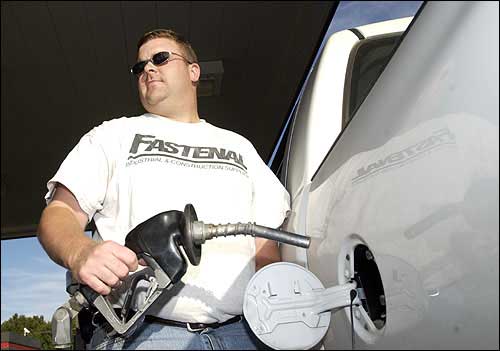
Adam Gabriel, of Lawrence, fills his fullsize pickup at the Zarco station at Ninth and Iowa streets. Crude oil futures went over 0 a barrel Tuesday, meaning higher prices for gasoline are likely to follow.
Seasonal demand
Homeowners and energy-intensive industries could feel the sting from high oil prices as seasonal demand picks up this winter, and already there is evidence that supply disruptions caused by Hurricane Ivan are making it more costly to drive.
The 75 percent increase in the price of oil in the past year also promises to heat up as a political issue, with just over a month until the presidential election.
Crude futures first hit $50 a barrel in after-hours trading late Monday, spurred by reports that rebels in Nigeria continue to battle for control of the vast southern oil fields in the world’s seventh-largest exporter.
Light crude for November delivery rose 26 cents to $49.90 to a new settlement high on the New York Mercantile Exchange after trading as high as $50.20 earlier in the day.
Adjusting for inflation, today’s prices are still about $30 a barrel less than the level reached in 1981 after the Iranian revolution. Even so, the United States is on pace to spend an extra $68 billion on oil this year, or 30 percent more than was spent last year.

 $2 gasoline on horizon as oil prices hit record
Although the average cost of unleaded regular gasoline in the United States is down from its springtime high of $2.06 a gallon, pump prices have risen more than 7 cents a gallon during the past two weeks to about $1.92. That’s 33 cents more than last year, and analysts say motorists shouldn’t expect much relief as long as oil prices remain high.
If that’s the case, Reed Niermeyer’s motoring days soon could be finished.
“If prices go up any more, I’m not going to be able to drive,” the Kansas University sophomore said while filling up his white Infiniti GX4.
Energy independence
Beyond gasoline, surging prices for diesel and jet fuel, which are similar to heating oil in their chemical composition, already are squeezing the trucking and airline industries. The average retail price of diesel fuel has risen 41 percent in the past year to $2.01 a gallon, according to the Energy Department, while spot jet fuel costs are up nearly 100 percent at $1.42 a gallon.
Democrats took advantage of the situation to renew attacks on the Bush administration for failing to keep energy prices in check.
Campaigning in Pittsburgh, Democratic vice presidential candidate John Edwards berated the Bush administration’s close energy industry ties and called for U.S. consumers to cut their dependence on foreign oil suppliers like Saudi Arabia.
“What are the odds that George Bush and Dick Cheney are ever going to do anything to move this country to energy independence?” Edwards asked. “It will not happen while they are in office.”
President Bush is a former Texas oilman and Vice President Cheney once headed oil services firm Halliburton Co.
Firing back, a Bush-Cheney campaign spokesman blamed high prices on a broad energy bill that stalled last year in the U.S. Senate after moderate Republicans and Democrats blocked it.
“It’s tragic that our economic recovery is bogged down by record energy prices that will only climb higher as winter sets in,” said Sen. Pete Domenici, R-N.M., who has led efforts to revive the bill in the Senate. “But until this Congress acts, that’s what is likely to happen.”
‘Obnoxious’ SUVs
Kristi Lamb isn’t in Congress, and she already has acted on high gasoline prices. The Lawrence resident used to own a gas hog — an eight-cylinder Chevrolet Camaro.
Now, with her Toyota Tercel getting close to 35 miles per gallon, Lamb said she couldn’t imagine paying what SUV drivers pay at the pump.
“I think SUVs are kind of obnoxious in general. They’re wastes of gas,” she said.
And as gasoline prices continue to go up, Lamb said the increase wouldn’t affect her driving, even with her twice-a-week commute to Kansas City for language classes.
“If worse comes to worse,” Lamb said, “I’ll just ride the bus.”
— J-W wire services contributed to this report.
City Government
Developer seeks incentive from City of Lawrence to build 131 units of housing near Wakarusa and Queens

Lawrence city leaders will consider whether to keep Community Building open, make 2 other rec centers free to access
A STAR Bond application raises questions for city leaders about Costco and housing west of the SLT

Soccer gear honoring Lawrence history’s all-star team is now on sale as part of city’s public art exhibition
To honor public servants, Lawrence’s July 4 celebration will have a whole gallery of their photos on display; submissions open now