Haskell storytellers recall campus’ haunted legends
Scotty Harjo, 76, says it’s true: Haskell Indian Nations University is haunted.
He knows because he’s heard the sounds of men playing on the football field only to turn the corner and find the field empty.
The same thing happened at the swimming pool. He heard people swimming and carrying on, but when he got there, the water was perfectly calm.
“The spirits are among us,” Harjo said Friday, addressing about 40 people who gathered at the university’s powwow grounds for a storytelling session.
The morning session was part of Haskell’s two-day 120th anniversary celebration, which concludes this afternoon with a powwow that’s expected to last until 10 p.m. The celebration coincides with the Lawrence sesquicentennial.
A decorated Korean War veteran and a former golden gloves boxer, Harjo coached several Haskell teams between 1957 and 1994.
For as long as anyone can remember, Harjo said, Haskell students have shared stories of encountering spirits on campus.
“Things like, in Pocahontas Hall, picture frames moving,” he said, “or being in bed and feeling someone tug the blanket when there’s no one else in the room.”
Harjo said Bob Martin, former Haskell Junior College president, once called him to report seeing what appeared to be young American Indian boys playing near the school’s football field. The boys, Harjo said, were dressed in long pants and long-sleeve shirts, much like those worn by the children brought to Haskell in the late 1880s.
Harjo said he didn’t doubt Martin’s account, noting he’d had a similar vision earlier.
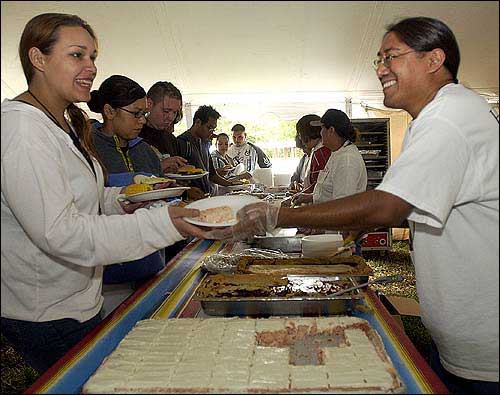
Kylene Chapman, left, Haskell Indian Nations University sophomore from Keshena, Wis., takes a piece of cake from Dan Davis, a recent Haskell graduate, during a meal celebrating the school's 120th anniversary. The Friday night event included music, food and other entertainment.
Handed down from one generation to the next, Harjo said the stories were part of the culture enjoyed by the “Haskell family.”
Though stories and visions of spirits are a tradition at Haskell, other aspects of the university have changed significantly after 120 years.
Former athletic director Jerry Tuckwin tried to define the Haskell experience.
“I got here in 1956,” said the 62-year-old Tuckwin, recalling a time when students at Haskell Institute, then a half-boarding, half-vocational school, were required to square-corner their beds every morning, be in study hall from 7:30 to 9 five nights a week, and be in bed by 10:30 p.m.
Few objected to the routine, Tuckwin said. Although most students were poor, their time at Haskell gave them confidence.
“Most of us were economically deprived,” he said. “Like me, I was orphaned at age 7. But you know what? We thought we were the greatest people in the world. That’s what Haskell did; it let us have our dreams. It let us know we could be successful; that was the beauty of Haskell.”
City Government

Developer seeks incentive from City of Lawrence to build 131 units of housing near Wakarusa and Queens

Lawrence city leaders will consider whether to keep Community Building open, make 2 other rec centers free to access
A STAR Bond application raises questions for city leaders about Costco and housing west of the SLT
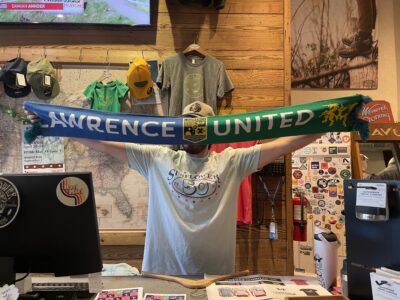
Soccer gear honoring Lawrence history’s all-star team is now on sale as part of city’s public art exhibition
To honor public servants, Lawrence’s July 4 celebration will have a whole gallery of their photos on display; submissions open now