Academics praised, advising panned in KU student poll
Kansas University students are increasingly pleased with the quality of their classroom instruction, faculty support and overall educational experience.
But they’re growing less content with academic advising.
Those are among the results released this week of the Student Perception Survey, which is taken every two years to gauge student satisfaction at KU.
“We try to make good decisions and changes based on information, not just anecdotal information or perceptions,” said Kathryn Tuttle, associate vice provost for student success. “We do pay attention to it.”
The survey, which has been administered since 1996, involved telephone interviews of 636 undergraduate students conducted this spring. On seven questions, students were asked to rate their responses on a scale of 1 to 5.
Among the results:
- Students averaged a 3.97 on how often KU classes have provided an intellectual challenge, with 1 being “never” and 5 being “very frequently.” That’s up from 3.84 two years ago.
- Students averaged a 4.13 on how satisfied they were with their overall educational experience, with 1 being “very unsatisfied” and 5 being “very satisfied.” That’s up from 4.09 two years ago but the same as the 2000 total.
- Students rated KU 2.77 on how often they had difficulty scheduling desired classes for a semester, with 1 being “never” and 5 being “very frequently.” That’s slightly better than 2.79 in 2002 and has improved steadily from 2.97 from 1996.
- Students averaged a 4.18 on how often teachers provided adequate instruction, with 1 being “never” and 5 being “very frequently.” That’s up from 4.12 two years ago but the same as in 2000.
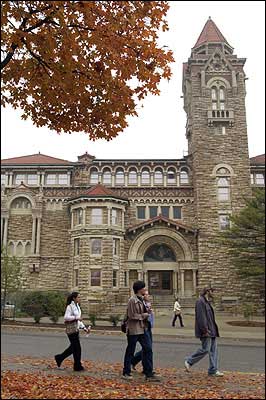
Kansas University students walk below a canopy of autumn leaves across from Dyche Hall between classes Thursday. A survey has found that KU students are more pleased with their overall educational experience and less pleased with academic advising.
One area didn’t reflect as positively. Students averaged a 3.49 on the quality of academic advising received, with 1 being “not at all helpful” and 5 being “very helpful.” That’s down from 3.54 two years ago.
Tuttle said KU continued to tweak its advising system. This year was the first that students received their adviser’s name before they arrived on campus.
On another question, students indicated they averaged one class in which the English language ability of the instructor was a problem in understanding course material.

 Student Perceptions Survey Spring 2004 (PDF)
“I think that’s a concern people in the state of Kansas have,” Tuttle said. “They hear a story from one student that it was difficult to understand an instructor, and it’s something they generalize.”
David Shulenburger, provost and executive vice chancellor, said he was pleased with the survey’s results.
“The levels of all the questions are in a range that I feel pretty good about them,” Shulenburger said. “There’s no bad news in these numbers. There’s lots of news that affirms what we’re doing.”
City Government

Developer seeks incentive from City of Lawrence to build 131 units of housing near Wakarusa and Queens

Lawrence city leaders will consider whether to keep Community Building open, make 2 other rec centers free to access
A STAR Bond application raises questions for city leaders about Costco and housing west of the SLT

Soccer gear honoring Lawrence history’s all-star team is now on sale as part of city’s public art exhibition
To honor public servants, Lawrence’s July 4 celebration will have a whole gallery of their photos on display; submissions open now