American Indian hopes to narrow community divide
Resource center director seeks to correct misperceptions
You couldn’t tell from warm lighting and cushy couches, but the Pelathe Community Resource Center is no one’s home.
Sure, it might seem like a second home to the people who volunteer there. Or to the people who use the center as a launching pad toward jobs and better homes — stability.
But when Caroline Hicks became director of the American Indian resource center in April, she transformed the locale from a cold office to a place where people could relax and open up about their problems.
“The people that walk in are not at their best,” she said. “We don’t want to put them off. They feel we’re more invested in a positive outcome for them.”
Since coming to the center four years ago as a part of New Dawn Native Dancers, Hicks has imagined ways the center could change to improve people’s lives.
Now as director, she’s seen some of those changes take place, and braces for the work to be done.
Q: If you had to give a State of the Union address for the American Indian population in Lawrence, how would it start?
A: I think this is something I run into oftentimes: I realize that my perspective and my understanding can be completely and totally different than other native people I talk to. I think perceptions are developed by experiences you have with people and places in the community. You have a cross-section of tribal cultures here that you will never see anywhere else in the United States, because of Haskell.
I think the Indian community secludes itself, and has had a history of doing that, through negative perceptions in the community. But I don’t want to say that it’s prejudiced or that it’s racist, because I don’t believe that it is.
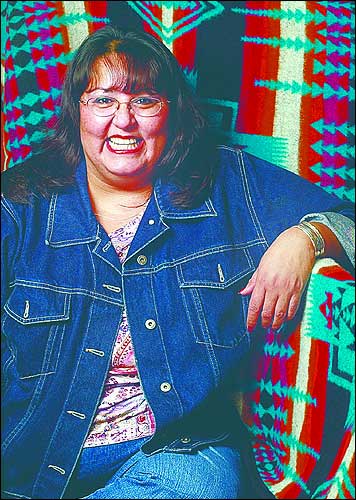
Caroline Hicks, director of the Pelathe Community Resource Center, says she hopes to change some of the negative perceptions of American Indians and Haskell Indian Nations University. She also would like to see faculty members and students at Haskell become more involved in the community.
Q: What are some of those negative perceptions that you see or hear about?
A: That all Indians have money and are getting a free ride through life. That’s not true. Just because there may be a casino within a tribe doesn’t mean that that person is rolling in dough. Sometimes the money doesn’t make it into tribal government or into tribal government programs.
That people should be afraid to go into Haskell Indian Nations University campus, that it’s not a place where the community is welcome. That’s completely not true. I talk to people and say, “Come on, they’re having a pow-wow,” and they say, “Are you sure, can I go there?” Well, yeah. “Do you feel comfortable going to KU?” And they say, “Yeah.”
I think those are real common. Then, there are also a lot of negative stereotypes: Drunk Indians, you know. We get a lot of that, too. I had somebody call me and want to know about starting a mental health outreach program here because Native Americans have such a high population of depression, and alcoholism and drug addiction, that this would be a perfect place to start that. There were no questions about what the numbers were for Lawrence, or what resources currently existed. They just wanted to do that program here, because we’re an Indian center. It has a good basis, but it’s still a negative perception that I had to take time to correct.
Q: What can be done to correct some of those perceptions? I just imagine that you can’t correct them all.
A: That’s something that I have to realize. I could sit down and talk to every person in the country, and there are still going to be negative perceptions of Native Americans.
Q: What can the community do?
A: People can stay more open-minded. Become involved with Haskell. Come to the events that are there. And I would like to see Haskell students more comfortable out in the Lawrence community. That’s part of what I see as a mission here. We take people that need stuff, need help and assistance, and we volunteer out in the community, spread information about native culture.
| Born: Syracuse, N.Y. She has lived in Lawrence since 1995.Tribe: Crow Tribe.Family: Two children, Eric, 20, and Kara, 14.Favorite place to read: Henry’s in downtown Lawrence.Favorite aspect of American Indian culture: “The sense of community and family, which is so strong in Lawrence.”How she spends holidays: With people from other tribes in Lawrence. |
But we don’t have financial aid assistance to offer. What I do is work with every other center in town to get as much help for our clientele as I can. I try to offer volunteer projects for Haskell students out in the community, to raise their public profile. I’m trying to raise our own public profile, to be more positive.
Q: You see a lot of people with problems, whether they’re financial problems or physical problems. How much does the environment of Lawrence have to do with that?
A: I think quite a bit. I see environment as the whole community. I see a lot of nontraditional students coming to Haskell. … I’ve been a nontraditional student. If you’re coming from a part of the country that is different than Lawrence, what you pay in rent here will knock your socks off. I lived in Oklahoma. I was going to move here for a job, came up here to start work. Just because I’m a poor person, I came here to check out rent and almost had a heart attack. We see people that are coming here that are not financially equipped to live here, but yet they’re here.
So economically, it’s very expensive to live here. And you know, we don’t have a lot of industry here. GE closed. Honeywell’s not here anymore. That has a definite effect. But, on the flip side of it, as a center for Native Americans that are living away from their tribes and reservations, there’s a lot to offer in this town that is very hard to get a hold of in Kansas City or Topeka that we have in Lawrence. So it can be difficult, but for the same reasons that it could be different anywhere else.
Q: In 10 years, if you’re still the director of the resource center, how would you want to have changed the American Indian community here?
A: I would want to see them have a higher profile. I would like to see them involved in more volunteer projects. I would like to see some of the churches, the Native American churches, come together, and have that arm of it, and have them be more vocal in the community. I would like them to be a lot more vocal. I would like them to vote. I would like to see them more involved in city government, and with the school boards and PTAs.
Q: How much work do you have to do to get there?
A: Lots. More than 10 years’ worth. But I’d still like to see it.
City Government
Developer seeks incentive from City of Lawrence to build 131 units of housing near Wakarusa and Queens

Lawrence city leaders will consider whether to keep Community Building open, make 2 other rec centers free to access
A STAR Bond application raises questions for city leaders about Costco and housing west of the SLT
Soccer gear honoring Lawrence history’s all-star team is now on sale as part of city’s public art exhibition
To honor public servants, Lawrence’s July 4 celebration will have a whole gallery of their photos on display; submissions open now