Rocket club takes off
Turns out it was rocket science.
But it still managed to look like simple fun this week in Watson Park as members of the Cordley Elementary Rocket Club attracted about 300 people to watch launching exhibitions Tuesday and Friday.
“Five … four … three … two … one,” the crowd chanted, time after time as the rockets were launched.
Wide-eyed, inquisitive children lined the sidewalk and watched from a safe distance as club members took turns serving at mission control, pushing the red button on a control box powered by a car battery.
With each punch of the button, electricity shot from the box through an extension cord and a dangling white wire connected to each rocket’s engine. Then came a fizz, a flare, and the mini-missiles were thrust high into the sunny sky, if not the stratosphere.
Nobody seemed to notice the aroma of burnt gunpowder that parched the air. They were too busy craning their necks, ooh-ing and aah-ing as the rockets soared 500 feet above.
Every rocket made a safe landing Tuesday. But a brisk wind Friday pinned a half-dozen rockets into trees and left another flattened by a passing car.
“That happens sometimes,” said club organizer Matt Costabile, chuckling. “If worse comes to worst, we’ll just build more rockets.”
The club members hardly mind that.
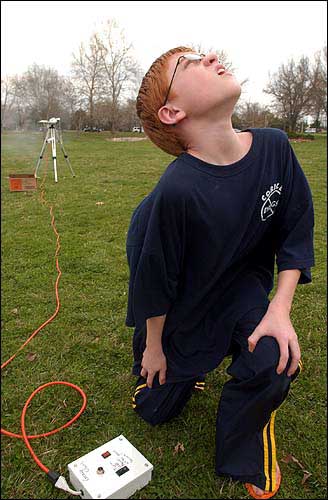
Kelly Aiken, 12, keeps an eye to the sky and tracks a rocket during a rocket launch in Watson Park. Members of the Cordley Elementary Rocket Club, an after-school program for fourth- through sixth-graders, launched rockets Friday.
“I like rockets because they’re creative,” said 9-year-old Dallas Conway, “and they’re extremely hard to build.”
The challenge, 11-year-old Grace Clark said, is crafting a rocket perfectly so it will have a successful launch and landing.
“It’s like putting together a big puzzle,” she said.
Rocket Club
Clark has more than 10 rockets in her fleet. Some have kissed the clouds. Others caught fire mid-flight or never left the ground. It’s all part of the learning experience that she and about 35 other students get each week at Rocket Club.
The club began three years ago when Cordley was looking for parents to begin student clubs. Costabile’s son suggested rockets, and Costabile has been searching for ways to use rockets to creatively teach science to interested students since. He now teaches summer clinics about rocketry and recently gave a lecture on the subject at Wisconsin University.
| The Cordley Elementary Rocket Club’s spring launch is set for May 16, at a site to be determined.For more information, including a photo gallery, visit the club’s Web site at sunflower.com/~cordleyrc. |
“If I was convinced that papier-mâche volcanoes were the greatest way to teach kids science, I would be doing papier-mâche volcanoes,” Costabile said. “I have not yet found anything that is as exciting as rocketry.”
Neither have many of his students, some of whom say they’ve found their calling in atmospheric science.
“It would be neat to work for NASA or the Army and help design bombs and rockets,” 10-year-old Jacob Wilson said.
Clark agreed.
“My dad told me if I keep my grades up, I can do anything I want … a doctor, veterinarian … ” she said. “I buzzed in ‘NASA,’ and he said, ‘Oh sure, you can do that.’ That’s one of my lifetime goals.”
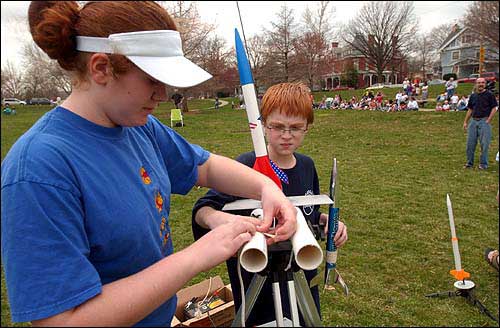
Members of the Cordley Elementary Rocket Club, an after-school program for Cordley School fourth- through sixth-graders, stage a rocket launch for parents and friends in Watson Park. Setting up a rocket on the launcher Friday are, from left, Grace Clark, 11 and Kelly Aiken, 12.
Building and launching model rockets is only part of what the club does. It studies the solar system, planets and the latest advances in space travel. Club members know there’s more to understanding outer space than watching Looney Toons’ Marvin the Martian or reading about little green men.
Like the real thing
“We are constantly reinforcing that although the rocket we’ve built may only be 7 inches tall, there are similarities and parallels between the aerodynamics of that rocket and the aerodynamics of the Delta II,” Costabile said. “Although with this the science is simpler, it is still the same basic tie-in to what NASA does. We try to look at the parallels between what we’re doing here and what’s happening right now out in the world of science.”
The students can tell you how NASA used a Delta II rocket to launch two rovers on Mars. They’ve watched videos explaining how the rovers work. One day they might build rover replicas.
Though the club watches plenty of videos and reads books about space and rockets, Costabile has found the best way for his students to learn is with hands-on.
That usually means building more rockets.
Now, a team of club members is constructing a “mach-buster” to challenge the speed of sound. Another team is building a high-altitude vehicle based on an old Navy drone rocket. That one will challenge the one-mile mark.
None of the rockets the club launched this week was more than 2 feet long, but the high-tech rockets will be. They’ll be so big and powerful that they’ll need Federal Aviation Administration clearance before they’re launched.
The club will show off its latest models at its spring launch, set for May 16, and blast them off again in September in Argonia at Airfest X, one of the largest regional launches in the country.
“The most rewarding part is launching in front of a crowd and seeing all of the little kids’ faces just light up when they see it go off,” 12-year-old Charles Frager said. “It’s really relieving when it doesn’t just explode on the pad, and it’s a good feeling to see it fly, then come down and land properly.”

 Cordley rocket club launches projectiles (11-10-03)
City Government
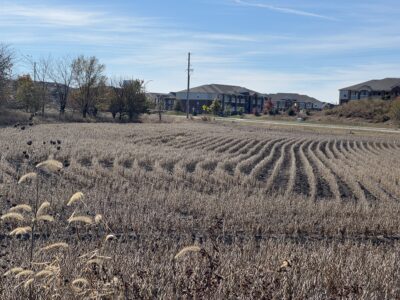
Developer seeks incentive from City of Lawrence to build 131 units of housing near Wakarusa and Queens

Lawrence city leaders will consider whether to keep Community Building open, make 2 other rec centers free to access
A STAR Bond application raises questions for city leaders about Costco and housing west of the SLT

Soccer gear honoring Lawrence history’s all-star team is now on sale as part of city’s public art exhibition
To honor public servants, Lawrence’s July 4 celebration will have a whole gallery of their photos on display; submissions open now