Homeowners can run afoul of spring’s skunk population
Critters create pungent warm-weather woes
If you’ve been on the highway lately, you’ve seen them. Smelled them, too.
Skunks.
“It’s that time of year — mid-February to mid-March. That’s when they’re out, looking for mates,” said Todd Olson, who owns Critter Control of Kaw Valley.
“You might say it’s a case of looking for love in all the wrong places,” Olson said, lifting a line from the “Urban Cowboy” movie soundtrack.
A dead skunk adding his stripes to the middle of the road is one thing. A live one starting a family under your front porch is quite another.
“Having a skunk at your house is just the worst thing in the world, and it could be dangerous,” said Jerry Potter, who lives “by the interstate” west of Lawrence.
Potter and his wife, Susan, had a skunk burrow under their front porch last year.
“You just don’t want them around,” he said. “We got a couple dogs, and who knows what would happen if they got a hold of it. Plus, they’re big rabies carriers.”
Olson’s company removed Potter’s skunks without incident.
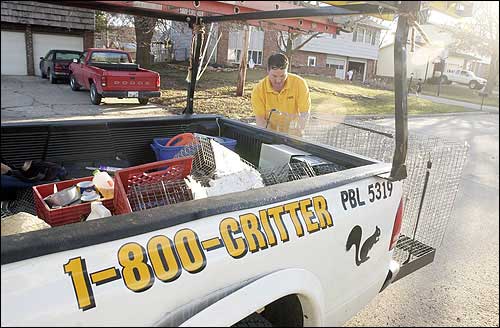
Casey McLenon, who oversees Critter Control of Kaw Valley's Lawrence and Topeka operations, checks one of several traps he sets around the city for various critters. Monday, McLenon was working on catching an opossum; he's also frequently called about skunk problems.
“I was really lucky,” Potter said.
Olson said his company has caught between 20 and 25 skunks in Lawrence in the past two weeks.
“The smell can be unbelievably bad,” said Casey McLenon, who oversees Critter Control of Kaw Valley’s operations in Lawrence and Topeka. “I’ve seen cases where skunks get up next to a house’s foundation, and the smell actually permeates the concrete.”
Some homeowners get rid of skunks by plugging the den openings, setting live traps or sprinkling mothballs around the area.
“I’ve seen do-it-yourselfers throw a sulfur bomb under their porch, thinking it would either drive them away or kill them,” McLenon said. “But if you think you’ve got a problem with a live skunk, the only thing that’s worse is a dead one.”

 Lawrence Police Department Animal Control
He doesn’t recommend setting traps.
“We get a lot of calls from people who say, ‘Uh, oh, I caught him. He’s mad, now what I do?'” he said.
Skunks captured by Critter Control are euthanized, McLenon said.
“The state asks that we not release them,” he said.
That’s because skunks are “the leading rabies carriers in Kansas,” said Matt Peek, Kansas Department of Wildlife and Parks’ expert on skunks.
Releasing captured skunks into the wild, he said, only increases the possibility of “infecting an uninfected population.”
Last year, skunks and an unusually warm winter were blamed for a dramatic increase in the number of rabies cases reported in Kansas:
- 23 cases in January 2003, eight in January 2004.
- 12 cases in February 2003, five in February 2004.
Of the 165 rabies cases confirmed last year, 123 involved skunks.
“At this time last year, we already had 37 cases; this year, we’ve had 14,” said Sharon Watson, spokeswoman for the Kansas Department of Health and Environment. “So, no, this year is not keeping up with last year.”
Douglas County health officials confirmed five rabies cases in 2003 — four skunks, one horse.
“We’ve not had any so far this year,” said Richard Ziesenis, director to environmental health at the Douglas County Health Department.
| Here’s how to deal with a skunk problem:¢ Call a professional animal-removal company.¢ Call the city of Lawrence’s animal control office, 832-7650. Be aware that the office deals mostly with domesticated animals running loose, rather than skunks, opossums or squirrels moving in.Douglas County Extension Agent Bruce Chladny offers these tips:¢ If you can, seal off all but one opening. Then sprinkle flour a foot or so outside of the hole. Return later that night and check for footprints that indicate the skunk has left for the evening. Then completely cover the hole. The next evening, open the entrance for one hour just after sundown to allow any remaining skunks to exit. Then permanently seal off the hole.¢ Place a live “trap” close to the entrance and bait it with fish-flavored cat food or peanut butter. Cover all but the entrance to the trap with a heavy tarp. The dark tarp is used to keep the trapped skunk docile and easy to move.After catching the skunk, take it at least 10 miles away and release it, using a long line tied to the door of the cage.¢ Try leaving mothballs or rags dipped in ammonia around the opening. Although this is not effective all the time, it may help temporarily drive off the intruder until more permanent measures are enacted. |
City Government

Developer seeks incentive from City of Lawrence to build 131 units of housing near Wakarusa and Queens

Lawrence city leaders will consider whether to keep Community Building open, make 2 other rec centers free to access

A STAR Bond application raises questions for city leaders about Costco and housing west of the SLT

Soccer gear honoring Lawrence history’s all-star team is now on sale as part of city’s public art exhibition

To honor public servants, Lawrence’s July 4 celebration will have a whole gallery of their photos on display; submissions open now