Program to offer ideas for healthy meals
Can anyone attend the program that you are offering this Friday on “Eating Well But Cooking Less”?
Yes. Anyone who is trying to provide healthy meals for their family while juggling time and money at work and home may be interested in attending this program. K-State Research and Extension — Douglas County, in cooperation with the Family and Community Education Council, is sponsoring the program, which begins at 9:30 a.m. Friday at the Douglas County Extension Office, 2110 Harper St.
Lisa Martin, Shawnee County Extension Agent in the Expanded Food and Nutrition Education program, will offer information on how to balance food choices and resources in order to eat well, have time for other activities, and stay within a budget.
Martin will address the trade-offs between scratch cooking and using convenience foods as she offers information on nutrition, time-saving tips, and quick-and-easy recipes. Samples of various dishes will be prepared and shared by the program participants.
To pre-register for the program, contact K-State Research and Extension — Douglas County at 843-7058. A minimal fee will be charged to cover food samples.
How many vegetables are we supposed to eat every day?
We recommend that you eat from three to five servings of vegetables a day. However, a survey by the National Cancer Institute and National Institutes of Health indicates that consumers are missing the mark — the average number of servings per week is 12. That means that consumers also are missing the health benefits vegetables can provide.
What are the health benefits of eating vegetables?
Eating vegetables have been shown to reduce the risk of developing some cancers, and also to lower the risk of heart disease, high blood pressure, pulmonary (lung) disease, stroke, cataracts, macular degeneration (a leading cause of blindness in older adults), constipation and diverticulosis.
Vegetables that are good sources of folate — like broccoli, spinach and dried beans — also are particularly important to women during child-bearing years. A lack of folate has been associated with birth defects like spina bifida.
If eating three to five servings of vegetables a day is recommended, what constitutes a serving?
Standard’ serving sizes usually are much less intimidating than the super-size portions currently being served in restaurants. Use measuring cups to learn to gauge serving sizes:
- Chopped, raw, nonleafy vegetables, like chopped broccoli — 1/2 cup.
- Raw, leafy vegetables, like lettuce or spinach — 1 cup.
- Cooked, fresh frozen or canned vegetables — 1/2 cup.
- Baked potato — one small potato.
- Vegetable juice — 3/4 cup.
Choosing vegetables over vegetable juice can be preferable because the vegetables offer fiber. Vegetable juices are, however, healthy and refreshing.
Aren’t fresh vegetables better for you than canned or frozen vegetables?
Garden-fresh vegetables available at farmers’ markets can be a treat, but frozen (which are picked at peak flavor and processed quickly to retain freshness) and canned vegetables (which are processed after a short cooking time) both retain a majority of vitamins and minerals. Canned vegetables usually are, however, slightly higher in sodium.
The important thing to remember is to eat a variety of vegetables — fresh, frozen or canned.
Is there a best way to cook vegetables?
Overcooking can rob vegetables of vitamins, minerals, flavor and texture. Adding high-calorie sauces or using high-fat cooking methods, such as frying potatoes, also can sabotage the health benefits vegetables offer. When well-scrubbed with a vegetable brush, many vegetables can be eaten raw. Many also are good candidates for light steaming, stir-frying or microwaving. Quick cooking with a minimal amount of water preserves vitamins and minerals.
How should fresh vegetables be stored?
A majority of vegetables are likely to retain flavor and quality when stored in the crisper drawer of the refrigerator — the crisper has a slightly higher humidity. Tomatoes can, however, be ripened on the counter; when cut, they should be refrigerated. Potatoes are best stored in a cool, dry place, away from bright light.
Food
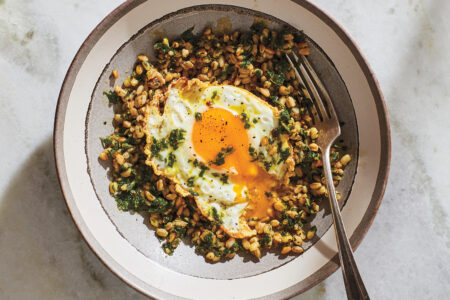
David Tamarkin’s recipe for Greens, Grains and Fried Egg works for any meal

Slow-cooked, sticky-glazed pork ribs go with cucumber slaw in Sam Way’s recipe

This quiche just might make you love leeks