Visit to France drives home invasion’s meaning
Bayeux, France ? Of the 9,350 white marble gravestones at the Normandy American Cemetery at Colleville-Saint-Laurent, 307 bear the inscription: “Here rests in honored glory a comrade in arms known but to God.”
We do not know their names. The horrors of war left their remains unidentifiable. But we know what they did. They gave their lives so the people of their generation, and of the generations to follow, could live free of tyranny.
D-Day was a pivotal event of the 20th century. The future course of history and the fate of millions depended on its outcome. Today, 60 years have passed since Allied forces invaded Nazi-occupied France. While time dims most memories, the story of their sacrifice is one we must never forget.
What visitors to Normandy see today is an area with a wide, sandy shoreline and peaceful blooming fields of green and yellow: a stark contrast to the carnage and courage that dominated this landscape June 6, 1944. Fierce fighting stretched 60 miles along the coast and dozens of miles inland.
The late Stephen Ambrose wrote there were nearly 10,000 casualties — no one is sure of the exact number — among the nearly 175,000 U.S., Canadian and British troops who came ashore that day. By the time the Allies secured the Cherbourg peninsula and achieved a strategic breakout from their beachheads in late July, the death toll for both sides had reached nearly a quarter of a million men.
Touring the battlefields of Normandy today, one is quickly struck by how much the fate of Western civilization rested in the hands of young men barely old enough to shave. Many of the graves in Normandy — especially among the Germans — belong to 15- and 16-year-olds. The youngest was 14. Most were in their late teens and early 20s.
For those surprised by the youthful face of war, Hollywood is, in part, to blame. Take for example Lt. Col. Benjamin H. Vandervoort of the 505th Parachute Infantry Regiment, 82nd Airborne Division. Despite breaking his ankle in a parachute jump behind enemy lines in the predawn hours of D-Day, he led his men in the liberation of the strategically vital Ste. Mere Eglise.
In the 1962 movie “The Longest Day,” John Wayne portrayed Vandervoort as a crusty old veteran. Wayne was in his mid-50s when the movie was filmed. Vandervoort was just 29.
Remembering the Allies
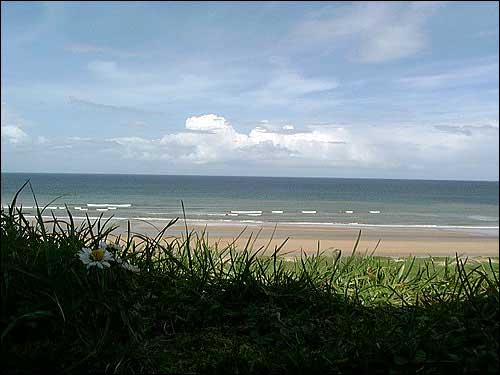
Omaha Beach on the Normandy coast of France presents an idyllic scene in 2004 -- much different than what faced the Allies' invading forces on D-Day, June 6, 1944.
Most Americans visiting here are immediately drawn to the U.S. landing beaches, Utah and Omaha. However, as the countless memorials and battlefield artifacts scattered throughout the Norman countryside remind us, D-Day is a story about the triumphs and tragedies of many nations.
The story of the Canadians is particularly touching. At the time of the war, Canada was a nation of only 11 million people with more than a million of its citizens in uniform. While the United States had the most D-Day casualties, Canadian forces suffered the highest percentage of losses. Roaring off of Juno Beach, Canadians made the deepest Allied penetration June 6. Centre Juno Beach, a majestic maple leaf-shaped building a short walk from the English Channel, stands as a reminder of Canada’s role in the liberation of Europe.
A more somber tribute can be found in the form of a simple plaque near a village square just a few kilometers inland. It bears witness to the cold-blooded murder and desecration of more than 40 Canadian prisoners at the hands of their German captors. It is of some consolation that many of these perpetrators, members of a crack German S.S. Panzer division, met their demise just one day later in a firefight with surviving elements of that same Canadian unit.
Fortified bunkers
Adolph Hitler boasted that his Third Reich would last a thousand years — and came up 988 years short. But many of the bunkers and trenches that comprised Hitler’s much-heralded Atlantic Wall could very well last that long. Each of these Widerstandsnests — resistance nests — are models of demonic design.

 Photo gallery: D-Day remembered
 6News video: Sunday marks 60th anniversary of D-Day (6-4-04)
 Dropped on D-Day
Hand built by slave laborers from Nazi-occupied lands, each was a maze of bunkers and gun positions designed to bring maximum firepower to bear on the invaders. A surviving German machine gunner at a Widerstandsnest fronting Omaha Beach says he fired more than 12,000 rounds of ammunition at American soldiers before abandoning his post eight hours after the first landings.
Built of steel-reinforced concrete up to 12 feet thick, these bunkers were virtually impervious to naval shelling. The best way to destroy them was to detonate explosives from the inside. That meant getting Allied soldiers close enough to lob hand grenades, usually at a horrendous cost.
While many of these Widerstandsnest are open for public view, others are discarded and overgrown with weeds and thicket. Some, such as the National Guard Memorial on Omaha Beach, serve as tributes to the liberators. A bunker near Utah Beach is now a restaurant called the Roosevelt Inn, named for Brig. Gen. Theodore Roosevelt Jr., the son of President Teddy Roosevelt. The younger Roosevelt led his troops ashore on D-Day and was killed in action the next day. Another bunker near Juno Beach is now a beach club.
A beach club? That’s right. Sixty years after this sandy stretch of shoreline became the focal point of a bloody battle between good and evil, Normandy’s beaches are a popular summertime stop for sunbathers and swimmers. “I know that seems odd,” one battlefield tour guide said. “But wasn’t that what these men were fighting for?”
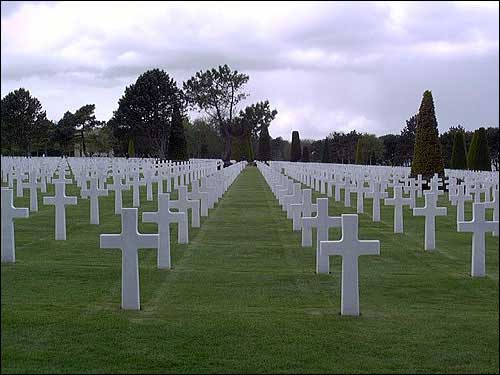
Rows of white crosses mark the graves of American soldiers buried in the U.S. cemetery above Omaha Beach.
‘Swords into plowshares’
In many ways, that reflected the sentiments of the man most responsible for setting the events of D-Day into motion: Gen. Dwight D. Eisenhower, supreme commander of the Allied Expeditionary Forces.
On June 12, 1945, after the defeat of Nazi Germany, Eisenhower said he hoped it would no longer be necessary for the world to “summon its sons and daughters from their peaceful pursuits to face the tragedies of battle.”
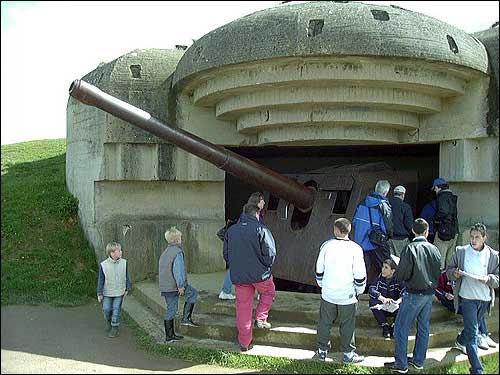
A surviving German bunker just above Omaha Beach is the object of tourists' curiosity. These bunkers, which formed Hitler's Atlantic Wall, were built by Slave Labor.
But the man from Abilene noted that freedom-loving people would never sell their birthright for physical safety or their liberty for mere existence.
“When this truth has permeated to the remotest hamlet and heart of all peoples,” Eisenhower said, “then indeed may we beat our swords into plowshares and all nations can enjoy the fruitfulness of the earth.”
— David W. Guth is an associate professor at Kansas University’s William Allen White School of Journalism and Mass Communications. On July 1, he will assume the role of associate dean. Guth toured and photographed D-Day sites in Normandy for three days last month while returning home from an overseas teaching assignment.
City Government

Developer seeks incentive from City of Lawrence to build 131 units of housing near Wakarusa and Queens

Lawrence city leaders will consider whether to keep Community Building open, make 2 other rec centers free to access

A STAR Bond application raises questions for city leaders about Costco and housing west of the SLT

Soccer gear honoring Lawrence history’s all-star team is now on sale as part of city’s public art exhibition
To honor public servants, Lawrence’s July 4 celebration will have a whole gallery of their photos on display; submissions open now