New scholarship hall to be greener, quieter
Neighbors of the new Rieger Scholarship Hall probably won’t have noise complaints about the hall’s air-conditioning and heating system.
It’s buried 400 feet in the ground.
Kansas University officials opted to install a state-of-the-art “geothermal” heating and air-conditioning system in the new hall. The system is both quieter and more environmentally friendly than its traditional counterparts.
The principle behind the heating and cooling system is fairly simple. The temperature far beneath the earth’s surface remains fairly constant. By pumping a solution similar to antifreeze through the 400-foot-deep pipes, the solution is warmed during the winter months and cooled during the summer months.
The solution then is pumped back to the surface, where it will warm or cool air that is circulated through the hall, which will be on the west side of the 1300 block of Ohio Street.
Drilling on the wells began recently, but rains have slowed the process. It should be complete in a few weeks, said Craig Stewart of Treanor Architects.
News of the new system was music to the ears of Candy Davis, president of the Oread Neighborhood Assn., which borders the KU campus. Association members have complained during the past two years about the high-pitched noise produced by a new ventilation system at GSP and Corbin residence halls.
The university is continuing to tweak acoustics at the GSP/Corbin site to alleviate the problem.
Rieger Scholarship Hall, which will be home to 50 women beginning in fall 2005, already has been the subject of controversy. Neighbors fought KU on whether the university could demolish several century-old houses on the block to make way for the hall.
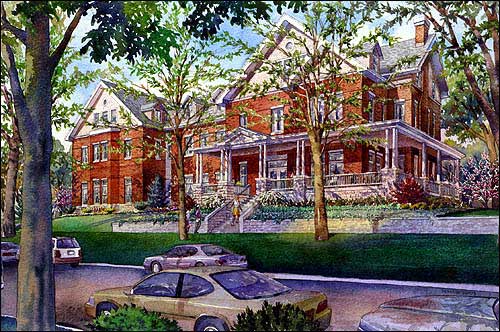
An architectural rendering shows how Rieger Scholarship Hall will look once the new building in the 1300 block of Ohio is finished. The hall's geo-thermal heating and cooling system will be less noisy and more environmentally friendly than traditional systems.
“To their credit, they’re working toward implementing an environmentally friendly system,” Davis said. “But I wish it could have happened multiple units ago. We just need to treat each other like good neighbors.”
While quiet operation is one benefit of the geothermal unit, Ken Stoner, director of student housing, said other factors drove KU to pursue the system. Though the system will cost $80,000 to $90,000 more than traditional systems to build and install, it takes less energy to operate.
He estimated it would take seven to 10 years of operation to recoup the additional cost for installation.
“If it’s built on a 50-year standard, the next 40 years we’d save money,” Stoner said. “In theory you get pay back on them. There are higher initial costs, but in the long term your operation costs should be lower.”

 KU anticipates historic groups will OK scholarship hall design (6-5-03)
City Government
Developer seeks incentive from City of Lawrence to build 131 units of housing near Wakarusa and Queens

Lawrence city leaders will consider whether to keep Community Building open, make 2 other rec centers free to access
A STAR Bond application raises questions for city leaders about Costco and housing west of the SLT

Soccer gear honoring Lawrence history’s all-star team is now on sale as part of city’s public art exhibition
To honor public servants, Lawrence’s July 4 celebration will have a whole gallery of their photos on display; submissions open now