KU receives record $18 million grant
KANSAS CITY, KAN. ? The fledgling Kansas life science industry received a boost Thursday in the form of the largest grant ever awarded to a university in the state.
The Kansas University Medical Center received a five-year, $18 million grant from the National Institutes of Health designed to develop bioscience research across the state through the Kansas IDeA Networks of Biomedical Research Excellence.
“The NIH is making a great investment in Kansas,” said Joan Hunt, senior associate dean for research and graduate education at the Medical Center.
The grant’s goal is to create a statewide network of life sciences researchers. Other participating institutions are Kansas State University, Wichita State University, Emporia State University, Fort Hays State University, Haskell Indian Nations University, Pittsburg State University and Washburn University
Hunt said the program has three main focuses:
- Increasing computing capacity at universities so scientists can easily share data on bioinformatics, the computer analysis of biomedical information.
- Providing $3,000 stipends to 30 students each year to pursue research projects.
- Providing $10,000 grants to promising young faculty in an effort to keep them in the state.
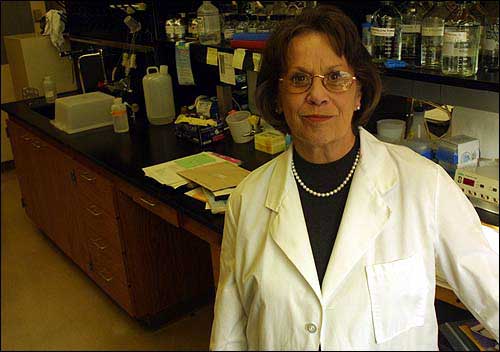
Joan Hunt, senior associate dean for research and graduate education at the Kansas University School of Medicine, recently began a stint on a National Institutes of Health advisory council.
One of those young researchers is Lisa Timmons, assistant professor of molecular biosciences at KU, who plans to use a grant to expand her genetic research.
“We have a few questions we just haven’t had the time or resources to address very well,” she said. “With this project, we’ll focus on questions that have an even more direct impact on cancer.”
Hunt said life science researchers would begin working more closely with information technology experts on the Lawrence campus to tackle bioinformatics issues.
“It’s a very practical sort of application,” she said. “Researchers are stunned at the amount of data they get out of their projects. Without computers, they could sit for 20 years studying the same data sets.”
Complements state efforts

 University’s research dollars up, ranking down
Hunt said the new grant would be a complement to the Kansas Economic Growth Act, the 2004 law passed by the Kansas Legislature that aims to pump $500 million into life sciences research and related economic development over the next 10 years.
“The more we emphasize our ability to get our products out to where they can ultimately be some assistance for human health, the better,” she said. “Believe it or not, we’re beginning to think more commercially, and that’s in part because that’s what the NIH wants us to do.”
Hunt, who serves as principal investigator for the project, said the grant would continue efforts begun in 2001 with the Kansas Biomedical Research Infrastructure Network, which was funded with an $8.2 million NIH grant. That grant helped establish a cooperative intercampus biomedical research program at nine campuses across Kansas.
The program is part of the Institutional Development Award (IDeA) program at the NIH, which pumps research funds into areas traditionally under-represented with federal research money.
Hunt said 24 states received grants during the first round of the program. Fifteen will continue their projects after the latest announcement of grants.
City Government

Developer seeks incentive from City of Lawrence to build 131 units of housing near Wakarusa and Queens

Lawrence city leaders will consider whether to keep Community Building open, make 2 other rec centers free to access
A STAR Bond application raises questions for city leaders about Costco and housing west of the SLT

Soccer gear honoring Lawrence history’s all-star team is now on sale as part of city’s public art exhibition
To honor public servants, Lawrence’s July 4 celebration will have a whole gallery of their photos on display; submissions open now