Caring and courage
Army nurse saw tragedy, shared laughter, found love during WWII
Nearly 60 years have passed, but Virginia Visser remembers her visit to Buchenwald concentration camp — in the days after it was liberated — as “one of the most searing experiences I’ve had in my life.”
Visser, then a young Army nurse serving in World War II, had no idea what she was getting into when offered the tour.
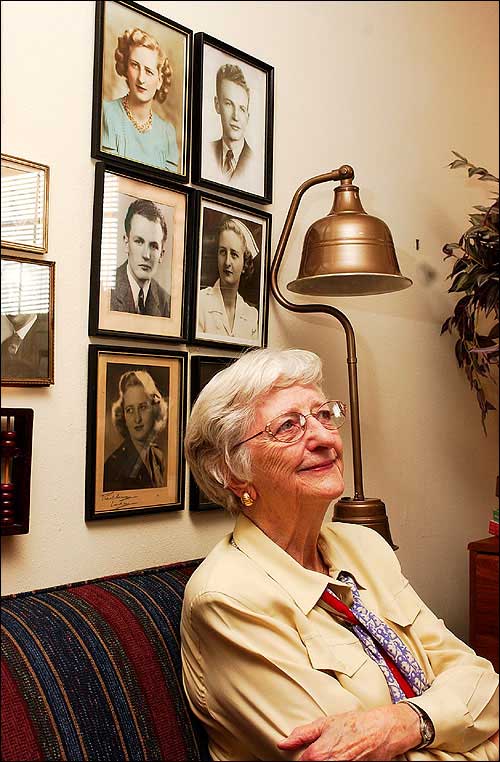
Virginia Visser was a small-town girl in Iowa when she enlisted to become an Army nurse in World War II. Visser, who's lived in Lawrence since 1997, is pictured in her home, near portraits of her husband and herself from graduation through the service.
“We were at Weimar, and when we were waiting there, in Germany … one of the guys in the transportation office said, ‘Do you want to go see the concentration camp out here at Buchenwald?'” Visser recalled recently.
“Of course, we really didn’t know what a concentration camp was, as such,” the 82-year-old Lawrence resident said. “We said, ‘Sure.'”
More than 56,000 people had been killed at Buchenwald; the Nazis had left behind ample evidence of their genocidal work.
“There were still bodies stacked out there that hadn’t been taken to the crematorium yet,” Visser said. “That was a real experience. It was something you didn’t expect, and you had no idea that all that was going on.”
There were survivors, weak from malnutrition and forced labor, laying on shelves that had served as bunks.
“They were either too weak to have been removed,” Visser said, “or maybe they were strong enough that they weren’t the first ones moved.”
At the time, Visser and her colleagues didn’t realize how enormous the Holocaust had been.
“I think we had no idea how many of the concentration camps there were. We just saw Buchenwald,” she said. “I think it made you very aware of how important life is, certainly, but how quickly life can be taken away, too.”
‘You wanted to join’
Visser — then known by her maiden name of Virginia Schuyler — didn’t need much persuading to join the Army when recruiters came to her nursing school at St. Vincent Hospital in Sioux City, Iowa.
“When we were in nurses training, in ’40, ’42, ’43, we were bombarded by recruiters coming in, getting nurses to sign up ahead of time so they’d join either the Army or the Navy,” she said. “I’ve written in one of my recollections that they were always so handsome when they came in, looked so neat in their uniform, of course you wanted to join the service.”
Visser made her choice — the Army — with an eye toward seeing the world. She would become one of more than 100,000 women to serve in uniform during the war.
After graduation in 1943, she reported to Camp Carson, Colo. She was assigned in late February to the 187th General Hospital and shipped to England, which was busy with preparations for the D-Day invasion of Europe.
“At that time, the amount of material that was coming into England was incredible, with all the artillery, infantry, all the equipment, just unbelievable,” Visser said. “But our hospital wasn’t set up, so we, the nurses of our group, were assigned to live with English families, which was a wonderful experience.
“The British had suffered so long. They had been bombed, bombed, bombed. And food was rationed. It was really tough for them. I think we were fortunate to realize, because we were pretty arrogant when we went there. We came from the land of plenty, and we had suffered no deprivation at all.”
The reality of war set in quickly. The Tilbury family took shelter from a German bomb raid the first night Visser spent with them — sitting under a steel table surrounded by mesh netting meant to catch bomb debris.
“We spent several nights under that table,” Visser said, “because they were getting hit pretty regularly.”
D-Day
For Visser’s first few months in England, doctors and nurses at the hospital near Swindon, in southwestern England, mostly treated regular ailments and injuries. Then came D-Day, June 6, 1944.
“On the morning of D-Day, when Eisenhower announced they landed in France, it was like a pall was cast over the hospital,” Visser said. “Nobody was sure just what was going to happen then. But then we started getting patients back very shortly afterwards from D-Day.”

 6News video: Portraits of Honor: Robert Johnson
 Memorial of Honor’s centerpiece put in place (6-16-04)
Soon, the system for treating soldiers was abandoned.
“A lot of these hospitals were set up, like for a chest hospital, were designated for certain wounds,” Visser said. “But when all the casualties started coming, that kind of fell apart somewhat, because patients, when they came, they were treated. … Whatever came along, that’s what we took care of.”
Soldiers arrived with gunshots, shrapnel wounds and burns. The medical staff went to work. Along the way, Visser was impressed by the courage of her patients.
“Americans … tend to make light of things. And the guys on the ward would joke with each other,” she said. “Some would not speak at all. Those patients had psychiatric care.”
She added: “The GIs, the soldiers, were so great. I don’t think anybody can say enough about the courage of the GIs that fought in World War II. We saw a lot of them.”
Treating the enemy
As Allied forces moved deeper into Europe, doctors and nurses were needed to follow close behind. On Christmas Eve 1944, Visser and a fellow nurse flew from London to France.
“Oh, it was so wonderful to go because they had lights on in Paris, and we’d been in blackout all the time since we’d been overseas, going around trying to find something at night,” Visser said. “They had wonderful crusty white bread that we hadn’t seen for a long time.”
After two days, the nurses were assigned to the 36th General Hospital — taking care of injured German prisoners of war.
“It was very different. They were treated very well. They got the same treatment that our GIs got,” Visser said. “As soon as they were able to get out of the hospital, they were taken back as prisoners.”
The jokes, so prevalent among American patients, were absent from the hospital.
“We weren’t there to be friendly, necessarily,” Visser said.
After a short time at Dijon, Visser was ordered to catch up with another hospital unit in Germany. It was during this time she saw Buchenwald.
Telling the story
The Germans surrendered in May 1945. Around the same time Visser met her future husband, John Visser, a future president of Emporia State University.
“We spent most of our time talking about how you couldn’t fall in love while you were overseas,” Visser said with a laugh.
The two were married in May 1946, after returning to the United States. Life returned to normal.
“I don’t remember ever talking about the war very much. Nobody asked, nobody was particularly interested,” she said. “People went back to doing what they were doing. Our generation got busy raising kids and stuff.”
Visser moved to Lawrence in 1997, after her husband died. She got involved in a writing class and started putting her nursing experiences down on paper, what would eventually become her book, “Through the Years.” She hopes to find a publisher for the book.
She remembered her war years with a sense of duty.
“It was totally different environment,” she said. “But we were all doing the same thing, anybody that was overseas: You were there to win the war.”
The Douglas County Memorial of Honor will be dedicated at 10:30 a.m. Saturday at the Lawrence Visitor Center, 402 N. Second. The memorial is a tribute to Lawrence area soldiers, sailors, police and firefighters. To commemorate the event, the Journal-World, 6News and World Online are telling the stories of veterans in the “Portraits of Honor” series.Tonight; See the 6News report at 6 p.m. and 10 p.m. on Sunflower Broadband’s Channel 6 about Walter Wettstein, a Navy veteran of the World War II battle of Iwo Jima.Friday: In the J-W and on ljworld.com, read about Wettstein and Bernard Kennedy, who was shot at the Battle of the BulgeFriday night: See the 6News report at 6 p.m. and 10 p.m. on Sunflower Broadband’s Channel 6 on Virginia Visser reminiscing about her experiences as an Army nurse in World War II Europe.Saturday: In the J-W and on ljworld.com, read about former Lawrence Mayor Erv Hodges, a retired Marine and the man who spearheaded the Memorial of Honor project.Sunday:In the J-W and on ljworld.com, find coverage of Saturday’s memorial dedication, as well as a profile of Ken Pine, a World War II veteran.Through the week:On ljworld.com and 6NewsLawrence.com, find stories and video reports from the series, plus audio clips and archived stories about the building of the memorial and past stories and video reports about Douglas County’s veterans.
City Government

Developer seeks incentive from City of Lawrence to build 131 units of housing near Wakarusa and Queens

Lawrence city leaders will consider whether to keep Community Building open, make 2 other rec centers free to access
A STAR Bond application raises questions for city leaders about Costco and housing west of the SLT

Soccer gear honoring Lawrence history’s all-star team is now on sale as part of city’s public art exhibition
To honor public servants, Lawrence’s July 4 celebration will have a whole gallery of their photos on display; submissions open now