City Commission to weigh Eagle Bend’s highest fee increase yet
Duffers at Lawrence’s Eagle Bend Golf Course will find out tonight whether it soon will cost them more green to hit the links at the city-owned facility.
At tonight’s City Commission meeting, Eagle Bend officials will ask commissioners to approve the largest fee increase in the course’s history. Parks and Recreation Department officials are recommending a fee increase of $2 per 18 holes of golf and $1 for nine holes of golf. Earlier this year, Eagle Bend officials had budgeted for only a 50-cent increase.
But Fred DeVictor, director of the city’s Parks and Recreation Department, said the fee increases were needed to compensate for a series of poor financial years following a downturn in the golf industry after the 9-11 attacks.
“There probably will be some golfers who don’t like the idea of increases, but we think there will be some who will be willing to pay a bit more to play,” DeVictor said. “We still have a good experience for golfers.”
With the increase, fees for 18 holes of golf with a cart would increase to $36 on weekends and $22 on weekdays. DeVictor said a survey of 14 other public golf courses in the area found that Eagle Bend, 1250 East 902 Road, would still be the fourth most affordable after the increases.
City Commissioner Sue Hack said that fact gave her some confidence about moving ahead with the increase.
“We always want to be careful that we’re not pricing ourselves out of business,” Hack said. “But I think this might be a good medium.”
The fee increases are expected to produce an additional $50,400 in revenue in 2005 for the course, which is expected to lose $103,000 in 2004. That’s down slightly from a $109,000 loss in 2003.
DeVictor said he hoped the fee increases, combined with a drier golfing season, would allow the golf course to break even in 2005.
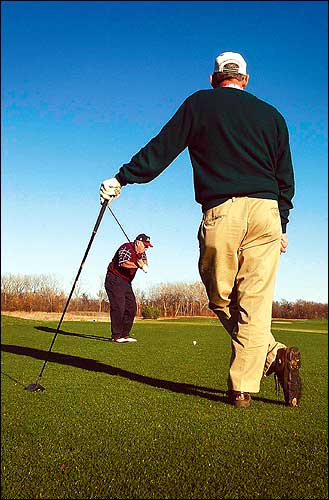
Charlie Wilson, Shawnee, tees off at Eagle Bend Golf Course with golf partner Bob Heacock, Lawrence, in attendance in this 2003 file photo. The City Commission will weigh a fee increase for the site at tonight's meeting because revenues are not up to expectations.
“That’s what we hope, but we have a lot of factors that are out of our control,” DeVictor said.
In 2004, weather played a major role in the course’s financial struggles. DeVictor said there were 17 days in July and August, including 11 on the weekends, when the course was closed or dramatically affected by rainy weather.
Hack said she also hoped the fee increases would be enough to bring the course’s finances back to the break-even point, but she doubted it.
The city transferred $150,000 of sales tax money to Eagle Bend in early 2004. Hack said the community might need to be prepared to subsidize the course in the future.
“To me it is like our swimming pools and the T,” Hack said. “Those are things that the community has indicated it likes, and that means the community is responsible for paying for some of the amenities. It is just the cost of being a community.”
Eagle Bend officials have said they expect the course to pay its own way or even make a profit after the debt to build the course is retired in 2016. City officials currently pay about $320,000 a year to retire the debt.
DeVictor also said the course would benefit from an upturn in the overall golf industry, although he said he did not know when that would occur.

 Eagle Bend again calls for tax dollars (11-11-04)
In a report to city commissioners, DeVictor cited figures from the golf industry that show the number of golfers across the nation declined by 2.7 million people from 2000 to 2002. During that same time period, though, about 1,200 new golf courses have been built in the country.
“This isn’t just an Eagle Bend problem,” DeVictor said. “It really is nationwide.”
City Government
Developer seeks incentive from City of Lawrence to build 131 units of housing near Wakarusa and Queens

Lawrence city leaders will consider whether to keep Community Building open, make 2 other rec centers free to access
A STAR Bond application raises questions for city leaders about Costco and housing west of the SLT
Soccer gear honoring Lawrence history’s all-star team is now on sale as part of city’s public art exhibition
To honor public servants, Lawrence’s July 4 celebration will have a whole gallery of their photos on display; submissions open now