Injured soldier’s education mission accomplished
Recovering in a hospital bed late last year, surrounded by wounded soldiers, Sgt. Chuck Bartles had plenty on his mind.
The blast.
His right arm, which no longer was by his side.
His comrades — the one that didn’t survive the blast, the two that did and the ones still in Iraq, facing increasing danger.
A college diploma simply wasn’t a priority.
Eventually, after several months, the wounds — both emotional and physical — began to heal. Bartles’ mind turned to unfinished business. He would complete the Kansas University education he left behind when his Army Reserves unit was summoned to Iraq.
“I just knew I had to do it,” he said.
Bartles this fall completed his master’s degree in Russian and East European studies. He’s one of approximately 1,200 KU students graduating in December.
Bartles’ route to graduation was far from usual.
It started in fall 2000, when he enrolled at KU. He had graduated with a degree in Russian from the University of Nebraska and wasn’t sure what he wanted to do with his life and figured a graduate degree couldn’t hurt him.
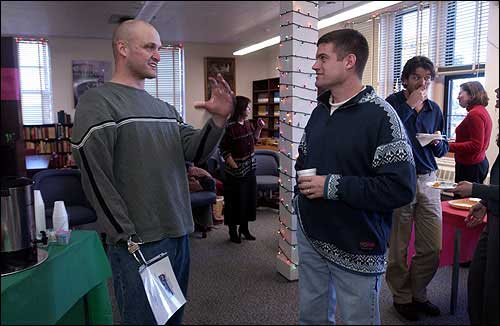
Chuck Bartles, left, a Kansas University graduate student, chats with Matt Dimmick, a graduate student from Johnson County, at a gathering for faculty and students in the Center for Russian and East European Studies at KU. Bartles, who lost his right arm in combat in Iraq, graduates this month from KU with a master's degree in Russian.
Bartles was nearly finished with his degree when his plans were altered in January 2003. His 418th Civil Affairs Battalion, based in Belton, Mo., was being called to active duty and was headed to Iraq to help rebuild the country’s infrastructure.
Bartles, 26, has served in the military reserves for eight years. He started in the Marines but switched to the Army in 2001.
Things changed for Bartles even more on Oct. 23, 2003. That’s the day his vehicle was struck by a roadside bomb. The blast killed one soldier and injured two others. Bartles’ right arm was shattered and had to be removed above the elbow.
He arrived at the Walter Reed Army Medical Center in Washington later that month for recovery.
Wrapping up thesis
Ray Finch, assistant to the director of the Russian and East European studies department at KU, heard about the accident in news reports and knew Bartles was a KU student. Finch e-mailed Bartles and asked whether he was interested in finishing his thesis — the only portion of his master’s degree that remained.
“Initially, he had other things on his mind instead of completing his paper,” Finch said. “We let him know we were there to help him get his mission accomplished.”
Eventually, in January, Bartles set out to finish his thesis, which examines nuclear proliferation and bioterrorism in post-Soviet Russia. He relied on libraries in the Washington area such as the Library of Congress for his research.

 6News video: Soldier returns to KU to earn masters degree
 Loss of arm doesn’t prevent KU student from re-enlisting (9-11-04)
The prosthetic arm Bartles is learning to use made research more difficult than before the blast. But he said he couldn’t complain about the process.
“I couldn’t type too well with my arm,” he said with a laugh. “There’s not too much difference.”
Bartles turned in the final draft of his 45-page thesis earlier this fall.
“It took me four years, but I finally got it done now,” he said. “It’s a weight off my shoulders.”
Now, he’s waiting for permission to leave the Walter Reed facility, which he’s expecting in the next few months. He said he was fully recovered from his injuries, other than the amputated arm.
Future plans
He’ll return to the Kansas City area, where he has a job with 7-Up waiting for him in Lenexa. With his injury changing his career goal of becoming a federal law enforcement officer, he’s applying to law school at KU and the University of Missouri-Kansas City. The Department of Veterans Affairs will pay for his education.
But while he’s returning to school, he’s not done with the military. Amputees usually are given medical discharges, but Bartles lobbied the Army to allow him to re-enlist in the reserves, which he did in September. He said he enjoys his service and has combat and language classes offered by the military that he still wants to take.
“I’m definitely happy to go back to school, but I’d go back (to Iraq) if my unit is called up,” Bartles said. “It was good to be over there. It’s a pretty beautiful place.”
Finch, who helped Bartles finish his degree, said he figured Bartles had done his duty for his country. To go back to military service and finish his degree, Finch said, is extraordinary.
“I’ve been simply amazed,” Finch said. “I know it would have been easy to say the heck with it. It sounds corny, but he’s a real inspiration.”
City Government
Developer seeks incentive from City of Lawrence to build 131 units of housing near Wakarusa and Queens

Lawrence city leaders will consider whether to keep Community Building open, make 2 other rec centers free to access
A STAR Bond application raises questions for city leaders about Costco and housing west of the SLT
Soccer gear honoring Lawrence history’s all-star team is now on sale as part of city’s public art exhibition
To honor public servants, Lawrence’s July 4 celebration will have a whole gallery of their photos on display; submissions open now