Traditional foods from modern era form Hanukkah menu
Tel Aviv, Israel ? Jewish people all over the world are now celebrating Hanukkah, the Jewish Festival of Lights, commemorating a miracle that occurred in Jerusalem in the winter of 165 B.C.
An eight-day holiday, Hanukkah recalls the time when the Syrian-Greek king Antiochus IV set out to destroy the religious and ethnic identity of the Jewish people under his control.
A small group of guerrilla warriors, known as Maccabees (their name is an acrostic of the Hebrew “Mi Kamocha B’Elim Adonai” — “Who among the mighty is like you, God?”), proved victorious and succeeded in liberating Jerusalem from the despot.
Their first mission was to cleanse and rededicate the Temple. But when the Maccabees sought to rekindle the menorah, tradition holds that they found only enough oil to last for a single day. Instead of burning just one day, the oil lasted for eight days — time enough for them to prepare fresh-pressed olive oil, at the end of the olive-pressing season.
From then on, the Maccabees held a winter celebration to commemorate the rededication of the Temple. But what they served at that celebration, no one really knows for sure.
In fact, no one really knows the origins of the first Hanukkah foods. From a practical standpoint, however, the Maccabees probably subsisted on whatever was available during that season — such foods as cooked lentils, chickpeas, wheat and barley, seasoned with fresh-pressed olive oil, together with diluted wine, the customary drink in those days.
After the destruction of the Second Temple in 70 A.D. and the resulting exile of the Jewish people, only one culinary custom survived: the copious use of oil to prepare Hanukkah foods.
For Jews who settled in Spain, the Middle East and around the Mediterranean basin (known as Sephardic Jews) where the olive-pressing season and seasonal foods resembled those of ancient Israel, holiday foods reflected the original olive-oil theme: batter-fried chicken in Italy, for example, and olive-oil fried sweet pastries for dessert.
But for those who settled far away in the shtetls of Eastern Europe (Ashkenazi Jews) no cooking oil was at hand and lard, the only solid fat available, was prohibited. The approach of Hanukkah was traditionally the time for fattening geese, so the unlucky bird came to serve as the centerpiece of the holiday meal with some of its fat (schmaltz) used for frying latkes (potato pancakes).
How did the latke come to be? Native to America, potatoes came to Western Europe in the 16th century, and by the 1840s cultivation spread throughout Russia, Lithuania, Poland and the Ukraine. Cheap and plentiful and easily stored for winter use, potatoes and goose fat were the perfect ingredients for a dish that could be prepared with little work, and precious little fuel.
For dessert, many Jews made puffs or rounds of dough, served with a honey or sugar syrup which the Sephardim scented with rose or orange-flower water. The Greeks had their loukomades, the Turkish their bumuelos, the Persians snail-shaped zelibi, and North Africans the bagel-like sfenj.
German Jews made fried jelly doughnuts with apricot filling and glaze, and brought the custom with them to the Holy Land in the 1930s, where the sweets became known as sufganiot. In Poland, Jews enjoyed fried doughnuts (paczki) or pancakes (placki) made from potato flour, also consumed by Lithuanian Jews.
Hanukkah menu
Although you might opt to make an elegant Hanukkah meal, the most traditional way of celebrating Hanukkah is by serving potato latkes, which together with sufganiot, fit most children’s idea of the perfect meal.
But this year, instead of serving one kind, why not make a variety of latkes and serve them with different toppings? A hot soup and a green salad would also help round out the meal.
Here are a few suggestions to choose from:
Sweet Potato Latkes With Spiced Maple Syrup
For the Latkes:
1 pound sweet potatoes
2 eggs
1/2 teaspoon baking powder
1/4 cup matzo meal
1/2 teaspoon salt
Pinch of white pepper
2 to 4 tablespoons light olive oil for frying
For the sauce:
1 cup real maple syrup
1/2 teaspoon grated fresh ginger root
1/4 teaspoon ground nutmeg
Pinch of ground cloves
Salt and pepper to taste
Chopped fresh coriander or mint leaves to garnish
Scrub the sweet potatoes, peel and shred on the fine side of a grater or in the food processor. Transfer to a wire-mesh strainer and squeeze to remove excess moisture. Let stand in the strainer or a colander placed over a bowl for 5 minutes.
In a medium bowl, beat the eggs with a fork and add the sweet potato, baking powder, matzo meal, salt and pepper. Let stand an additional 5 to 10 minutes.
In the meantime, prepare the sauce: In a small pan mix the ingredients for the sauce, heat over low heat and keep warm. Heat 2 tablespoons oil in a large skillet and add a small ladleful of the batter. Flatten gently and fry on both sides till golden-brown. Check to see if you like the texture of the latke, and add a little more matzo meal to the mixture, if desired. (Let the mixture stand 3 minutes before using).
Add more oil to the pan as necessary, and fry the remaining latkes. Place the latkes on a paper towel-lined plate to absorb excess oil. Pour some of the heated sauce on individual plates and arrange three latkes on top per serving, or use a serving platter. Garnish with fresh coriander or mint. Pass the rest of the sauce around to taste. Serve with sour cream or plain yogurt if desired.
Makes 10 to 12 latkes.
Lightened-Up Potato Latkes
2 1/2 cups shredded, unpeeled russet potatoes (about 1 pound)
1/2 cup grated onion
1/3 cup peeled shredded carrot
1/3 cup flour
2 tablespoons snipped fresh chives
1 teaspoon kosher salt
1/4 teaspoon freshly ground pepper
1 egg plus 1 egg white
2 tablespoons vegetable oil, divided
Scrub potatoes and coarsely grate. Immediately place in a bowl of ice water to keep potatoes from discoloring; let stand for 5 minutes.
Meanwhile, place the onion, carrot, flour, chives, salt, pepper and eggs in a medium bowl and stir well.
Drain the potatoes and squeeze out moisture; stir into egg mixture. Heat 1 tablespoon oil in a large nonstick skillet over medium-high heat until very hot. Spoon about 1/4 cup of potato mixture for each pancake into skillet, cooking 4 at a time. Cook for 3 to 4 minutes per side, flattening with the back of a spatula and cooking until golden-brown and crisp on both sides. Drain on paper towels. Repeat with remaining oil and potatoes. Serve immediately with chunky applesauce and low-fat sour cream.
Makes 4 servings.
Olive Latkes
2 cups finely chopped pitted green or black olives in brine, drained (or use half green, half black)
1/2 cup olive oil
1 cup chopped onion
2 tablespoons chopped garlic
1 cup unbleached all-purpose flour
1 teaspoon baking powder
1/2 teaspoon baking soda
1 teaspoon salt
1 teaspoon cumin
2 eggs, beaten
1 to 2 tablespoons water (optional)
Chop the olives finely or process in the food processor. Transfer chopped olives to a strainer and squeeze out as much moisture as possible. Heat 1/4 cup of the oil and saute the onion and garlic till golden. Set aside.
In the meantime, sift flour, baking powder, baking soda, salt and cumin. Beat in the eggs and onion and garlic mixture with a fork. Add the water if the mixture seems too thick. Heat the remaining oil and use a small cup or soup ladle to form 3 or 4 small latkes each time. Fry on both sides till golden. Serve with thick yogurt or sour cream.
Makes about 8 latkes.
Zucchini, Feta and Basil Mini-Frittata
2 cups coarsely grated zucchini (about 4 small-medium)
2 large eggs, separated
1/4 cup chopped scallions
1/2 cup unbleached all-purpose flour (or slightly more if necessary)
1/2 teaspoon baking powder
1 1/2 teaspoons chopped fresh basil or oregano (or half basil, half oregano)
1/4 teaspoon black pepper
1 and 1/3 cups coarsely grated feta cheese
Olive oil for frying
Wash the zucchini, grate and place in a colander. Let drain 15 minutes and squeeze to remove excess liquid. Mix together the egg yolks, scallions, flour, baking powder, basil, pepper and feta cheese. Add the drained zucchini, and mix well. Whip the egg whites till soft peaks form and fold into the feta mixture.
Heat just enough oil to cover the bottom of an 8-inch heavy or nonstick frying pan and pour in just enough batter to cover the bottom (about 3/4 cup). Cook over medium heat till golden-brown on one side, flip and cook the other side. Keep the finished frittata in a warm oven till the batter is done.
Makes 30 latkes or 8 frittata.
Mini-Ricotta Latkes With Sour Cherry Sauce
For the Latkes:
1 pound whole or part-skim milk ricotta cheese
4 eggs
6 tablespoons unbleached all-purpose flour (half whole-wheat pastry flour if desired)
1/2 teaspoon baking powder (optional)
1 tablespoon walnut oil
2 tablespoons granulated sugar or turbinado sugar
1 teaspoon vanilla extract
Oil for frying
For Sour Cherry Sauce:
1 cup canned or bottled sour cherries in syrup (measure without liquid)
1 cup liquid from can or bottle
1 1/2 tablespoons cornstarch
1 tablespoon water
1 tablespoon Cherry Heering, or other cherry liqueur
Make the sauce first: In a small saucepan, mix cherries and syrup and heat over medium-low heat. In a small bowl, mix the cornstarch and water till smooth and add to the pot. Continue to heat, stirring, until the mixture thickens slightly. Stir in the cherry liqueur, cover and keep warm while preparing the latkes. (May be prepared in advance and reheated).
To make the latkes: Put all the ingredients for the latkes in a blender and process till smooth. Heat a small amount of oil in a frying pan and drop 2 tablespoons of the mixture at a time to form a mini-latke. Cook briefly on one side till lightly brown on the bottom, then flip and cook the other side for under a minute. Serve warm with the sauce.
Makes 12 to 14 latkes.
Food
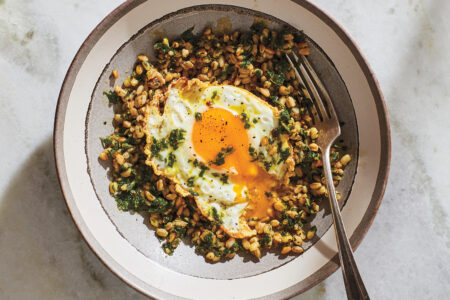
David Tamarkin’s recipe for Greens, Grains and Fried Egg works for any meal
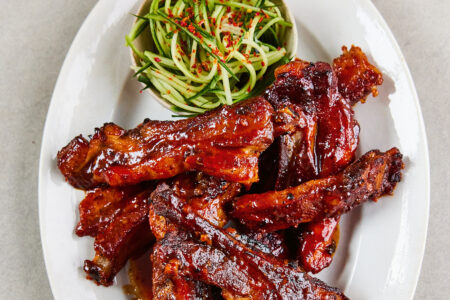
Slow-cooked, sticky-glazed pork ribs go with cucumber slaw in Sam Way’s recipe