Chamber president reflects on first year
Lavern Squier became president and chief executive of the Lawrence Chamber of Commerce in July 2003. It’s been a busy first year — getting to know the community and beginning initiatives to retain local businesses and create a bioscience industry.
He sat down with the Journal-World to reflect on those first months and the challenges ahead:
What have been some of the highlights of your first months here?
In some respects, pretty traditional standard fare in terms of meeting staff, getting introduced to the other groups in the community that our board of directors and staff interact with. That ranges from city officials, county officials, school district officials, university officials — it’s a broad list, goes far and wide.
It’s been very interesting to come in contact with those folks, get to know them. Really, I think, not only to get to know them and to carry what would seem to be the traditional chamber message to them, but to start to develop some sense of identity about what our message was, what flavor we were going to put into the equation. People had some desire to see the chamber be a little bit different than maybe it had been before. So we’re trying to accommodate those internal desires.
When you say ‘different,’ what do you mean exactly?
If you look at the information we’re preparing, that’s about to come on out, relative to our fiscal year change that’s effective April 1, we’ve gone through a strategic planning process. We’ve gone through a re-think and reallocation of staff duties internally. We’ve looked at processes internally. We’ve obviously changed the logo and look and feel of the organization. We’re changing the detail we’re giving to certain topics and groups, expanding some of those affiliations. We’ve reinstated — not during my time, but just prior — some of the agricultural focus, small-business focus. It’s something we want to pay more attention to.
All those characterizations are about making us a better organization that’s more responsive to membership and relative to the community at-large.
You’ve also had a chance to experience a fair amount of Lawrence politics since you’ve been there. Specifically the living wage — the chamber made some movements in its own position toward the end of that debate. … What are your feelings about that process?
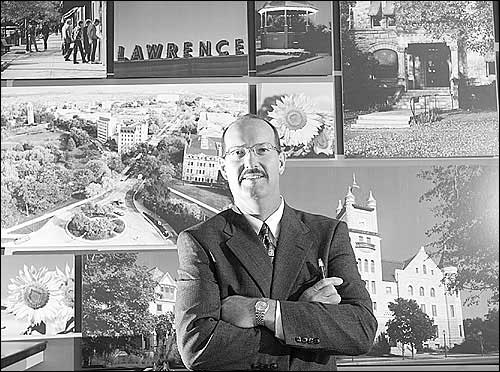
LAVERN SQUIER is president and CEO of the Lawrence Chamber of Commerce
I think to recap the experience, one would really have to look at the intent of the chamber in that process. I think the intent was to have the chamber’s thoughts and wishes somewhat recognized or appreciated under the process. We want to make ourselves a responsible party at the table — and those are designations you typically have to earn. You don’t just get those thrust upon you in some fashion. So I think the upshot of it all is the chamber found a way to deal with an issue with some good representation of our members and our thought process.
We could have stood by and let the issue move on through and take its course, and been a vocal opponent of the process. I don’t think that would’ve done certainly as much as what was done.
The living wage seems to be some basis for some cataclysmic moment in people’s analysis of the chamber, that that’s who we are. I don’t think it is. It is just one topic that moved through during the chamber’s 125-year history — if you look at the chamber overall, we’re about so much more than a given topic.
What are some of those other topics that you feel the chamber is becoming about?
I don’t think we’re only about topics. We should be about who we are — we represent a significant number of business people, business interests in the community. But we are not exclusively a business organization. We have a growing number of individual representatives, if you will, individual members of the chamber. … You’ll have a growing segment of individuals in the community that care about what’s going on, want to stay in touch, want to have networking opportunities. They attach themselves to a group like ours — that’s a fundamental change.
How does that affect what you do?
I think it makes you aware there are a variety of interests at play on any given topic. This is how you relate your structural life back to the events of the day. You may have more interests, more varied interests, at the table. That’s not to say that anyone is ignored or anyone is not appreciated, or anyone is overappreciated. You just have a growing, varied group to keep informed, to talk to, to share with — and that’s really part of our goal is to get better at communicating with our membership. That’s a challenge.
The chamber is largely responsible for economic development efforts of Lawrence and Douglas County, has a contract with the city and county. There’s been some talk, and it sounds like it’s going to become an issue with the city at least, about creating an economic development planner. Is that something you’ve heard about, is that something you’ve given thought to?
Yes, we’ve heard about that and we’ve thought about that. It’s not clear what the job functions would be, how it would parallel or complement what we’re doing. I don’t think the basic structure is going to change. I think the investors — the city, county and the chamber — are happy with the partnership we have in place. That’s something I do want to emphasize, that it is a three-way partnership to have that activity. If the city wants to augment that in some fashion, that’s their prerogative. The details are not to the point to have any firm view.
What are some of the exciting things you see coming up this year?
I think the biosciences initiative, if it can move through Topeka, I think that initiative is going to propel us as a state and community down the economic road in such a way that is going to spur action on task levels, land issues, vocational training and technical training issues. It’s going to cause us to get in gear on a number of those issues … it’s going to propel us forward, and it’s a great thing.
I’m really excited to see us moving on small-business issues. Cathy Lewis, our VP for membership services, has done a good job creating more substantive programming for small businesses, and that’s something that’s critical for us to do. Over 80 percent of our membership is classified as small business. We want to serve them in a greater way.
Our communications processes are going to continue to improve as we move forward. We’ve made some significant changes so far; we’ll make more.
City Government

Developer seeks incentive from City of Lawrence to build 131 units of housing near Wakarusa and Queens

Lawrence city leaders will consider whether to keep Community Building open, make 2 other rec centers free to access
A STAR Bond application raises questions for city leaders about Costco and housing west of the SLT
Soccer gear honoring Lawrence history’s all-star team is now on sale as part of city’s public art exhibition
To honor public servants, Lawrence’s July 4 celebration will have a whole gallery of their photos on display; submissions open now