Community service turns lives around, spruces up county
The sound Raymond Williams hears all day every day at work is that of more than 50 dogs barking inside cages. They let out high-pitched yelps and deep, throaty woofs. The sound never stops, and it echoes off the concrete-block walls all around him.
“I love it,” said Williams, 47, an employee of the Lawrence Humane Society, 1805 E. 19th St. “It’s like music to my ears.”
Sometimes, as he cleans the waste out of the dogs’ cages, he barks back at them.
Perhaps one reason Williams identifies so well with these stray dogs is that he, too — along with other people who help keep the Humane Society clean — has spent some time in the proverbial doghouse.
Williams owes his job to the fact that, in 2002, he was charged with making a criminal threat. He began doing community service as part of a deal with prosecutors to have the charge dropped, and while he was working off his hours at the city garage, a supervisor saw he was a hard worker and helped him get the Humane Society job.
He’s one of thousands of Douglas County residents in recent years who have had to scrub, pound and squeegee their way back into society’s good graces by doing community service. Since 1997, these workers have contributed an average 11,600 hours of labor per year in Douglas County: the equivalent of a staff of 5.5 full-time workers.
They improve the community by building houses for Habitat for Humanity, painting over graffiti and picking up trash on the roadside. And though some people, including the mother of a 13-year-old girl raped last summer, say it’s not a tough enough punishment in certain cases, others say community service is an example of the justice system at its best.
“What will society gain from (offenders) being put in prison?” asked a ninth-grader at South Junior High School ordered to community service for vandalizing schools. “If people get put into community service, maybe they’ll get this ethic to help people.”
The teenager, who’s busy this spring working off 50 hours at the Humane Society, spoke on condition that his name not be used.
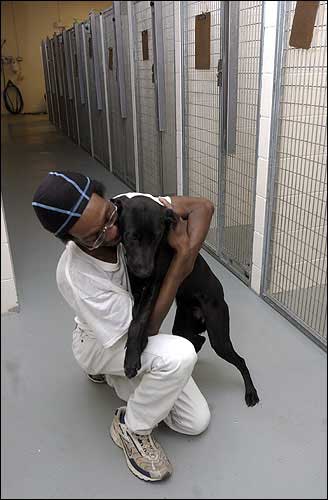
Raymond Williams, 47, plays with one of the dogs as he cleans cages at the Lawrence Humane Society. Williams got his job at the Humane Society through his experience performing community service after a run-in with the legal system.
“It’s a great thing to do if you think about it. This is a nonprofit place. You come here and you just start helping people out,” he said.
In the news
Most commonly, people doing community service are working with prosecutors to have their charges dropped or have been ordered there by a judge as a condition of probation.
“We provide a big chunk of labor for the surrounding communities,” said Tony Jones, the county employee who matches offenders with agencies that need workers.
Jones sees between 300 and 600 cases closed per year, and he expects to be busier in years ahead. One reason he cited is Dist. Atty. Christine Kenney’s decision last week to begin offering diversion agreements to people caught using “hard” drugs such as methamphetamine and cocaine. If they want to have charges dropped, they’ll be required to serve between 50 and 100 hours of community service, among other requirements.
| About Douglas County’s community service program:¢ Started in 1982.¢ The program, housed in the basement of the Judicial & Law Enforcement Center, 111 E. 11th St., takes referrals from places including Douglas County District Court, Lawrence Municipal Court and Douglas County District Attorney’s Office.¢ Common work assignments include cleaning roadsides, building homes with Habitat for Humanity, removing graffiti and working at the Lawrence Humane Society.¢ Between 1997 and 2003, the offices provided the community with 81,441 total labor hours. That’s $58,172 worth of labor per year when calculated at $5 per hour — the normal rate applied when people work off court fines by doing community service.¢ Here’s what city prosecutor Jerry Little says about the program: “It costs $50 a day to house somebody in custody. With community service work, they’re contributing to the community rather than taking from the community.” |
One high-profile person who might be lending a hand around Lawrence soon is John Randle, the Kansas University running back, who was sentenced last week for attempted theft, disorderly conduct and having a fake driver’s license. A judge allowed him the option of working off $250 in fines by doing community service at a rate of $5 per hour, city prosecutor Jerry Little said.
Two of the most prolific workers in coming years will be 19-year-olds Brian K. Ussery, of Tonganoxie, and William N. Haney, of Lawrence, both of whom were sentenced earlier this year to probation and so-called shock time in jail for raping an intoxicated 13-year-old girl. As a condition of probation, District Court Judge Paula Martin ordered them each to serve 500 hours of community service in the next five years.
“When you have that many hours, it’s not just an add-on,” said Ron Stegall, the county’s chief executive probation officer. “You have to start making it a big part of your life.”
Hard work or cakewalk?
The presumed penalty under state law for rape is at least 13 years in prison, but Martin made an exception for Ussery and Haney, in part based on her finding that the victim was harmed less than some rape victims and was an “active participant.”
Rape-victim advocates called the sentences a slap on the wrist, but Ussery’s attorney, Michael Clarke, isn’t convinced his client has it easy. Whenever his clients charged with driving under the influence have a choice between a two-day jail sentence or 100 hours of community service, he almost always advises them to go to jail.
“I tell them our jail really isn’t that scary,” he said. “It’s not so much that community service is necessarily that hard to do, but it is hard to get it done.”
By keeping Ussery in the community, he might be able to put his drywall expertise to work building homes, Clarke said.
“It’s a win-win, whereas putting him in jail is just a waste,” Clarke said.
The girl’s mother, however, said that what her daughter is going through — harassment on the street and at school, episodes of self-mutilation — is far worse than trying to juggle a schedule to include community service.
“There could be a lot of good accomplished from community service, but I also feel that this should be reserved for specific offenders,” she said. “I think the impact on the victim should be evaluated extensively in all cases. In our case, it was not. Rape is a serious crime, and I do not think Haney and Ussery’s sentences reflect that.”
One person who says community service isn’t that difficult is the ninth-grader who’s working at the Humane Society. He sometimes brings homework with him.
“It’s a nice place to work,” he said. “People don’t treat you like a criminal.”
Finding redemption
By far the worst part about the job, he said, is “all the poop.”
“It’s like a shock everytime I go back there” to the dog cages, he said. “If you think about the smell, it smacks you in the face.”
The Humane Society, with its steady population of animals in need of companionship and clean cages, is one of the most popular places for people to do community service every year.
“These animals don’t care what people have done,” said executive director Midge Grinstead. “They don’t care about anything except licking their faces and being their buddy.”
Some people, especially teenagers, arrive with a bad attitude, she said. But she boasts at least two people on her staff who have turned community service into a steady job.
One is Susie Seetin, 45, Lawrence, who was charged with DUI and assigned last year to the Humane Society to complete 40 hours of community service. She now has a job at the agency taking care of cats.
“What I did was wrong, no matter how I try to rationalize it, and I needed to pay for it,” she said. “But I do like it here.”
Another success story is Williams, who doesn’t complain about the scent of his surroundings.
“I love it all,” he said.
As he works his way along the rows of dog cages each day, he wields a squeegee on a stick, a power washer of the kind used at a car wash, and a two-piece tool consisting of a pan and a scraper.
Whenever dogs comply with his requests to move here or there as he cleans, he always tells them, “Thank you.”
City Government

Developer seeks incentive from City of Lawrence to build 131 units of housing near Wakarusa and Queens

Lawrence city leaders will consider whether to keep Community Building open, make 2 other rec centers free to access
A STAR Bond application raises questions for city leaders about Costco and housing west of the SLT
Soccer gear honoring Lawrence history’s all-star team is now on sale as part of city’s public art exhibition
To honor public servants, Lawrence’s July 4 celebration will have a whole gallery of their photos on display; submissions open now