Middle East journalists visit KU
State Department program brings reporters to U.S. to further understanding
Rana Kamshad didn’t think twice when her Kuwait City newspaper was looking for volunteers to cover the recent war in Iraq.
She started packing her bags.
“It was a good experience,” she said. “It was history.”
Kamshad, 24, and Nada Al-Wadi, a 23-year-old reporter from Bahrain, spoke Friday at Kansas University’s school of journalism as part of a State Department program that sponsors visits by young reporters from throughout the world.
The entourage initially was to include six journalists, but the other four didn’t receive their visas in time for the trip.
The women arrived Sept. 6 in the United States and have toured media outlets in Washington, D.C., and San Francisco. They arrived Wednesday in Kansas City and will head to New York before returning home. At KU, they talked with a journalism class, toured the University Daily Kansan and KUJH-TV, and met with professors.
“The program’s goal is promoting understanding of the world to potential future leaders,” said Nabil Mohamed, a State Department escort and interpreter.
Much of their KU visit was spent discussing coverage of the war in Iraq. Kamshad, who writes for the Arabic daily Al Seyassah, said she spent about two weeks in Iraq with U.S. troops, often stopping in regions the day after the front lines arrived.
“I saw things getting better and better,” she said. “I saw Iraqi people cooperating with Americans. They want peace. … They just want to live.”
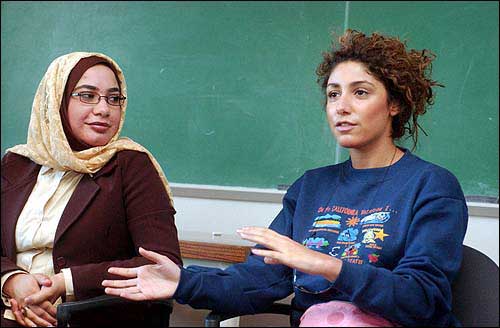
Nada Al-Wadi, left, a native of Bahrain, listens to Rana Kamshad, a Kuwaiti, explain some of her views about journalism to Kansas University students at Stauffer-Flint Hall. The two journalists visited Friday as part of a State Department program.
Al-Wadi said her newspaper, the independent Arabic daily Al Wasat, had faced censorship troubles during its coverage of the U.S. fight against terrorism in Bahrain, a small island nation of about 670,000 off the coast of Saudi Arabia.
Bahrain’s minister of information decreed that newspapers couldn’t write about the court proceedings of an accused ring of al-Qaida terrorists there.
The paper’s editor ignored the ban, and now faces court proceedings that could lead to a fine, Al-Wadi said.
“We hope our media will get as independent” as American media, she said. “It is, but you cannot do everything you want. There are some rules you cannot ignore.”
Kamshad said Kuwait’s press freedoms were similar to those in the United States.
Both women said they were surprised how little international news was in American newspapers. Kamshad said her paper typically had 12 to 14 pages of international news each day.
But she said she considered U.S. coverage of the war in Iraq generally fair and accurate.
“They were trying their best, as were all of us,” she said. “Dealing with the military is hard.”
Kamshad said she thought the split among Middle Eastern people over the war resembled splits in the United States and around the world.
“Not all people in the (United) States agreed with the war, as it was with people around the world,” she said. “It was the same way in Arab countries.”
Personally, she supported the war.
“I think it was the last solution to happen,” she said. “The (United) States tried to use diplomatic solutions to get rid of Saddam. What else can they do?”
Tom Volek, a journalism professor who arranged the women’s visit, said providing an international perspective on journalism was especially important after the 9-11 terrorist attacks and the war in Iraq.
“We need to understand what’s going on not through our own American eyes, but through the eyes of the people who live there and work there,” Volek said. “That’s why these two ladies are so important to us.”
City Government
Developer seeks incentive from City of Lawrence to build 131 units of housing near Wakarusa and Queens

Lawrence city leaders will consider whether to keep Community Building open, make 2 other rec centers free to access
A STAR Bond application raises questions for city leaders about Costco and housing west of the SLT
Soccer gear honoring Lawrence history’s all-star team is now on sale as part of city’s public art exhibition
To honor public servants, Lawrence’s July 4 celebration will have a whole gallery of their photos on display; submissions open now