Policy restricts medical care
Despite new federal rule, LMH not planning to change emergency room procedures
For sick people without health insurance, hospital emergency rooms have been the place of last and sometimes first resort.
But that safety net for the poor and the working poor, critics say, has been weakened by a new Bush administration policy that is winning applause from hospital administrators.
“Everybody always said the emergency room is the last resort, because they don’t turn anyone away,” Michael Fox said. “Now they’ll be able to turn people away.”
Fox is an associate professor of health policy and management at Kansas University’s School of Medicine in Kansas City, Kan.
Tom Bell, senior vice president of the Kansas Hospital Assn., disagreed.
“I don’t think that’s true at all,” Bell said. “The law is very clear in its essence: When you come to an emergency room, the hospital’s obligation is to treat the condition you present if it’s an emergency condition.”
Area hospitals say they plan no big shifts in their emergency room policies.
“The changes won’t affect the way we do things,” said Janice Early-Weas, a spokeswoman for Lawrence Memorial Hospital.
Busy places
Emergency rooms in and around Lawrence are busy places.
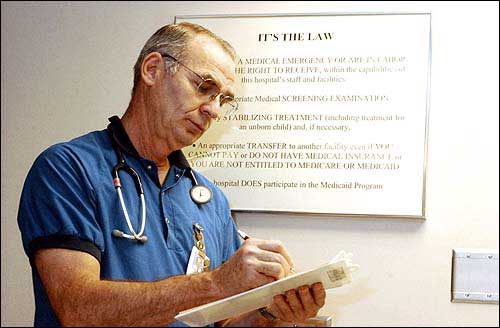
Although the Bush administration is changing rules for how hospital emergency rooms handle patients, Lawrence Memorial Hospital's policy is that no one will be turned away. Registered nurse Bob Hixson, of Ozawkie, reads over a patient's information under a statement of LMH policy.
LMH saw more than 28,000 patients in the emergency department in 2002, a rate of more than 75 people per day. Ransom Memorial Hospital in Ottawa treats an average of 8,500 to 10,000 people a year, and KU Med in Kansas City, Kan., saw 38,774 people in the year ending June 30.
None of the hospitals could say how many patients ended up unable to pay for emergency room care, but LMH and KU Med said their costs of treating all patients who can’t or don’t pay are rising quickly. LMH has absorbed $1.7 million in “charity care” so far in 2003, officials said, $300,000 more than expected.
“We are seeing more people at the hospital who can’t afford care,” Early-Weas said.
“Obviously with the economy, with a lot of people being out of work, pressures on people who can’t afford insurance, the emergency department is obviously a place people seek treatment — not always for emergency treatments,” she said.
In 1986, Congress passed the Emergency Medical Treatment and Active Labor Act — EMTALA — to prevent hospitals from dumping patients to avoid those costs.
Under the law, hospitals must provide a medical screening to anyone seeking care. If they need treatment, the emergency room must treat and stabilize the condition, without concern for payment.
The new rules:
l Clarify that patients who go to a hospital’s satellite clinics for treatment don’t have treatment rights there under EMTALA.
l Outline the definition of “emergency department” to include only departments licensed for emergency care, publicized as an emergency room, or that provided emergency care in at least one-third of all its outpatient visits.
l Give hospitals the power to decide which physicians will be on call to respond to emergencies; hospitals will no longer be required to keep specialists on call.
Concerns
That last provision particularly worries Fox.
“The downside is, what this effectively means is that people will be turned away from hospital emergency rooms if they have a condition that requires specialty care,” he said. “It provides them with an excuse to turn people away.”
Dr. Matt Lewis is co-director of medical care for Health Care Access, a Douglas County agency that helps the poor with their medical needs. He shares Fox’s concerns.
“Our main concern is that it may discourage people from seeking health care who really need it,” he said.
At LMH and Ransom, however, officials said there were no plans to change on-call policies for doctors and specialists.
“The rule is still the same as it’s always been, that everyone’s entitled to a medical screening,” said Kelly McDermeit, a spokeswoman for Ransom. You don’t turn away anybody because of an inability to pay.”
Early-Weas agreed.
“I think these changes are a little more appropriate to urban settings where there are more hospitals,” she said. “The changes won’t affect the way we do things.”
Skyrocketing visits
KU Med is such an urban hospital. It has been buffeted during the last year by the closure of two other Kansas City hospitals, Bethany and Trinity, that sent its emergency room visits skyrocketing by 30 percent.
“We are just now going through the official thing,” said Dennis Minich, a spokesman for the hospital. “We’re trying to figure out where we are in this.”
Even if local hospitals continue to provide the same service, though, Lewis and Fox warned there could be fallout at the national level.
“It’s taking away a safety net provider for many people — which shouldn’t be a safety net,” Fox said. “People should have access to better quality care.”
City Government

Developer seeks incentive from City of Lawrence to build 131 units of housing near Wakarusa and Queens

Lawrence city leaders will consider whether to keep Community Building open, make 2 other rec centers free to access
A STAR Bond application raises questions for city leaders about Costco and housing west of the SLT

Soccer gear honoring Lawrence history’s all-star team is now on sale as part of city’s public art exhibition
To honor public servants, Lawrence’s July 4 celebration will have a whole gallery of their photos on display; submissions open now