Little-known KU museum turning 15
Curator Paul Rehak wants to take the wraps off the Wilcox Classical Museum, a sleepy Kansas University institution that is hidden in plain sight.
“Unfortunately, we don’t get many people walking in off the street,” said Erika Dickey, a graduate student and guard at the museum. “I frankly don’t think even people who would be interested know about it.”
Most days, Dickey said, no more than 10 or 20 students — most of them assigned to do so — visit the museum, which is tucked inside Lippincott Hall and advertised with a small sign out front.
As the museum, which celebrates ancient Greek and Roman life, marks its 15th anniversary today, Rehak is looking to increase awareness of the collection.
“We want to get the word out,” said Rehak, assistant professor of classics.
The museum opened in October 1988. It has two sections. In one are displayed genuine antiquities, including tiles with Latin and Greek inscriptions, historical coins and other items, such as lamps.
It is the other section that typically gets the most attention. It is dedicated to plaster of Paris casts of famous Roman and Greek statues, including the “Venus de Milo” and sections of the frieze from the Parthenon.
Historical copies
Betty Banks, retired professor of classics who initially organized the Wilcox Museum, said the first of those casts arrived on campus in 1888. In the late 1800s and early 1900s — when travel was more difficult and high-quality photographs were harder to come by — many museums and universities ordered casts to teach visitors and students about classical art.
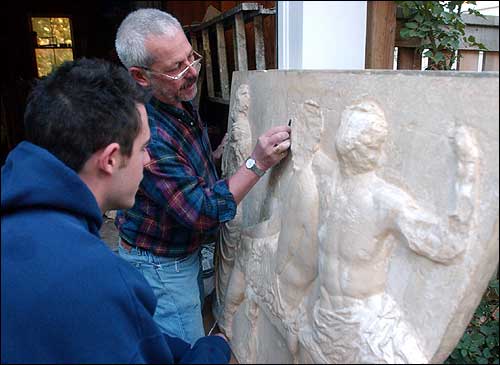
Kansas University junior John Senn, left, of St. Louis, and classics professor John Younger clean a plaster cast panel that is part of the Wilcox Classical Museum collection. The little-known museum at KU is marking its 15th anniversary today. Senn and students in assistant professor of classics Paul Rehak's archaeological discovery class are restoring additional pieces that have been in storage, to allow the museum to have a rotating collection.
The casts were on display in Old Fraser Hall until the building’s demise in 1965. They were moved to a storage facility on west campus, where a leaky roof significantly damaged the plaster of Paris.
Then, after the school of law moved to the newly constructed Green Hall, the classics department secured a portion of the first floor of Lippincott to again display the casts and other items from the collection.
After more than a year spent restoring the damaged casts, the museum opened. It is named for A.M. Wilcox, a former professor of classics.
Teaching facility
Today, the museum gets between 2,000 and 3,000 visitors a year, mostly students assigned to go there for classes.
“It’s a modest facility, and its purpose is primarily pedagogical,” Banks said. “But it turned out to be useful to more departments than we ever imagined.”

 Photos: Wilcox Classical Museum
Classics students tour the museum to learn about the era. Art students learn about the pieces and use the casts to learn to draw nudes. Students studying Greek and Latin use the inscriptions to learn about the languages.
“I think it offers a lot more than an art history book,” Dickey said. “This is actually a 3-D view. As a student you get a much better understanding and appreciation of the level of art at the time.”
Looking to the future
Now, Rehak said, it’s time to share the museum with more people.
He came to KU in 2001 and pledged to spend two years with the collection before making any major changes.
Now, he wants to start public programs based on the museum, a docent program and an internship program for museum studies students.
One of Rehak’s classes is restoring additional pieces that have been in storage, to allow the museum to have a rotating collection. Most of the pieces on display haven’t changed since the museum opened in 1988.
The casts themselves — and not just the statues they represent — are becoming a part of art history, since only about a dozen cast collections exist in the United States.
“A lot of them ended up in fraternities and sororities with mustaches painted on them, that sort of thing,” Rehak said.
Another of Rehak’s goals is to restore the museum’s hours. It was open 40 hours a week until budget cutbacks forced the elimination of the full-time guard position last year. Now, students staff the museum from 1 p.m. to 5 p.m. Monday though Friday.
Though he’d like more public attendance, Rehak said the museum’s primary focus would continue to be on students.
“The collection was designed as a teaching collection,” he said. “We’re not trying to outdo the Metropolitan Museum of Art.”
City Government
Developer seeks incentive from City of Lawrence to build 131 units of housing near Wakarusa and Queens

Lawrence city leaders will consider whether to keep Community Building open, make 2 other rec centers free to access
A STAR Bond application raises questions for city leaders about Costco and housing west of the SLT

Soccer gear honoring Lawrence history’s all-star team is now on sale as part of city’s public art exhibition
To honor public servants, Lawrence’s July 4 celebration will have a whole gallery of their photos on display; submissions open now