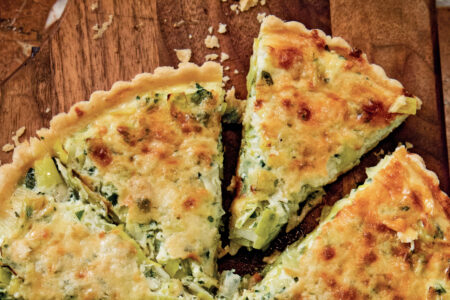
Holiday traditions abound
Holidays, being annual events, measure time. But more than that, holidays provide a yearly benchmark of all things family, a sort of annual stock-taking of our primary relationships in the present — and of our relationship to a collective past. These networks form the basis of the gratitude the Thanksgiving holiday is supposed to celebrate.
It’s no coincidence that the ritual at the heart of Thanksgiving, the mother of all family holidays, is food. The Thanksgiving meal is an act of communion, if there ever was one. On this one day of the year, more than any other, families assemble around their tables and break bread in a highly ritualized way.
The menu is pretty much set in stone, a matter of tradition, and many of us appear loath to tinker with it in any way. Turkey, stuffing, gravy, potatoes — these items define the Thanksgiving meal. Within families, however, the small details become ritualized as well: the ingredients for the dressing, the kind of potatoes and the variety of complementary dishes to be served, and the specific recipes for all of the above.
Don’t mess with menu
I once heard a gasp in a relative’s kitchen when I proposed doctoring the stuffing mix with fresh rosemary I had brought from home. While my suggestion certainly wasn’t revolutionary, I realized in that moment that I was tampering with another person’s expectation for what a Thanksgiving meal should taste like.
After all, the whole point of holiday rituals is to do the same thing in the same way every year in order to reassert our sense of family continuity.
In most families, certain relatives become associated with specific Thanksgiving foods. Aunt So-and-So always brings the pie and her sister-in-law always does the relish tray. And ever was it so. Thanksgiving has a way of transforming a person’s identity into a side dish, and even the people most directly affected don’t seem to mind.
Day of reflection
The Thanksgiving holiday also is a time to take roll and reflect. Looking around the table, we note who has always been there, who is new, who no longer is with is. These are the people who love us best, past and present — or at least the people who tolerate us best. The bond among those who sit around the table, whether based on blood or marriage, has been reinforced by all the turkey dinners over the years, when we have come together to eat the same thing time and time again.
I’ve often wondered how anthropologists and historians, a thousand years hence, will regard U.S. Thanksgiving customs. People unfamiliar with the idea of Thanksgiving might be puzzled by its origins. What will they make of the fact that a tale about a friendly dinner between some pilgrims and American Indians has completely overshadowed the formal origins of Thanksgiving, namely that the 16th president decreed the holiday in order to reunify a nation torn apart by civil war? Why is one story more romantic than the other?
And what will the anthropologists and historians make of this turkey thing? Maybe it will be seen as a form of ritualized animal sacrifice. In this version, the dining room table becomes the altar. Stuffing will be harder to explain.
The Thanksgiving holiday simply doesn’t make sense unless we view it sentimentally and take the bond of family into account.
In this vein, one of the genealogy addicts in my family e-mailed the other day to report that my maternal grandfather was a seventh cousin of Richard Milhous Nixon, by virtue of a common relative who died in Maryland in 1715. The genealogist noted that various members of our family might be amused or even appalled by this news. Regardless of our individual reactions, though, everyone who received the e-mail was immediately swept up in a common bond that transcended political difference.
Many of us care deeply about such things. We attach great meaning to our lineage, to belonging, and that’s what Thanksgiving is all about.
Food
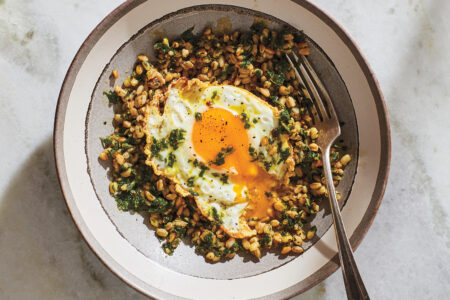
David Tamarkin’s recipe for Greens, Grains and Fried Egg works for any meal
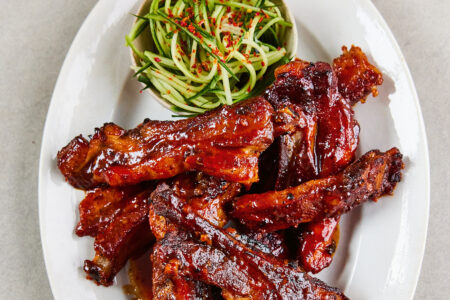
Slow-cooked, sticky-glazed pork ribs go with cucumber slaw in Sam Way’s recipe