Raising rhubarb
North Lawrence resident has grown treat for decades
Call him Rhubarb Bob.
Charles R. Snow — most folks just call him Bob — has been growing rhubarb, among other fruits, vegetables and flowers, on land in North Lawrence that he has owned since 1946.
And year after year, area residents have been showing up to buy his homegrown rhubarb, fresh from the garden.
Most people buy 10 or 20 pounds of it at a time. Some buy even more.
“I sold to the fire chief from Ottawa,” says Snow, 82, who’s lived in North Lawrence all his life, except for a stint in the U.S. Army during World War II.
“He used to come every year and buy 75 pounds of it.”
Snow is a prodigious gardener. On his 2.5 acres of land just north of the levee near the Kansas River, he grows peas, beets, asparagus, spinach, potatoes and strawberries. In fact, before he sold off a few of his acres, he used to have 7,000 strawberry plants. He planted every one of them himself.
Snow grows flowers, too. His property is ablaze with irises, poppies and peonies.
But if there’s one crop in particular that Snow knows well, it’s rhubarb.
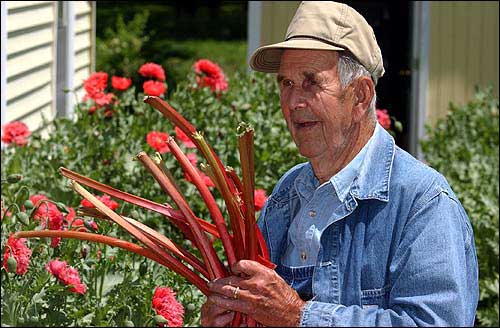
Charles Snow, Lawrence, sells rhubarb that is grown on his 2.5 acres of land. Snow says he has grown rhubarb since 1946 when it was worth 10 cents a pound. Now, he sells it for per pound.
“Rhubarb starts Mother’s Day, about the 10th of May, and runs about 30 days. I set about four rows of it. I got into red rhubarb way back; I got it in Topeka. People like red rhubarb,” he says.
Rhubarb seems to be a taste of yesteryear. It’s mainly popular among older generations.
“Every time you read in the paper about some 80-year-old woman dying, you’ve lost a customer. That’s the way it is,” Snow says.
“I started growing rhubarb when it was worth 10 cents a pound in 1946. Now it’s a dollar, and people still like to buy it. But no young people buy it; they don’t know what to do with it. They come down off the levee and say, ‘What are those dark green leaves?'”
Why haven’t more young people developed a liking for rhubarb?
“Because they don’t have it at McDonald’s,” he says.
| Charles R. “Bob” Snow has been raising rhubarb, among other things, on his land in North Lawrence since 1946.For more information on Snow’s rhubarb, call at 843-5923. |
Healthful, versatile
Rhubarb tends to be underappreciated these days, agrees Susan Krumm, extension agent in family and consumer sciences with K-State Research and Extension-Douglas County.
“It’s easy to grow, and it’s always one of the first things out of the garden, and yet the problem is that young adults don’t know how to cook very much anymore, so they’ve never experienced it,” she says.
Yet it’s good for you, and tasty as well.
“Actually, rhubarb does contribute Vitamin C and fiber to the diet. It’s 95 percent water. I really like to use it with strawberries. With the sweet strawberries and the tart rhubarb, it makes for a nice combination.”
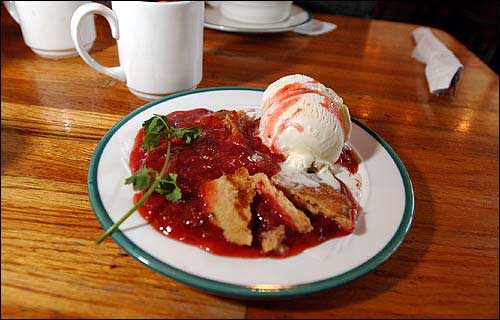
Rhubarb cobbler seems to be a hit at Free State Brewery. Ice cream tops off this cobbler that contains strawberries and rhubarb.
That’s an understatement.
Rhubarb and strawberries, paired over the years in countless homemade pies, are a flavor combo for the ages, like pizza and beer. They just go together.
Rhubarb’s also a great ingredient for jams and jellies, muffins, quickbreads and cobblers. Or even all by itself as a sauce.
“It’s so nice, because you can just use as much sugar (in it) as you desire. It’s a nice little side dish to complement a meal. It’s very easy to work with,” Krumm says.
There’s just a few things to know about rhubarb.
“You should look for fresh and firm rhubarb with a bright, glossy appearance. The stalks should have a large amount of pink or red color, although there are many good quality stalks that will be predominantly light green. Be sure that the stalk is tender and not fibrous,” Krumm says.
“You should avoid either very slender or extremely thick stalks, which are likely to be tough and stringy. You also want to avoid rhubarb that is wilted and flabby.”
Once you get your rhubarb home, refrigerate it. Then, just before preparation, wash it off in cold water.
And remember: Don’t eat the leaves.
“Rhubarb leaves contain oxalic acid that may cause lesions in the mouth if eaten. Some people will even say that it’s toxic,” Krumm reminds cooks. “You should only eat the stalks.”
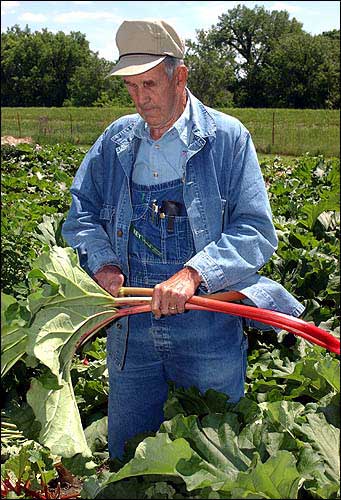
Charles Snow, Lawrence, holds a stalk of rhubarb. Rhubarb, which contains Vitamin C and fiber, can make a delicious summer treat.
Limited supply
Snow likes raising rhubarb because it’s easy to take care of and easy to handle. And customers are able to use it a variety of ways.
“People can it, they freeze it. It keeps real good,” says Snow, who worked 32 years as a shift supervisor at Astaris (formerly FMC), 440 N. Ninth St.
Even after decades of toiling among rhubarb in his garden, he still likes the taste of it.
“Rhubarb pie’s awful good. I wish I did have one in the house, I’d call you in right now. It’ll make you happy.”
If you want to buy some of Snow’s rhubarb, it’s a good idea to call ahead and let him know you’re coming. He’ll pluck it from the garden and have a bag of it waiting for you.
Snow will probably have some on hand for another week or 10 days, if you’re lucky. Word gets around fast.
“I put an ad every year in the Journal-World: ‘Rhubarb is ready — Bob Snow, 876 Oak.’ And that’s it.”
Food
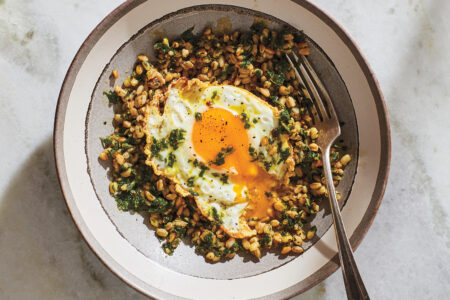
David Tamarkin’s recipe for Greens, Grains and Fried Egg works for any meal
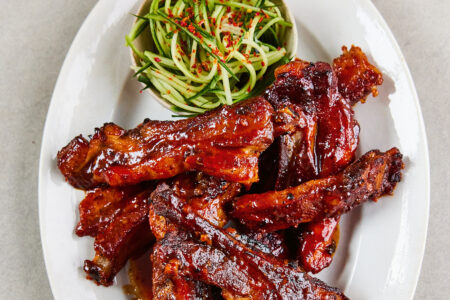
Slow-cooked, sticky-glazed pork ribs go with cucumber slaw in Sam Way’s recipe