U.S. jets strike Iraq
Precision attack aimed at top leaders
Washington ? War erupted Wednesday night as the United States launched dozens of Tomahawk cruise missiles and aimed 2,000-pound bombs at Iraqi leader Saddam Hussein and other “leadership targets” in Baghdad.
The strike was aimed at “decapitating” Saddam’s regime and specifically targeted him, his two sons and other senior leaders of the Baath Party and Iraqi Revolutionary Command Council, according to a senior Bush administration official.
Saddam’s fate was not immediately known, though Iraqi television early today broadcast what it said was a live statement by him. Looking wan and drawn, the man mentioned today’s date and vowed enduring defiance.
“We pledge in the name of the fighting people and its heroic army that we will confront the invaders,” he said.
U.S. forces also took control of the frequencies used by Iraqi state radio and began broadcasting messages in Arabic, officials said. The message said the Iraqi people’s day of liberation had arrived.
But a fearsome array of U.S. and allied troops and weaponry poised for action at the Iraq-Kuwait border did not appear to have been ordered into combat as of Wednesday night.
President Bush announced the attack in a four-minute television speech to the nation. “On my order, coalition forces have begun striking selected targets of military importance to undermine Saddam Hussein’s ability to wage war,” he said. “These are the opening stages of what will be a broad and concerted campaign.”
Minutes before the speech, an internal television monitor showed the president pumping his fist. “Feels good,” he said.
Shortly after his announcement, the State Department warned that U.S. citizens traveling or living abroad faced increased threats of terrorist actions and anti-American violence. “As a result of military action in Iraq, there is a potential for retaliatory actions to be taken against U.S. citizens and interests throughout the world,” the advisory said.
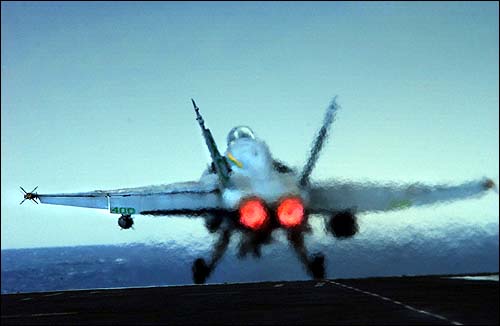
U.S. forces struck at Iraqi military leaders early this morning near Baghdad. Tomahawk land attack missiles launched from warships and precision-guided bombs dropped from F-117 stealth fighters lit up the sky over Baghdad. Above, an F/A-18 Hornet takes off Wednesday from the USS Harry S. Truman.
Targeting leaders
The missile attacks were an attempt to behead the Iraqi leadership without risking the civilian deaths and destruction that a full-scale war would produce, said the senior administration official, who spoke on condition of anonymity.
Another official, who also requested anonymity, said at least two Navy ships in the Persian Gulf and a submarine in the Red Sea fired three dozen Tomahawk cruise missiles. Following that, F-117 “stealth” attack planes carrying 2,000-pound bombs joined in the attack. The Tomahawk cruise missile carries an explosive half that size.
U.S. intelligence operatives had been in Baghdad and other parts of Iraq for weeks, tracking the movements of senior Iraqi officials, according to the administration official.
Air raid sirens sounded in the capital at dawn and anti-aircraft fire and explosions were heard across Baghdad, but calm appeared to return to the city shortly after the initial strike.
The attack — far less massive than the strike many thought would ignite the war — came after a lengthy meeting between Bush and his national security advisers that began at 2:40 p.m. CST Wednesday and broke up at 7:20 p.m.
Defying predictability
In the end, presented with credible intelligence information suggesting that Saddam was vulnerable, President Bush made the decision to authorize the strike.
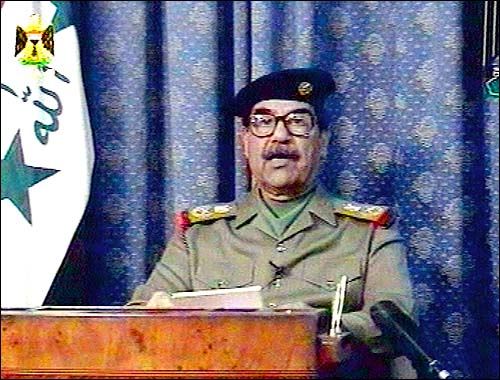
Iraqi President Saddam Hussein appears on Iraqi television today, a few hours after the first U.S. cruise missiles and bombs fell on Baghdad. In the nationally televised address, Saddam accused the United States of committing a shameful crime by attacking Iraq.
“They decided not to wait, to go after Saddam Hussein now,” said Loren Thompson, a defense analyst with well-placed sources in the Pentagon. He said administration officials feared missing an opportunity to kill Saddam.
And so, the second Gulf War — a pre-emptive war everyone saw coming and no one could stop — erupted about 5:30 a.m. local time, 8:30 p.m. CST.
That was about 90 minutes after the 8 p.m. Wednesday deadline set by the president for Hussein’s capitulation passed without any indication that he had fled into exile.
Retired Air Force Gen. Charles A. Horner, commander of all allied air power in the first Gulf War, said the strike illustrated that U.S. military officials are determined not to be predictable.
But he said the larger, more powerful and sustained war was likely to start very soon. “You’ve got to go on the ground to really convince the Iraqis we mean business,” he said.
Welcome to the front
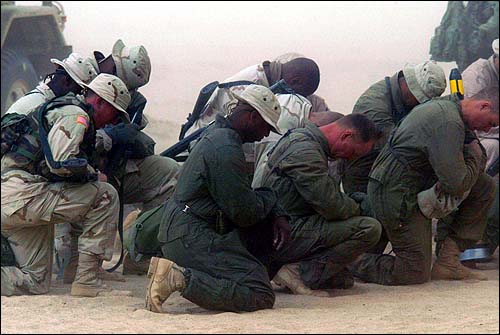
Tank crews from the Alpha Company 4th Battalion 64 Armor Regiment pray during a heavy sandstorm before convoying to a position near the Iraqi border. The troops were ordered Wednesday to reposition to locations near the border as President Bush's deadline for Saddam Hussein to leave Iraq approached.
Tens of thousands of American and British soldiers and Marines prepared to do just that, rolling to within 100 yards of Iraq where they remained throughout the day awaiting orders to cross the border.
“Welcome to the front line,” Army Maj. Frank McClary told officers from the 3rd Infantry Division as they stood at a breach in the fence that separates Kuwait and Iraq.
No Iraqis were visible and a U.N. guard post about 500 yards across the flat, featureless border appeared abandoned. Dozens of Bradley fighting vehicles and Humvees idled nearby. Large American flags flapped in the desert wind.
A few miles away, soldiers of the 101st Airborne Division completed a pre-combat ritual: They shaved their heads. “That means they are locked, loaded and ready,” said Army spokesman Max Blumenfeld. “This is their D-Day.”
U.S. officers said Army engineers cutting holes in the border fence were startled when two Iraqi soldiers surrendered well before hostilities began. The Pentagon reported that at least 17 Iraqis surrendered to allied forces rather than face U.S. forces.
Defensive strategies
Throughout Kuwait U.S. troops stepped up preparations against early Iraqi attacks on staging areas, sabotage of Iraqi oilfields and possible terrorist attacks. At Camp Virginia, 45 miles from the border, concern grew over a possible attack by Iraqi missiles. Many of the 7,000 soldiers there became visibly tense.
“If we have a Scud attack tonight, we need to meet back here after,” Col. John Gardner of the 7th Combat Support Group told his staff. “I need to know you’re safe.”
Beginning today, Air Force personnel on bases in the region will be required to wear flak jackets and helmets whenever they are not inside secure buildings, according to Air Force Capt. John Sheets. They already were carrying gas masks, bio-chemical suits, field gear and antidotes for nerve agents.
In addition, 75 American oil-fire experts began arriving in northern Kuwait in case Saddam blows up the Rumailah oilfields in southern Iraq. In 1991, his forces torched 700 Kuwaiti oil wells.
A towering sand storm blanketed the region Wednesday, but U.S. Marine officers said it would subside by mid-day today. In any event, it was not likely to be a “showstopper” if Bush ordered a wider attack, one officer said.
Army Gen. Tommy Franks, the commander of all allied forces in the Persian Gulf region, returned Wednesday to his forward base in Qatar after a meeting in Saudi Arabia. Throughout the day, military planes roared north from Qatar’s airfield, apparently bound on surveillance and training missions.
Pre-invasion strikes on Iraqi artillery batteries in southern Iraq intensified Wednesday as U.S. planes used precision-guided bombs to attack 12 positions within range of allied forces.
About 10,000 armored and other vehicles were mustered to roll into Iraq from Kuwait, according to Maj. Gen. Buford Blount III, the 3rd Infantry Division’s commander. Two hundred of those vehicles could be lost to the rough terrain, he said.
Defections expected
The Iraqi military has about 389,000 troops, but U.S. Army officials believe that only the 15,000 elite Republican Guard troops may be loyal enough to fight to the end.
U.S. officials believe thousands of others will defect during the first hours of bombing.
“Some will defect immediately and go to their homes,” said one Army official, who requested anonymity. “Others will wait, knowing that if they turn themselves in as POWs, they’ll get a good meal.”
Standing at the border, the 3rd Infantry Division’s McClary said his 1st Brigade Combat Team would secure attack lanes. His soldiers also were equipped with bridging equipment, needed to cross two ditches dug on the Iraqi side of the border.
“Once we cross here, we’re rolling,” said McClary, 39, of Andrews, S.C. “Once we cross the international border, it’s a fight from there.”
Apache Company of his 1st Brigade Combat Team was assigned to push up to the border fence, establish a defensive screen and wait for the order.
“I don’t know whether to be excited or nervous,” Spec. David M. Beebe, 20, of Gadsden, Ala., said as he sat atop an M113 armored personnel carrier. He used binoculars to scan the other side of the border.
“Now, we are waiting for word from higher,” said 1st Sgt. Michael “Todd” Hibbs, 36, of Boise, Idaho.
As darkness fell and sentries took to their posts, Hibbs sent a final message of the night to his troops. He told them to get some rest.
“You’re going to need it tomorrow,” he said. “We’ve got some long days coming up.”
National
Man pleads guilty to killing a top Minnesota Democrat and her husband
New tornadoes outside Chicago as severe storms pummel the Midwest
Feds won’t seek death penalty in plea deal with man accused of killing top Minnesota Democrat
NASA unveils astronauts to test tech for future moon landing
Social Security’ fund faces shortfall one year earlier than expected
WASHINGTON (AP) — Social Security 's retirement trust fund is projected to face a funding shortfall in 2032, a ...