Economy cools Downtown 2000
Project creates tax decision for City Hall
Lawrence taxpayers may not know it, but the empty buildings and undeveloped lots of the Downtown 2000 project in the 900 block of New Hampshire Street are costing them money.
That’s because the project — which proposes to turn virtually the entire block into a hub of retail stores, offices, upscale lodging and an arts center — is a first-of-its-kind partnership between City Hall and private developers.
So just as the city began a development project that counted on robust retail activity, the economy went south after the 9-11 terrorist attacks and hasn’t recovered.
Now taxes that the project was supposed to generate for the city aren’t happening, and city commissioners will have to figure out how to address the situation during budget deliberations this summer. The most likely scenario is a property tax increase, perhaps as high as half of one mill. A mill is $1 in property tax for every $1,000 in assessed value.
“It will definitely add to the challenges for building our 2004 budget,” Assistant City Manager Dave Corliss said.
The partnership
Here’s how the city became involved in the development:
After several years of talk, city commissioners and the Lawrence development group 9-10 LC finalized an agreement in 2000 to become partners on the project. Basically, the deal called for the city to build a 500-space parking garage in the block, which would serve all of downtown and specifically the new projects in the development.
Those projects included a new Lawrence Arts Center, a luxury hotel, 20 loft-style apartments, 30,000 square feet of office space, and 30,000 square feet of retail space. In exchange for the city agreeing to build the nearly $8 million garage, developers proposed the city use tax increment financing, or TIF.
A TIF generally allows all new property and city sales taxes generated as a result of the project to be earmarked to help pay for a portion of the parking garage.
The problem is, three years later, the tax dollars aren’t rolling in like either the developers or city officials anticipated. The arts center is completed, but it doesn’t pay property taxes. The luxury hotel, planned for the southwest corner of Ninth and New Hampshire streets, has yet to materialize. One of the two retail/office buildings has been put on hold, and the one building that has been built, at the northwest corner of 10th and New Hampshire streets, has yet to find a retail tenant.
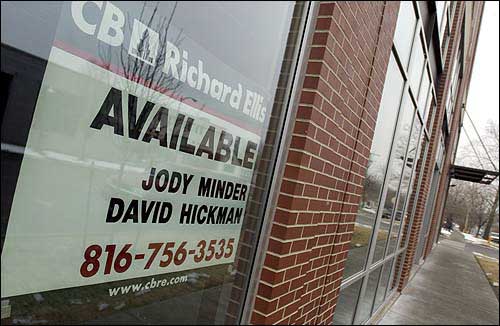
The retail space at the corner of 10th and New Hampshire streets, part of the Downtown 2000 project, is still available for lease. The space has been empty, throwing a wrench into the city's plans to pay for the parking garage that is part of the project.
The end result is that the project won’t be producing in 2003 the nearly $340,000 that both city officials and developers had expected when the project began. City officials are still figuring how much, if any, new taxes were generated as result of the project. But it is expected that the amount, technically called an increment, will be less than $10,000.
Ed Mullins, the city’s finance director, said that was important because the money was scheduled to be used to help pay about 50 percent of the city’s first large bond payment due on the garage. The payment will have to be made whether the city receives the money or not, because the bonds were backed by the full faith and credit of the city.
“It’s fairly simple: What we don’t get in an increment, we have to make up for in property tax,” Mullins said.
The sluggish economy
City officials are taking a “what-can-you-do” approach. They insist that it is not the fault of the developers that the project hasn’t attracted the expected new business.
“We’re not disappointed in anyone,” Corliss said. “We’re disappointed in the economy.”
Martin Moore is one of the lead developers on the project along with the Shmalberg family, owners of Scotch Fabric Care Services, which has headquarters just down the street.
Moore said all the development’s struggles had been related to the economic slowdown. He said that before 9-11, a wide variety of retailers were looking at expanding into Lawrence because the economy was strong. Now, Moore said, most retailers aren’t expanding at all, and the ones who are expanding are looking to do so in larger cities.
“Retail is slow right now,” Moore said. “I think everybody understands that. Lots of multi-store retailers are concentrating on more urban markets right now.
“Quite a few desirable retailers are only interested in being in markets of 200,000 population or better. Before 9-11 you had a chance to pull them down to a community our size. Now, they’re going the opposite direction. They’re going to bigger cities.”
The office market isn’t any better. Recent studies have suggested the vacancy rate for offices in Lawrence may be as high as 17 percent.
Then there’s the lodging market. Moore said he’d like the project to include an approximately 100-room luxury hotel on the southwest corner of Ninth and New Hampshire streets. The company has been in discussions with Lawrence-based hotel developer Linquist & Craig Hotels and Resorts Inc. Chains such as Radisson, Hilton and Crown Plaza have expressed interest in the idea, but Moore said the timing continued to be wrong.
That’s because the travel and lodging industry was among the hardest-hit sectors after 9-11. Moore also said the fact that the SpringHill Suites by Marriott decided to open in the Riverfront Plaza, created questions about whether the Lawrence market needed another upscale hotel.
Moore said developers hadn’t wanted to give up on the hotel idea, in part, because it could be a major generator of sales tax revenue that the city could use to help pay off the parking garage.
On hold
What it all means, Moore said, is that developers will be taking a wait-and-see approach before they move forward on building either of the two remaining buildings planned for the project.
“It is all market driven, and we’re not going to get ahead of the market,” Moore said. “We’re still going to build our buildings, but if you asked me what our time frame is, I couldn’t tell you. We’re going to build them, but we’re not going to put up a lot of vacant space. We’re just trying to ride out the storm right now.”
A delay in the project may cause city commissioners to make another decision about the project. As part of the agreement signed in 2000, the developers agreed to pay the city $100,000 if all the buildings in the development weren’t under construction by September of this year.
Moore is making no promises that the buildings will be started by then. If they are not, he said the developers likely would ask the city to forgive that payment.
“The city has the same goal we do,” Moore said. “They want it to be successful. I think they realize that building a bunch of vacant space isn’t in anybody’s interest.
“We view that payment as a ‘you’ve gone away, you’re not going to do this project’ type of penalty. We believe the city knows that isn’t the case.”
Future TIFs
Corliss said he didn’t think the slow start to the project would stop city officials from considering other TIF projects.
“I’m sure everyone is disappointed in the economy, but we’re very pleased with what’s already been accomplished. We’re pleased with the arts center, we’re pleased with the parking garage, we’re pleased with the office space.”
Corliss said city officials also were optimistic that the TIF ultimately would accomplish its goal, which was to provide enough funding to pay for approximately 50 percent of the garage’s cost.
“We think the redevelopment plan eventually will be accomplished, but if somebody could tell me how the economy will perform in the future, I’ll know better.”
City commissioners also didn’t express regret about becoming involved in the project. But City Commissioner Mike Rundle said the city could have done more to protect its investment.
Rundle said part of the problem the project had in attracting retail tenants stemmed from the planning commission’s not properly controlling the number of areas that can be developed for retail purposes.
“This is exactly why the planning commission needs to monitor commercial growth as required by Horizon 2020 and do so in a meaningful way,” Rundle said. “I think they are trying to alter the policy to make it completely meaningless.”
Moore said he hoped the project’s slow start didn’t make city residents reluctant to have their government become involved in other public-private partnerships in the future.
“I know it can be hard for the average citizen to understand, but we have to remember that the economy is the problem,” Moore said. “It’s not the TIF.”
City Government

Developer seeks incentive from City of Lawrence to build 131 units of housing near Wakarusa and Queens

Lawrence city leaders will consider whether to keep Community Building open, make 2 other rec centers free to access
A STAR Bond application raises questions for city leaders about Costco and housing west of the SLT

Soccer gear honoring Lawrence history’s all-star team is now on sale as part of city’s public art exhibition
To honor public servants, Lawrence’s July 4 celebration will have a whole gallery of their photos on display; submissions open now