Fire chief embraces challenges
No matter how hard they try, fires can’t seem to shake Jim McSwain.
For 25 years, McSwain has led the city’s charge to douse blazes and quell other emergencies as chief of Lawrence-Douglas County Fire & Medical, formerly known as the Lawrence Fire Department.
Twenty-four hours a day, seven days a week and 365 days a year, McSwain’s 123 employees fight to keep the community’s property and people safe.
Even when the chief’s not around.
He didn’t get a chance to set up a command post after a tornado ripped through Kmart and South Iowa Street in 1981. That’s because he’d already picked up a victim — a storm spotter whose face had been sprayed by shattered glass and who accepted a ride in the chief’s truck to Lawrence Memorial Hospital.
In 1991, McSwain was on vacation in Montgomery, Ala., when he learned a fire ravaged Hoch Auditorium at Kansas University. A battalion chief at the Hoch fire called McSwain the next morning to check in. McSwain asked what was happening back home.
The response, McSwain recalled with a subdued chuckle: “‘Have you been watching CNN?'”
But his most telling absence came during his first year in Lawrence. McSwain and a team of fire captains had traveled to a seminar in Tulsa, Okla., where they would learn how to establish standard operating procedures within a department.
Trouble was, as the leaders learned how to inject consistency into their operations, an anything-but-typical fire was ripping through three buildings in the 700 block of Massachusetts Street, where three firefighters would fall injured.
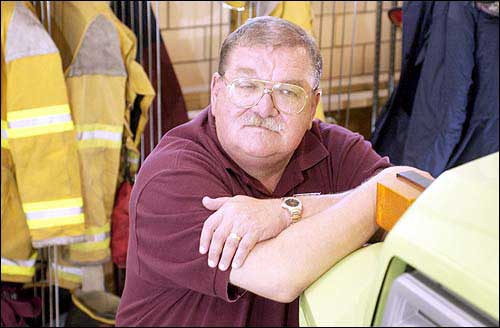
Jim McSwain has been the fire chief of Lawrence-Douglas County Fire & Medical for 25 years. During his tenure, he's implemented standard operating procedures in the department. His latest project involves positioning stations around town to enable crews to respond anywhere in the city within four minutes.
“We didn’t have any standard operating procedures at that time,” McSwain recalls now, a quarter century — and reams of new operational regulations — later. “Now we do. We’ve had a lot of different type stuff happen, and you have to always expect the unexpected.”
Planning ahead
Plans fill notebooks in McSwain’s office on the second floor of his downtown office. Whether it’s dousing a Dumpster fire or handling an exposure to weapons of mass destruction, the department’s personnel are trained to go by the book when emergency strikes.
Such challenges are what drew McSwain to Lawrence.
He took over as chief in July 1978, stepping up the career ladder after a decade at the Montgomery (Ala.) Fire Department, where he left as a captain; and later serving as an associate professor in Oklahoma State University’s fire-training program.
The Lawrence job offered a new challenge.

 6News video: Firefighters feel budget pinch (7-24-03)
 Fire chief sounds alarm to fund new station (5-21-03)
“I wanted to see if what I was teaching would work in the real world,” he said.
As the department’s top officer and administrator, McSwain oversees an annual budget of $9.8 million, and plans for expanding the department’s reach in the coming years. A new fire station opened in April on Harper Street, freeing up a former station at 19th Street and Haskell Avenue as a training center.
Plans are in the works for a station to be built next year on KU’s west campus, near 21st and Iowa streets. It is expected to open in 2005.
The city expects to spend $2.4 million to build a station at 21st Street and Wakarusa Drive, to take over for a station opened in 1982 on Stone Barn Terrace.
Growing needs
The idea is to keep emergency personnel based within a 4-minute trip of Lawrence addresses, a prospect that becomes more of a challenge as the city continues its expansion.
It’s a plan McSwain started compiling in 1989 and finished in 1995 — six years of departmental work he’d like to see in service before he leaves the fire line for the last time.
“It’s really what the fire-protection system needs in this city, and it will last for probably another 20, 25 years before we have to add another station,” McSwain said. “It’s really something I want to say was accomplished while I was here.”
City Government
Developer seeks incentive from City of Lawrence to build 131 units of housing near Wakarusa and Queens

Lawrence city leaders will consider whether to keep Community Building open, make 2 other rec centers free to access
A STAR Bond application raises questions for city leaders about Costco and housing west of the SLT

Soccer gear honoring Lawrence history’s all-star team is now on sale as part of city’s public art exhibition
To honor public servants, Lawrence’s July 4 celebration will have a whole gallery of their photos on display; submissions open now