

Film offers reality retrospective
Documentary recalls fallen son from 'An American Family'
New York ? “The Osbournes.”
Now that I have your attention, let’s talk about another series — one that pioneered “reality TV” three decades ago — and about a new documentary celebrating that series’ breakout star, “Lance Loud! A Death in an American Family.”
Long before “The Osbournes” and its brand of cartoonish cinema verite, the 12 no-nonsense episodes of “An American Family” chronicled much of 1971 as lived by Santa Barbara, Calif., couple Pat and Bill Loud and their five teenage children, including the oldest, 19-year-old Lance.
Premiering 30 years ago this month on public television, “An American Family” drew a weekly audience of 10 million, making good on the clan’s surname by creating an uproar.
One startling plot point: Pat and Bill decided to divorce while the camera looked on.
But viewers were most intrigued by Lance. He was a free spirit, a showboat, a beautiful boy with Keith Partridge hair. Most notable: He was a homosexual — right there on TV, sharing the screen with his siblings and parents.
Lance Loud was the first gay person to come out on television. For that, the public loved him or scorned him — and always would, as “Lance Loud!” demonstrates.
This absorbing film airs at 8 p.m. Monday on PBS. Then, at 9 p.m., Episode 2 of “An American Family” is rebroadcast.
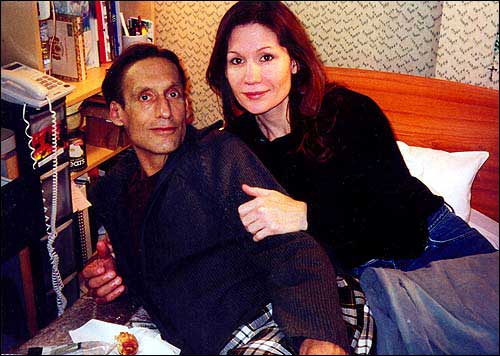
Lance Loud is shown with his sister Michele Loud in 2001 at a Los Angeles hospice. The two were part of An
That episode tracks Pat’s trip to New York to see Lance, who is there on an extended visit, in May 1971. Moments after arriving at his hotel (the Chelsea, of course), she meets his neighbor, Andy Warhol superstar Holly Woodlawn, and later accompanies her son to a transvestite variety show in Greenwich Village.
“Is there a message that I didn’t get?” Pat asks him the next day.
By the end of the episode, the message is clear.
But Lance Loud was more than the gay man “An American Family” made famous. Tapping his newfound TV notoriety, he returned to New York where he pursued the rebel-artist dreams he had imagined since childhood. For a decade, he sang in a punk-rock band called The Mumps that shared CBGB’s stage with Talking Heads and Blondie. (“I always told him that he had the best band in town,” Andy Warhol opines in a video snippet.)
When the band folded, he went back to California, where he became a music and pop-culture journalist for publications including The Advocate, Details and Vanity Fair.
He also wrestled with a drug problem (“By the end of it I was injecting what I knew to be rat poison, and I didn’t care,” he recalls), and then, during the 1990s, wrestled with sickness.
 ¢ www.pbs.org/lanceloudOn the air“Lance Loud! A Death in an American Family,” airs at 8 p.m. Monday on PBS, Sunflower Broadband channels 7 and 11. ¢ www.pbs.org/lanceloudOn the air“Lance Loud! A Death in an American Family,” airs at 8 p.m. Monday on PBS, Sunflower Broadband channels 7 and 11. |
He died Dec. 22, 2001, from liver failure caused by hepatitis C and HIV co-infection. He was 50 — the same age as his father circa “An American Family.”
Documentarians Alan and Susan Raymond, who filmed the Louds way back when, now have made a touching, even entertaining film to remember Lance by. More than that, it is a portrait commissioned by its subject as his dying wish. From his Los Angeles hospice in October 2001, he called upon the Raymonds, with whom he, like the rest of his family, had remained close through the years.
In November and early December 2001, they filmed him feeding his cat, chatting on the phone with his dad, taking stock of his life.
Last January, they were back, but this time, sadly, to shoot his memorial service at the Chateau Marmont Hotel. A session with Lance’s mother, Pat, was filmed just three months ago.
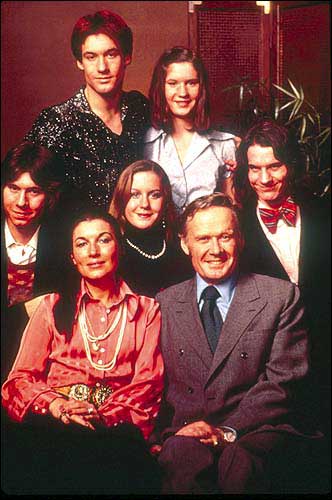
The William C. Loud family, circa An
Arts and Entertainment
Photos: Lawrence begins World Cup festivities with downtown block party
Watkins Museum to open special exhibit detailing how Douglas County celebrated America’s Bicentennial
Go, See, Do: Kaw River Roots Festival, markets and more
Soccer gear honoring Lawrence history’s all-star team is now on sale as part of city’s public art exhibition
Nominations, call for artists open for Lawrence’s 2026 Phoenix Awards