Dole director pinch-hits for snowed-in Pulitzer Prize winner
Abraham Lincoln was the surprise topic at the Dole Forum lecture series Sunday night — as was the speaker, Richard Norton Smith, director of the Dole Institute of Politics.
Smith pinch-hit for Roger Wilkins, a former Washington Post editorial writer and Pulitzer Prize winner who had been scheduled to speak as part of the series.
Wilkins, now a professor at George Mason University in Fairfax, Va., was unable to make the trip to Lawrence for the presentation at Woodruff Auditorium because of a snowstorm in the Washington, D.C., area. Nearly 2 feet of snow had fallen Sunday.
“He called and apologized,” Smith said. “We will reschedule sometime in the spring.”
Although Wilkins’ appearance was to be free, tickets were required. New tickets will be issued when the new date is set, said Erik Nelson, associate director of the Dole Institute.
Although people arriving at Woodruff expecting to hear Wilkins were told that Smith would substitute, few turned around. The 510-seat auditorium was nearly full.
Almost 140 years after he was assassinated, Abraham Lincoln continues to be one of America’s most identifiable presidents, yet he was a man of complexities, Smith said.
“He remains a vital part of America’s future as he is an indelible relic of our past,” he said.
Speaking on the eve of Presidents Day, Smith said Lincoln seemed to be running a “permanent campaign” before the American public. He also continuously battled his own self-doubts and troublesome bouts with depression.
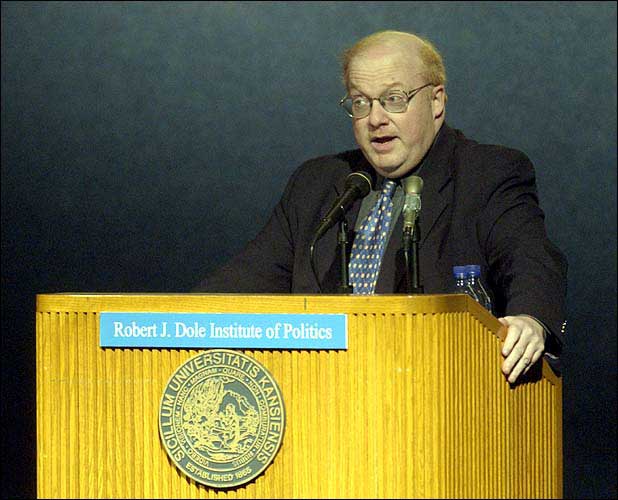
Richard Norton Smith, director of the Dole Institute of Politics, gives an impromptu speech about Abraham Lincoln. Smith stepped in for snowbound would-be speaker Roger Wilkins on Sunday at Woodruff Auditorium.
During Lincoln’s debates with Stephen A. Douglas for an Illinois U.S. Senate seat, Lincoln often used his humor to respond to some of Douglas’ remarks. One response came when Douglas called him “two-faced,” Smith said.
“If I had more than one face, do you think I’d wear this one?” Lincoln, who was not noted for his looks, reportedly said.
Nevertheless, Lincoln’s character had many sides, said Smith, a presidential historian. He allowed his political supporters to portray him as a rail-splitter instead of a rail lawyer.

 Influential Watergate-era journalist to speak in Dole series (1-13-03)
“If a supporter exaggerated his virtues, Lincoln tried not to make a liar out of him,” Smith said.
Lincoln also had a dark side, Smith said. Some who knew him found him to be preoccupied with insanity and death, and he may have even had a premonition of his own death.
City Government
Developer seeks incentive from City of Lawrence to build 131 units of housing near Wakarusa and Queens

Lawrence city leaders will consider whether to keep Community Building open, make 2 other rec centers free to access
A STAR Bond application raises questions for city leaders about Costco and housing west of the SLT
Soccer gear honoring Lawrence history’s all-star team is now on sale as part of city’s public art exhibition
To honor public servants, Lawrence’s July 4 celebration will have a whole gallery of their photos on display; submissions open now