Project records residents’ memories of WWII
When John Glinka and Les Hannon were trying to survive World War II, they had no idea that more that 60 years later they’d still be thinking and talking about their experiences.
“I enlisted and just wanted to serve my country and then come home,” said Glinka, 83, of Lawrence, who was sent to the southwest Pacific with an Army Signal Corps unit. “It was just a short interlude in my life.”
“World War I was just 20 years earlier, and people were very much aware of the heavy loss of life then,” said Hannon, who grew up in Northern Ireland and joined the Royal Air Force. He came to the United States in 1963 and has lived in Lawrence since 1973.
Earlier this year, Glinka and Hannon talked about their experiences during audiotaped and videotaped interviews with Lawrence high school students.
The interviews are part of a continuing program by the Lawrence Public Library to record and save the memories not only of World War II military veterans but also civilians who lived through that war period.
The program is part of a joint effort by the library, the Dole Institute of Politics and the Department of Veterans Affairs, which is collecting such memories from across the country. Nationally, the program is called the Veterans History Project.
Copies of the local tapes are being kept at the library, 707 Vt., and the Dole Institute, on Kansas University’s west campus. Additional copies are sent to the Department of Veterans Affairs to be forwarded to the Library of Congress.
Pattie Johnston, outreach coordinator at the library, is taking charge of the interviews. Last spring she used history students from Lawrence and Free State high schools to help conduct interviews. So far, about 20 interviews have been conducted. They went well, she said.
“A lot of veterans didn’t think anyone was interested in their stories,” Johnston said. “Once we get past that, they are very talkative. I haven’t had to pull anything out of any of them.”
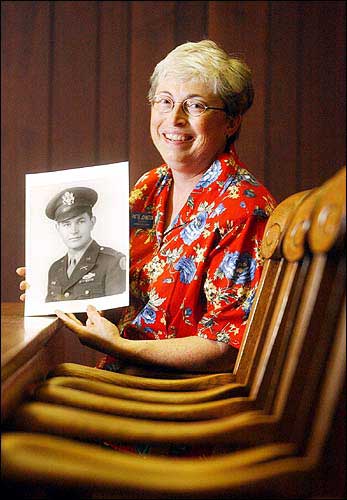
Pattie Johnston is involved in an ongoing project to tape interviews with World War II veterans and civilians. Friday at the Lawrence Public Library, she held a photo of Army veteran Martin Jones, whom she interviewed for the project.
The veterans don’t have to have been in combat to be interviewed, Johnston said. And she is looking for any civilians who lived through the period to talk about life on the home front.
“We haven’t lived through anything like that, and life has changed so much since then,” Johnston said. “They remember things and went through things that people today don’t know about.”
Zach Elmore, who is a senior this year at LHS, interviewed Hannon. He listened as Hannon recalled moments during the German V-1 and V-2 rocket attacks on London.
“It was a great experience,” Elmore said of interviewing Hannon. “He was pretty talkative. He liked telling the stories.”
Collecting those stories to be heard by future generations is important, Elmore said.
“I think World War II really shaped the world the way it is today,” he said.
Glinka and Hannon agreed.
“It might have some interest to people,” Glinka said. “A lot of things that happened in the military then were different. Things are a lot faster now than they were then.”
Hannon, who commended Elmore for the way he conducted the interview, said, “It doesn’t hurt a bit for people to know what was going on then.”
Johnston finds out about subjects for interviews primarily from word of mouth and by attending community group meetings. Last Tuesday she attended a dinner at the Dorsey-Liberty American Legion Post No. 14, 3408 W. Sixth St. She found several people who were willing to be interviewed and was told of others to contact.
“It just mushrooms,” she said.
Anyone wanting to be interviewed can contact Johnston at the library.
City Government
Developer seeks incentive from City of Lawrence to build 131 units of housing near Wakarusa and Queens

Lawrence city leaders will consider whether to keep Community Building open, make 2 other rec centers free to access
A STAR Bond application raises questions for city leaders about Costco and housing west of the SLT
Soccer gear honoring Lawrence history’s all-star team is now on sale as part of city’s public art exhibition
To honor public servants, Lawrence’s July 4 celebration will have a whole gallery of their photos on display; submissions open now