Judge shares lessons gained from hard times
Tom Webb has every reason to be an angry man, but he’s not.
His alcoholic mother forced him to fend for himself in the 1950s on the streets of a village 60 miles south of the demilitarized zone separating North and South Korea.
When he should have been in elementary school, he was stealing food to survive. He slept in garbage bins.
But Webb, now a judge in Sublette, was in Lawrence on Thursday to tell 1,700 high school students that his life was changed — saved, perhaps — by people who believed unconditional respect for others made a difference in a negative world.
It’s a message he asked students to emulate.
“You can touch a lot of people if you choose to become a positive influence,” Webb said.
Webb’s visit to Lawrence is sponsored by Leadership Lawrence and the Douglas County Foundation. He spoke Thursday at Free State High School and Lawrence High School and will talk to Lawrence Alternative High School today. He also will present a public talk at 7:30 p.m. today at the Lawrence Arts Center. Admission is $5.
At Free State, he chronicled his journey from Korea to the United States.
It began with food. Webb, born in 1952, was caught stealing food in 1958. A police officer told him to sit on a bench, which he did. An elderly woman joined him. She put her arms around him and offered him a piece of candy.
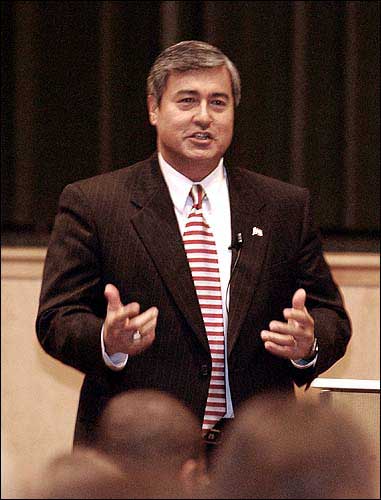
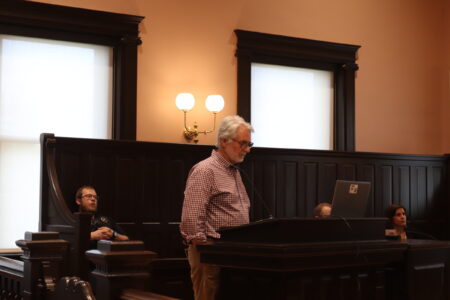
Judge Tom Webb, of Sublette, talks to Free State HIgh School students Thursday about his difficult childhood in Korea and the lessons he learned from his adoptive American family.
She gave Webb a choice: Live in an orphanage or go to jail.
After six months at the orphanage, he was flown with 120 other children to Portland, Ore. The only English words Webb knew at that time were “Jesus loves me” and “cowboys and Indians.” He weighed 39 pounds.
Webb was met at the airport by Roy and Ruth Webb of Tulsa, Okla. They became his adoptive parents.
He thrived under their guidance. The family moved in the 1960s to Junction City, where Ruth Webb taught school. She also taught her son the virtue of treating people with dignity.
“Every person she came in contact with she treated with respect,” he said.
Webb served in the U.S. Marine Corps, got married, earned a master’s degree in family therapy and was named 2001 outstanding judge by the Clinical National Judges Assn.
Through it all, he has focused on lessons drawn from adversity.
“If we’re truly going to make a positive difference … we need men and women who are going to reach out and say, ‘I choose to value you.'”
City Government

Developer seeks incentive from City of Lawrence to build 131 units of housing near Wakarusa and Queens

Lawrence city leaders will consider whether to keep Community Building open, make 2 other rec centers free to access
A STAR Bond application raises questions for city leaders about Costco and housing west of the SLT
Soccer gear honoring Lawrence history’s all-star team is now on sale as part of city’s public art exhibition
To honor public servants, Lawrence’s July 4 celebration will have a whole gallery of their photos on display; submissions open now