Voters reject $59 million school bond issue
District could propose smaller, reconfigured package within year
The April Fools’ Day lesson: Elementary school consolidation and school bond issues are a mercurial mix.
No joke.
The Lawrence school board picked up evidence of this fact April 1 when voters rejected its offer to close two elementary schools at the same time it sought a property tax increase to finance a $59 million bond for school construction and renovation.
Fifty-five percent of voters said “no” to the district’s 160-word ballot resolution that would have financed projects at 15 schools. It also would have shut down East Heights and Centennial schools.
“Even though the school board wanted to disassociate the bond issue from the issue of school closings, the two could not be disassociated — that, I suspect, was a major reason,” said Jerry Schultz, a member of the Centennial Neighborhood Assn. steering committee and an opponent of the bond issue.
So, the big question is whether the school board will turn around and offer voters another bond later this year.
John Fuller, an executive in the DLR Group consulting firm that helped the board develop the bond, said the voting indicated the bond proposal wasn’t completely off target. But with just 45 percent approval, he said, it was clear that the package had to be revised.
“It is not a wholesale defect,” he said.
‘Critical’ postmortem
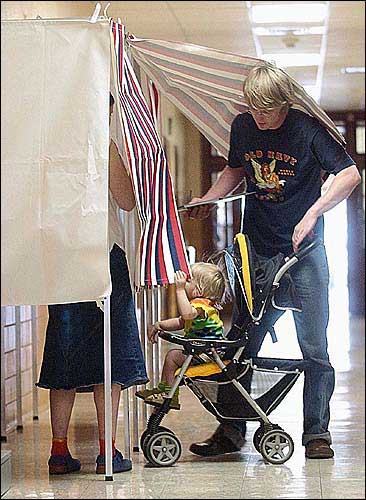
Henry Morland, 2, takes a peek under the poll curtain to watch his mother, Kristin Morland, Lawrence, vote. At right is Henry's father Timothy Morland. The Morlands voted April 1 at New York School.
Figuring out what went wrong will involve input from bond supporters and bond opponents.
“The postmortem will be really critical,” he said.
Was it elementary consolidation alone? Or was it the economy? War? Could the price tag have been too large? Did enough information about the bond get into the public’s hands? Was it the timing?
Fuller said the district could modify the bond and let voters pass judgment on it this fall. Or the district could hold off for a year or so.
“That will be up to the board,” he said.
If you ask bond opponent Burdett Loomis, the election proved that Centennial and East Heights have powerful constituencies in Lawrence. He also believes the bond package should have been smaller.
“It was too big, and it attacked two schools — Centennial and East Heights — that had strong constituencies,” said Loomis, a professor of political science at Kansas University.
However, board member and bond proponent Sue Morgan said the choice was between closing three elementary schools — Riverside will close in May — and slashing spending on school programs and staff.
Reconfigured bond issue
Consolidation of three elementary schools is projected to save the district $1.4 million annually, said Morgan, the only incumbent to win re-election.
“I fear that we’ve lost an opportunity to deal with the fiscal constraints that we are under in a way that’s most advantageous for the kids,” she said. “Now, I’m afraid we’ll be forced to deal with things in ways that are less advantageous — and that’s a disappointment.”
Morgan said she expected the new school board to eventually assemble a smaller, reconfigured bond issue.
“The issues that are driving this have not gone away,” she said, warning constituents to expect another round of painful spending cuts.”
That would suit Leonard Ortiz, a bond opponent who received the most votes for school board.
“People want a bond,” Ortiz said. “They didn’t want this bond.”
Three neighborhood associations affected by the proposed closings — Centennial, East Heights and Brook Creek — unofficially opposed the $59 million bond issue.
Voters across the city voiced objections to the bond plan.
“I’m totally against the school closings,” said Donna Johnson, who voted at Mustard Seed Christian Fellowship church.
Reminded of the school board’s quest to cut costs with consolidation, Johnson replied, “I’ve seen the numbers. I don’t believe them — they’re not going to save the money (by closing schools) they say they are.”
Allen Ackland of Lawrence said the district’s handling of the last bond in 1998, which was for $16.6 million, led him to vote against the $59 million plan.
After the previous election, the board spent part of the bond money to buy a $4.1 million administration building. That wasn’t included in the bond proposal.
“To be honest about it, I was disappointed in the way the last bond issue was handled and, I’m sorry, but people have to be held accountable,” Ackland said.
City Government

Developer seeks incentive from City of Lawrence to build 131 units of housing near Wakarusa and Queens

Lawrence city leaders will consider whether to keep Community Building open, make 2 other rec centers free to access
A STAR Bond application raises questions for city leaders about Costco and housing west of the SLT

Soccer gear honoring Lawrence history’s all-star team is now on sale as part of city’s public art exhibition
To honor public servants, Lawrence’s July 4 celebration will have a whole gallery of their photos on display; submissions open now