Researchers focus on wireless devices
Joe Evans wants your cell phone to get to know your laptop.
Evans is leading a team of Kansas University researchers investigating how wireless devices communicate with one another.
The research is guided by the Bluetooth Special Interest Group, an Overland Park-based consortium of businesses developing a standard chip that someday could be included in most wireless devices.
The goal is to be able to transmit data from one source to another, and to make it as easy as possible.
“Five minutes after you have a gadget out of the box, you should be able to get it to work with another Bluetooth device,” Evans said. “You don’t have to be a computer scientist to do it.”
Bluetooth, formed in the mid-1990s, includes many major technology companies, including 3Com, Agere, Ericsson, IBM, Intel, Microsoft, Nokia and Toshiba. Its chairman and executive director is Mike McCamon, a 1985 KU graduate who also has worked for Intel.
Evans, a professor of electrical engineering and computer science, said McCamon came to KU last year looking for researchers for the project.
The initial project, funded by about $34,000 from Bluetooth, started in December and will be complete by the end of spring.
Researchers are looking at how about 20 devices interact with one another. Evans said much of the interaction is based on the software built into devices, not the chip itself. That means almost every device will need to be tested with other devices to see whether they work together.
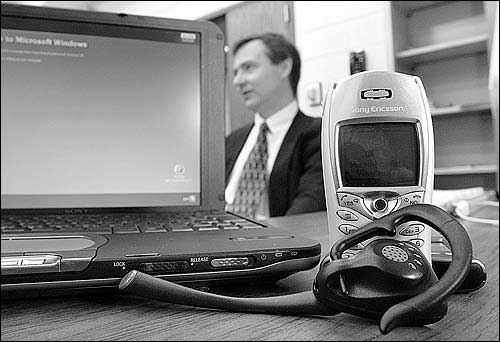
Joe Evans, Kansas University professor of electrical engineering and computer science, is a principal investigator on a research collaboration between KU and the Bluetooth Special Interest Group. Researchers are working on how wireless devices will connect to each other.
That leads Evans to expect further research possibilities in the future.
“The number of combinations and permutations is frightening,” he said.
Some of the possible applications for the technology include:
- Hands-free, wireless headsets for cell phones.
- Transmitting calendar information from a personal data assistant (PDA) to a laptop computer.
- Transmitting electronic business cards from device to device.
- Using a cell phone to open a garage door.
Evans said his research was centered on making the electronic interactions simple to use.
“If you want to send somebody an electronic business card, it’s not very useful if you have to spend 20 minutes figuring out how to do it,” Evans said.
Evans said only a handful of devices on the market offered Bluetooth chips. More were available in Europe.
But he expected Bluetooth communication to be a common technology in the next few years.
“We’re just seeing the wave of this technology,” he said. “I expect to see more and more of this. I think there’s a lot of benefit to the manufacturer and to society as a whole.”
City Government

Developer seeks incentive from City of Lawrence to build 131 units of housing near Wakarusa and Queens

Lawrence city leaders will consider whether to keep Community Building open, make 2 other rec centers free to access
A STAR Bond application raises questions for city leaders about Costco and housing west of the SLT

Soccer gear honoring Lawrence history’s all-star team is now on sale as part of city’s public art exhibition
To honor public servants, Lawrence’s July 4 celebration will have a whole gallery of their photos on display; submissions open now