Growing retail space concerns store owners
The past year didn’t create as much heartache for retailers as was previously expected, but concerns continue to increase over the growing amount of retail space in Lawrence, according to a pair of retail experts who took part in a roundtable discussion for the Journal-World.
Here’s a brief look at the panelist and an excerpt of questions and answers from the roundtable discussion, which was broadcast last month on Sunflower Broadband’s River City Weekly.
- John Kiefer is owner of Kief’s Audio-Video, a South Iowa Street electronics store that has been doing business in Lawrence for 42 years.
- Maria Martin is owner of Southwest & More, a downtown specialty shop that sells a variety of Native American and Mexican art and gift items. Martin also is the co-director of Downtown Lawrence Inc., a trade group that represents retailers and other downtown businesses.
- Greg Hurd, host of River City Weekly, moderated the discussion.
Q: If you looked back at 2002 and had to describe it in a sentence or two, how would you describe it?
Kiefer: Well, from my point of view, we saw a year of complete evolution. Very different products sold. Very good year though.
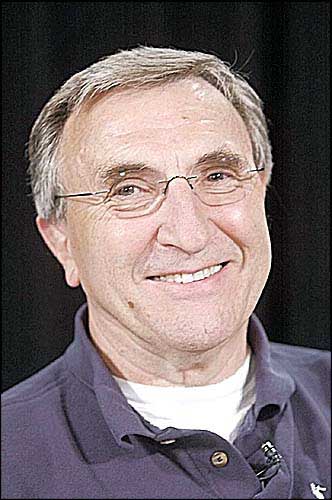
John Kiefer is owner of Kief's Audio-Video, an electronics store that has been doing business in Lawrence for 42 years. He says he's optimistic for the rest of 2003.
In terms of technology, for example, we really didn’t have plasma screen TVs too long ago. They are a $5,000 to $25,000 item, so if you sell four to five of them, you have a completely different financial picture.
Martin: Retail gift items and specialty items are really what we sell. Specialty items really carried us. I think from that standpoint I can say it ended up being a much better year than I thought it would be.
Q: If you put on your other hat as co-director of Downtown Lawrence Inc., what did you see?
Martin: I think what I heard by the end of the fourth quarter from people who previous to that weren’t feeling very good about the year and weren’t expecting too much out of the fourth quarter, a number of them were quite surprised.
Q: Let’s try to project ahead and pretend we’re looking back at 2003. How do you anticipate it having gone?
Martin: From my standpoint, I don’t know if I’m going to see that much of a change. I think I feel very good given the state we’re in now with so much affecting the economy.
As I’m saying that now, I’m almost proving myself wrong because the first two months of the year have turned out very well. I don’t know though, there sometimes are just little shifts that happen. John and I were talking earlier and it almost seems like things are picking up. I don’t know. I might be wrong. It might just be the week, but it is looking good. I really hope I’m saying that at the end of 2003.
Kiefer: I’m very optimistic on 2003. I think there are areas of the store that we’ll have to eliminate. But on the other side of the coin, we’re expanding enormously our custom installation division. That business, we think, will pick up dramatically.
Walk-in retail, I’m not so sure how I feel. I’m concerned whether people are doing their shopping on the Internet and through catalogs and they’re just walking in to browse things. That may be the difference on walk-in retail for me, but I’m still pretty optimistic.
Q: We have heard a lot about national retailers coming to Lawrence and the potential impact. How do you look at national retailers coming on the scene?
Kiefer: In my case, we’re going to see Best Buy, which is the largest audio/video and electronics retailer in America. They’re in a completely different game than us, though. They are in a very fine game and they’re good at what they do, but they’re different than us . . .
We think they actually could be a help to us. What I mean is that it is very often that a person come into our store and says, well, I’m going to go to Kansas City and look at Best Buy. Some will buy there, but the majority come back. Now, if they can go down the street and the competition is that much closer, I think it will be a positive. Because now if they go to Kansas City, they can go to Best Buy or about 56 other stores over there. If they stay in Lawrence, it is us or them, and I think we’ll do very well on a one-on-one basis.
Martin: With my specialty shop, it is a little different. We specialize in American Indian jewelry, fine arts and items, Mexican imports, so we’re selling items chains aren’t going to carry.
For all of downtown, it is a little bit different. There is more competition when you bring in national chains. Not only are you competing with merchandise that could be sold at Weaver’s or other shops downtown, you are adding more outlets for shopping.
Some people will get hurt by the more chains that come in because their merchandise is not that different than what the chains offer. National retailers can offer better prices, better sale offers, better price points. What they may not be able to offer is the service that comes with the independently-owned businesses.
Downtown has national chains, and I think they do as well as anybody else. When things are slow downtown, they are slow as well. It is just that the dollar is not there at times.
Kiefer: I think everybody who wants to be in Lawrence has a chance to be here. I would be against giving any type of tax breaks to large corporations to make the playing field unlevel . . .
I don’t see a strong advantage to encourage people to come into town with a different playing field. I think anybody who wants to come should come to town. Come on in, the water’s fine.
One thing I will say, is I owned, at one time, part of the ground where the Kohl’s store has been developed. When we were negotiating to sell the land, I remember asking the developer how many square feet they were going to develop there …
He said 490,000 square feet of space and would park 500 people. I remember asking a question about how many dollars the store would have to do in sales to survive. The man from Malan (the developer) said we have to do about $300 a square foot a year, and if it get real competitive, that number has to go up.
I said, ‘My gracious. If you are going to develop around 490,000 square feet here . . . (plus the Super Target and J.C. Penney store that were also under development at the time) I said that is another 700,000 square feet of retail space.’
At $300 a square foot that is $210 million in sales. I asked him where a town of less than 100,000 people was going to get an extra $210 million to spend with everybody else that is already in business staying healthy. Well, he said it wouldn’t work that way.
He predicted, and this was in ’94, the mall out on the highway would go broke, and it did. He said the Riverfront Mall would have to completely change, and it did. He said you would see downtown Lawrence evolve with more bars, more restaurants, more used and recycled stores, and it did.
So that was the most accurate thing I had heard in quite awhile. For awhile, that actually scared me, then I started thinking what the heck. I just have to be the best I can be.
Q: Have you evolved in your business since?
Kiefer: Very much. At that point in time, Kief’s was probably 70 percent CD/software. Today we are not. That business has gone to the Internet and burning CDs and downloading them. We had to get out of a very, very profitable business we had been in for 35 years. That change is the evolution I’m talking about.
At that point we started doing shipping, we started doing Internet sites. Today, if you are in my business and are not on the Internet, I’d say you have a problem. That is business that is not done in Lawrence. It is really outside of Lawrence and brings money into Lawrence.
Q: In the past several years, there has been a discussion about a glut of retail space. I wonder if that is still a concern, or if it is still true. How does that work from downtown’s perspective?
Martin: It is a draw for the city and county to have a very viable, interesting and preserved downtown. Lawrence city leaders have kept it that way. They have fought to do that. Business leaders have fought to keep it that way. There will always be growth, but what city leaders have to be concerned about is how it expands.
You can’t just keep bringing in new businesses, new ventures, new things. You end up blighting the wonderful things that drew you here to begin with.
You will lose revenue from people who come into town for the day if you have strip mall after strip mall like they do in Everywhere Else USA. That’s what eventually could hurt. …
You want to maintain what you have, but still grow. You have to do that by planning, careful planning. That’s the key. I think we have to prepare ourselves to grow as the population grows. Grow as you city and county’s population grows, but don’t overgrow. I think we have overgrown, and it will hurt.
Kiefer: I think we do have more retail today than we have bodies to consume it. The great thing about Lawrence is we have all the student and they have fathers and mothers and they love to see their kids, and we get a tremendous amount of money coming into town that way.
City Government

Developer seeks incentive from City of Lawrence to build 131 units of housing near Wakarusa and Queens

Lawrence city leaders will consider whether to keep Community Building open, make 2 other rec centers free to access
A STAR Bond application raises questions for city leaders about Costco and housing west of the SLT
Soccer gear honoring Lawrence history’s all-star team is now on sale as part of city’s public art exhibition
To honor public servants, Lawrence’s July 4 celebration will have a whole gallery of their photos on display; submissions open now