Briefly
Gaza Strip: British peace advocate shot in the head
A 21-year-old British peace advocate was critically wounded Friday as he tried to get two children out of the line of fire in the Gaza Strip, witnesses said.
Thomas Hurndall suffered a head injury and was declared brain dead after arriving at Rafah Hospital, Dr. Ali Musa said.
Witnesses said Israeli troops firing from a tank struck Hurndall as he other activists in a pro-Palestinian group approached an army position on the edge of a Gaza refugee camp.
The Israeli army had no comment about Friday’s shooting but said it would investigate.
Hurndall, of Manchester, England, was the second advocate wounded in a week. A third member of the group, the International Solidarity Movement, was killed a month ago while trying to stop an Israeli army bulldozer.
Palestinians have long complained that Israeli troops are using excessive force against civilians, and the mounting casualties among foreigners were expected to draw renewed attention to Israeli army practices in the West Bank and Gaza Strip.
Washington, D.C.: U.S. drops resolution criticizing China rights
Two weeks after declaring that China had a poor human rights record, the State Department said Friday it would not seek a resolution criticizing China in the top United Nations rights forum.
Spokesman Richard Boucher credited China with “some limited but significant progress” in protection of human rights, including the release of a number of political prisoners.
He said much remained to be done, adding that the administration would continue to press China’s new government to improve its human rights record.
Since China’s crackdown on pro-democracy demonstrators in 1989 at Tienenman Square, the United States has introduced China resolutions almost every year at the annual meeting of the U.N. Human Rights Commission in Geneva.
Because of effective Chinese diplomacy, no such resolution has been approved in the 53-member commission.
Besides this year, China resolutions were not introduced in 1998 or 2002.
Afghanistan: Franks reassures troops of U.S. commitment
The U.S. general leading the war against Iraq returned Friday to Afghanistan with a special envoy to assure the government and international troops that the United States can fight two wars at once.
With world attention focused on Iraq, Gen. Tommy Franks said American forces remained committed to Afghanistan and to capturing al-Qaida leader Osama bin Laden, who may be hiding there.
“It’s part of the global war on terrorism. It is important to my nation and it will remain important to my nation,” Franks said.
Zalmay Khalilzad, President Bush’s special representative to Afghanistan and Iraq, also brought a message of reassurance to Afghan President Hamid Karzai, who is struggling to establish the supremacy of his government over a nation of factions and warlords.
Khalilzad said Afghanistan’s multiethnic government might be a model for postwar Iraq, where a transitional government will face the delicate task of representing all segments of the society, including the Iraqi Kurds.
South Korea: Government launches stealth spy warship
South Korea on Friday launched a stealth warship capable of spying on North Korea Friday, while the communist state’s leader called proposed U.N. nuclear inspections a “sinister design” by Washington to find an excuse for war.
In the past few days, North Korea has increased its anti-U.S. rhetoric in anticipation of the Bush administration shifting its attention to North Korea after it resolves the war in Iraq.
Tensions were underscored Friday as South Korean President Roh Moo-hyun attended the launch of a new stealth warship capable of electronic spying on North Korea.
The United States had hoped its key ally, South Korea, could convince Pyongyang to allow in U.N. inspectors and scrap nuclear facilities.
City Government

Developer seeks incentive from City of Lawrence to build 131 units of housing near Wakarusa and Queens

Lawrence city leaders will consider whether to keep Community Building open, make 2 other rec centers free to access
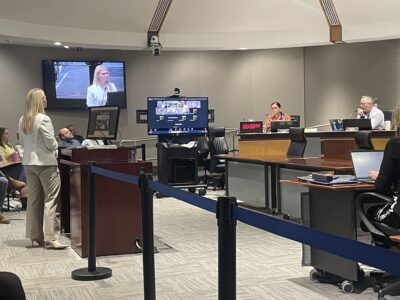
A STAR Bond application raises questions for city leaders about Costco and housing west of the SLT
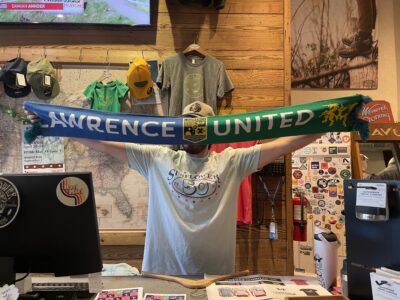
Soccer gear honoring Lawrence history’s all-star team is now on sale as part of city’s public art exhibition
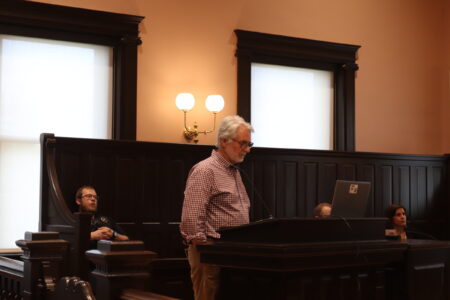
To honor public servants, Lawrence’s July 4 celebration will have a whole gallery of their photos on display; submissions open now