Chancellor: Cuts won’t keep KU from success
State budget cuts shouldn’t keep Kansas University from working toward its goal of being a top-25 public university, Chancellor Robert Hemenway said Thursday.
Hemenway spoke to about 200 faculty and staff members at their annual convocation at Budig Hall.
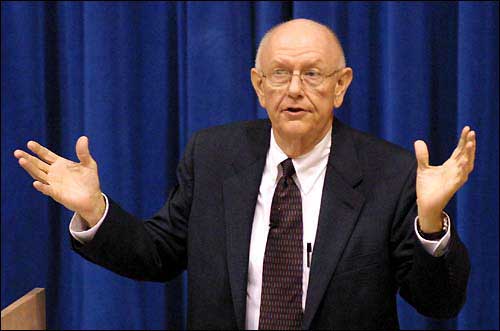
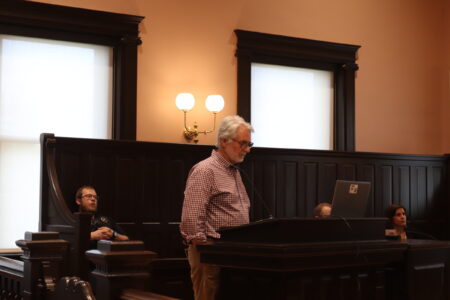
Kansas University Chancellor Robert Hemenway talks about KU's budget situation at faculty and staff convocation in Budig Hall. Hemenway said Thursday that despite significant cuts in KU's budget, the university should have no problem continuing on its track toward becoming a top-25 university.
“I don’t believe that kind of progress will be stopped,” he said. “Yes, we’ll have to learn to maneuver in a tight budget.”
Hemenway said he had “cautious, realistic optimism” that the budget approved by the 2002 Kansas Legislature which resulted in a 4 percent, or $6 million, cut to the budget at KU’s Lawrence campus would be an anomaly.
“We can whine,” he said. “We can complain. I personally like to mope. We can despair.
“I don’t believe, when we look at the large picture, we have to give up our goal of being one of the top 25 public universities in this country.”
David Shulenburger, provost and executive vice chancellor, said KU next year would ask the Legislature for an annual budget increase of 2.35 percent, plus an increase equal to the annual Higher Education Price Index. That index, which measures the cost of providing a college education, generally runs between 3 percent and 4 percent.
Such a combined increase over five years combined with increasing research, tuition and endowment funds would help KU reach the average funding of its state-selected peer universities.
“There’s a reasonable way to get to the goal,” he said.
Tom Mulinazzi, a professor of civil engineering and president of the Faculty Council, urged faculty and staff members to become more involved in the university, despite the funding situation. That includes attending faculty committees, lectures and sports events, he said.
He also urged faculty members to sign up for a new speakers bureau to spread the word about KU’s research and teaching. He said 85 people had volunteered so far.
“There should be more,” he said. “We’re all experts.”
City Government
Developer seeks incentive from City of Lawrence to build 131 units of housing near Wakarusa and Queens

Lawrence city leaders will consider whether to keep Community Building open, make 2 other rec centers free to access
A STAR Bond application raises questions for city leaders about Costco and housing west of the SLT

Soccer gear honoring Lawrence history’s all-star team is now on sale as part of city’s public art exhibition
To honor public servants, Lawrence’s July 4 celebration will have a whole gallery of their photos on display; submissions open now