KU museum supporters not giving up
Anthropology exhibits slated to close this fall; director exploring options
Supporters of the Kansas University Museum of Anthropology have not given up their battle to keep the budget-bitten museum open to the public.
“We’re not ready to roll over and play dead,” said Mary Adair, the museum’s director.
KU officials in July announced the public part of the museum would be closed this fall, eliminating five positions and saving from $150,000 to $200,000 each year. Artifacts will remain available for researchers and educational uses.
Since the announcement, museum supporters have sent many letters to KU administrators and the Journal-World offering ideas and seeking help to keep the museum open.
“We’re trying to make the public aware that something that is an extremely valuable asset to the university and the community has essentially been shut down,” said Ann Cobb, president of the museum’s community advisory board.
The Museum Students Organization will make another plea for public support from 10 a.m. to 3 p.m. Saturday during KU’s Open House, when members will distribute fliers at the museum.
Adair said she had met with Kim Wilcox, dean of the College of Liberal Arts and Sciences, about the possibility of transferring oversight for the museum from the KU Center for Research to Wilcox’s school. That could open new possibilities for the museum, especially with additional tuition money being distributed to campus departments.
“I don’t expect they’ll reverse their decision,” she said. “But with this tuition money, we’re looking at creative and innovative ideas for new projects. We can’t have it the way it used to be. I know I’m being vague, but that’s been the level of the discussions so far.”
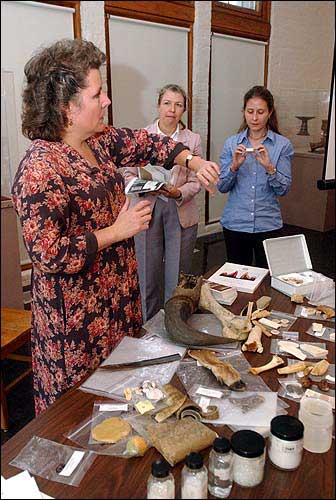
Julie Reilly, left, of the Gerald R. Ford Conservation Center in Omaha, Neb., talks to archaeologist Virginia Wulfkuhle, center, Topeka, and Jeannette Blackman, archaeological collections manager at Kansas University Museum of Anthropology, about the preserving of bones at the museum. Supporters of the museum are continuing to look for ways to keep the public exhibits open this fall.
Wilcox said Wednesday he didn’t expect to take control of the museum.
“There’s been no decision to change that at this point,” he said. “I don’t want to pretend to see the future. Right now it doesn’t look like it’s going to happen.”
Lynn Bretz, a KU spokeswoman, said the only possibility for keeping the museum open to the public would be raising about $3 million for an endowment.
“We’re refocusing its mission,” she said. “We’re transitioning it to a research and education function.”
She said discussions about closing the museum had been under way about a year. She said the museum’s relatively low attendance from 35,000 to 40,000 people per year lent weight to the decision to close. KU’s Natural History Museum draws about 200,000 people a year.
“The feeling was the numbers had been modest,” Bretz said.
The museum’s public space had been scheduled to close after the Lawrence Indian Arts Show, which runs through Oct. 20. But Adair said the Center for Latin American Studies was planning to organize the museum’s annual Day of the Dead exhibit in November.
City Government
Developer seeks incentive from City of Lawrence to build 131 units of housing near Wakarusa and Queens

Lawrence city leaders will consider whether to keep Community Building open, make 2 other rec centers free to access
A STAR Bond application raises questions for city leaders about Costco and housing west of the SLT
Soccer gear honoring Lawrence history’s all-star team is now on sale as part of city’s public art exhibition
To honor public servants, Lawrence’s July 4 celebration will have a whole gallery of their photos on display; submissions open now