Fulbright scholars mix familiar, new cultures
Twenty-eight Fulbright students from 16 countries celebrated their academic duration in the United States Saturday with home-cooked international foods and a universal love for the Beatles.
Scholars from Spain, the Ivory Coast and Japan gathered around a piano at West Side Presbyterian Church and sang “Let It Be” as they waited for their turn to cook food from their native country. About a dozen others took turns chopping vegetables and cooking rice.

Fulbright scholars from Kansas University's Pre-Academic Orientation Program prepared a feast Saturday of cuisine from their homelands but first they had to buy the groceries. From left, Itsu Hirayama, 30, from Japan; Koji Matsunobu, 28, from Japan; Geri Lamer, special program assistant at KU's Applied English Center; and Ramiro De Ocampo-Godoy, 25, from Mexico, get ready to head out at Checkers, 2300 La.
The 28 Fulbright students are participating in the Fulbright Pre-Academic Orientation Program at Kansas University. They arrived July 1 and will leave Aug. 10 to earn master’s degrees at different universities around the country.
KU runs the only six-week pre-academic orientation in the country for incoming Fulbright students. KU’s Applied English Center runs the program of English language instruction and cultural and American academic orientation for the students.
Though they are staying at Naismith Hall, the students took a break from dorm life to stay with Lawrence host families Saturday night. They met their host families for the first time at the buffet dinner they prepared. None of them seemed apprehensive Saturday morning as they shopped for more than $600 of groceries at Checkers and the Oriental Supermarket. The Applied English Center paid for the groceries.
KU receives funds from the U.S. State Department to run the Fulbright program.
“We are all the same,” said Poengky Indarti, 32, of Indonesia. “It’s an opportunity for them to learn about my culture and people and for me to learn a bit more about Americans.”
Indarti, who will study international human rights law at Northwestern University, Evanston, Ill., prepared a soup called soto and oseng-oseng sayur and bakso, a dish of carrots, peas and meatballs.
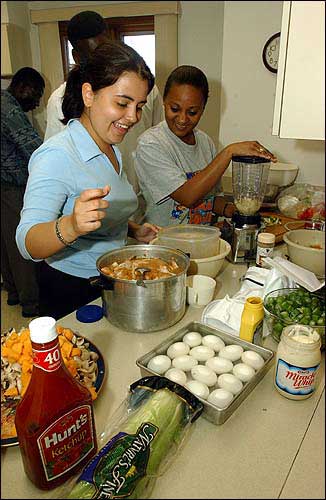
Kristel Meza, 24, left, from Honduras, and Aminata Keita, 32, from West Africa, learn some cooking secrets from each other as they prepare their traditional meals.
Ivory Coast native Adolphe Yace, 36, prepared alloco, which is fried plantains, or bananas, in a tomato-like sauce with hot peppers. He said the orientation program in its third year gave him a chance to immerse himself in American culture before beginning his graduate studies in music at the Boston University Center for Fine Arts.
“You get to feel the society,” said Yace, who was director of the National Music School of Ivory Coast. “You get to feel the people.”
Students in the program spend all day in classes, including a grammar course, computer course and research course.
Geri Lamer, special program assistant at the Applied English Center, said the orientation program gave the scholars valuable information.
“It’s an incredible bonding experience,” she said. “Past participants have kept in touch afterwards and that really helps them get through studying in a foreign country.”
All the courses and other experiences, Yace said, will help him in Boston.
“Whether we notice it or not, we are all different,” Yace said. “The way you think isn’t the way I think. If you jump into a system and you have an academic requirement and a social requirement, you’ll get lost. This program helps prevent that.”
City Government
Developer seeks incentive from City of Lawrence to build 131 units of housing near Wakarusa and Queens

Lawrence city leaders will consider whether to keep Community Building open, make 2 other rec centers free to access
A STAR Bond application raises questions for city leaders about Costco and housing west of the SLT
Soccer gear honoring Lawrence history’s all-star team is now on sale as part of city’s public art exhibition
To honor public servants, Lawrence’s July 4 celebration will have a whole gallery of their photos on display; submissions open now