Weighing all the facts of an issue
Newest planning commissioner gets a reputation for being a dogged researcher
It wouldn’t be accurate to say John Haase has defied expectations during his short tenure on the Lawrence-Douglas County Planning Commission.
His appointment last spring to the commission was so quiet especially compared with the high-profile battle over David Burress’ appointment at the same time that it’s hard to say that there were any expectations.
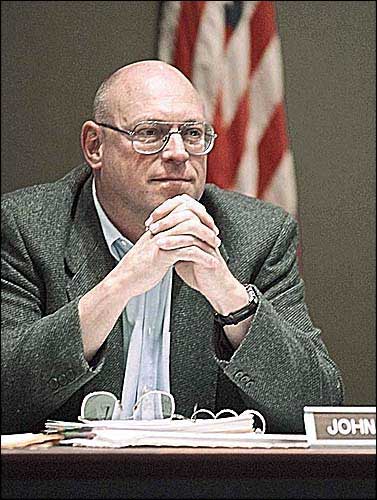
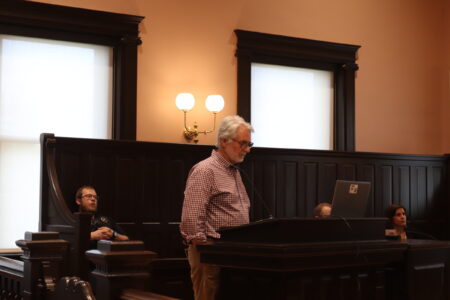
John Haase, one of the newest members of the Lawrence-Douglas County Planning Commission, listens to public comments during a January meeting.
“There wasn’t so much controversy,” said Douglas County Commissioner Bob Johnson, who made the appointment.
Certainly, Haase wasn’t promising to bring a radically different viewpoint to the commission.
“I really only have one goal,” he said at the time, “and that is to be an exceptionally good listener for a period of time, carefully consider the input on the issues, render whatever contribution I can and make the best judgments I can as the issues come up.”
But while many planning commissioners say the first year or two of service involves a lot of listening and almost no talking, Haase has emerged as one of the commission’s most vocal members and one of its more dogged researchers. He has surprised observers by taking different stands than Johnson on some big issues.
No problem, both men say.
“John has taken some positions I don’t know I entirely agree with,” Johnson said. “Whether I agree with him or not, though, I never doubt that he’s studied it thoroughly and looked at it from all sides. And I respect that.”
Haase, meanwhile, downplays his role.
“I’m still a pretty quiet commissioner,” Haase said. “The only thing I’ve done is work pretty hard on a couple of issues and present that information as best I can to the rest of the commission.”
Hitting hot topics
Haase has played the presenting role, though, in two of the biggest issues to hit the planning commission last year: the South Lawrence Trafficway and proposed restrictions on floodplain development. In late January he volunteered to take on another hot topic: the county’s five-acre exemption.
Haase was one of seven members of a task force designed to voice the community opinion on proposed routes for the trafficway. During the task force meetings, he developed a “matrix” as a scientific method to help determine which route the task force would endorse.
The committee split, however. Five members including Johnson voted to endorse a 32nd Street route; Haase and Burress favored a south-of-the-Wakarusa-River alignment.
Differences of opinion
Johnson said he never had a “litmus test” for the appointment and thought the diversity of views was healthy. Still
“When somebody makes a vote you agree with, you think, ‘I made a pretty good appointment,'” Johnson said, chuckling. “And when they don’t, you think, ‘Well why did I do that?'”
Haase, though, thought his view wasn’t so different from Johnson’s.
“I think the important thing to notice is Bob and I weren’t on opposite sides of the issue,” Haase said. “We both believe the SLT should be completed. We just had different views where it should go.”
Haase next ended up on a planning commission subcommittee reviewing proposed floodplain regulations. He has been the most ardent voice on the subcommittee in favor of restricting floodplain development, and he has done the digging to support his views in January, he presented fellow committee members with a document of more than 30 pages, summarizing his research.
“He researches the topics fantastically,” said Planning Commissioner Jane Bateman, chair of the subcommittee. “It’s phenomenal how he researches everything he can get his hands on.”
There’s a reason for his research, Haase said.
“The sheer importance of those two issues propelled me into wanting to be as informed as I possibly could,” he said.
Planning decisions in Lawrence often take on political overtones. Despite his willingness to speak up on those issues, Haase said he shuns the political side.
“I really don’t want to be part of that,” he said. “I want to be part of a process where we craft clear and useful regulations and policies and then enforce them.”
City Government
Developer seeks incentive from City of Lawrence to build 131 units of housing near Wakarusa and Queens

Lawrence city leaders will consider whether to keep Community Building open, make 2 other rec centers free to access
A STAR Bond application raises questions for city leaders about Costco and housing west of the SLT
Soccer gear honoring Lawrence history’s all-star team is now on sale as part of city’s public art exhibition
To honor public servants, Lawrence’s July 4 celebration will have a whole gallery of their photos on display; submissions open now