Floodplain debate continues to flow
Outlying areas on agenda next
It has been nearly a decade since the 1993 flood wreaked havoc on Lawrence and much of the rest of the state. But Douglas County officials are still wrestling with its aftermath and how to prevent a recurrence of the destruction.
The Lawrence-Douglas County Planning Commission and the Lawrence City Commission appeared on track this spring to approve new regulations that would greatly restrict development in floodplain areas.
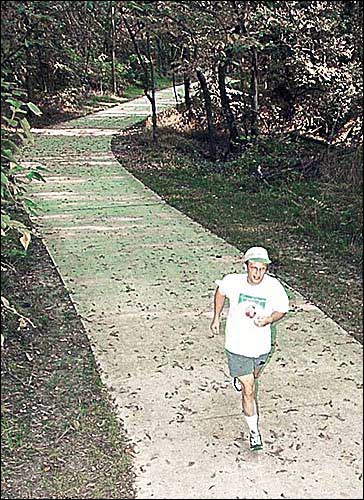
A sidewalk winds its way along the floodplain that the city of Lawrence purchased in Naismith Valley to circumvent flood-related property damage. David Dunfield, Lawrence city commissioner, jogs the trail, which is directly south of Naismith Drive near 27th Street.
And Lawrence, sandwiched by the Kansas River, the Wakarusa River and Clinton Lake, has plenty of floodplain.
But the debate probably isn’t over. The planning commission will now turn its attention to developing floodplain regulations for the unincorporated areas of Douglas County.
Approval there is not a sure thing. County commissioners have suggested they want floodplain regulations that will dovetail with the city’s, but they also asked that the original proposal be delayed.
“It seems to me the more notice people have, the better,” Douglas County Commissioner Bob Johnson said in September. That way “people can talk about what they want to do with their property.”
For many, the issue boils down to private property rights versus the public interest.
Proponents of regulations note the 1993 flood was expensive for Douglas County taxpayers. In the immediate aftermath, the city spent $2.3 million to repair streets, sewers and other parts of the infrastructure. Another $1.2 million went to designing and building a pump station to slow the buildup of rainwater in North Lawrence.
Additionally, the federal government provided Douglas County with $4.4 million to assist farmers, families and businesses in flood recovery efforts.
With an eye toward preventing more devastation, the city created a stormwater management master plan to find ways to move water away from inhabited areas and into streams and fields where buildings and homes wouldn’t be damaged.
The city has committed $11 million so far to implement that plan, creating stormwater channels at Third and Michigan and 21st and Carolina streets, among others. Other projects in the plan could cost the city another $40 million by 2014.
“That’s what taxpayers are going to pay to protect what’s already developed,” Lawrence City Commissioner David Dunfield said last fall. “The economics and costs of floodplain development are enormous. From an academic view, anyway, it’s easy to avoid those costs.”
Others, however, said the proposed regulations might hinder economic development and the ability of property owners to see a return on land investments. Some floodplain land, they said, can be developed without harmful effects.
“For a lot of people, that’s their life insurance, their savings accounts, the thing they’re going to leave their families,” Pete Wempe, who has opposed the regulations, said last fall.
The city regulations evolved during the process, starting as a virtual ban on floodplain development before morphing into a version that still sets the bar high for developers: Construction is allowed if the builders can produce a study showing the new building will have zero effect on the floodplain.
The rules apply only in the 100-year floodplain a line where, theoretically, floodwaters will reach once a century. Put another way, there is a 1 percent chance floodwaters will reach that point in a given year.
Planning Commissioner Jane Bateman said the practical effect of the rules, even the modified version, will be a big drop in floodplain development.
That would be fine with Ted Boyle, president of the North Lawrence Improvement Assn. He remembers boating in North Lawrence during the 1993 flood and doesn’t want to see a repeat. New houses in his neighborhood, he said, would leave less room for floodwaters to flow away from his own home.
“Building in a floodplain,” he said, “is not a good idea.”
City Government
Developer seeks incentive from City of Lawrence to build 131 units of housing near Wakarusa and Queens

Lawrence city leaders will consider whether to keep Community Building open, make 2 other rec centers free to access
A STAR Bond application raises questions for city leaders about Costco and housing west of the SLT

Soccer gear honoring Lawrence history’s all-star team is now on sale as part of city’s public art exhibition
To honor public servants, Lawrence’s July 4 celebration will have a whole gallery of their photos on display; submissions open now