Farmers survive by diversifying crops, embracing new technology
Traditional farming is on its way out in Douglas County.
As the nation’s farm economy continues to struggle and urbanization and population increase in Douglas County, Lawrence-area farmers are diversifying their products and turning to new technologies to survive.
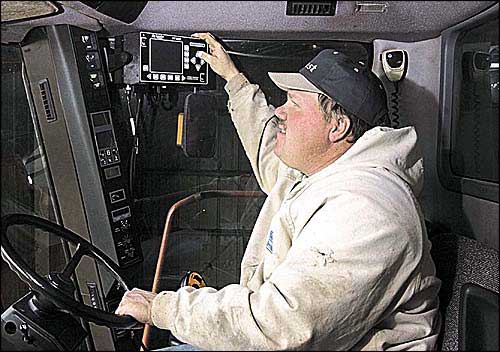
Mark Wulfkuhle, who lives south of Stull, checks the settings on the Global Positioning System on his Case combine.
For farmers like Mark Wulfkuhle, who continue to concentrate on growing traditional crops such as corn and soybeans, surviving means using high-tech equipment such as Global Positioning System satellite information and yield monitors.
“We’re becoming more site-specific in our use of fertilizer and lime on our fields,” Wulfkuhle said. “Eventually we’ll try variable-rate seeding.”
Translated, Wulfkuhle means GPS information has allowed him to break up his crop fields into 2.5-acre map sections. Soil testing tells him which sections need more fertilizer. Where the soil is already rich, less fertilizer is needed.
A yield monitor is a device Wulfkuhle has attached to his combine to determine the amount of bushels cut per acre in each map section. The yield monitor will tell him which field sections are the most productive.
Response to low prices
Last spring Wulfkuhle began using GPS for the first time. He is unsure at this time how much it helps his bottom line.
“It’s probably going to take several years of data collecting before we know how it does,” he said.
When Wulfkuhle turns to variable-rate seeding sometime in the future, the number of crop seeds in a section also will be determined by how productive the ground is. Less seed will be used in areas that consistently are low on production.
Wulfkuhle, 38, manages a 3,500-acre farm in western Douglas County. About 1,200 of those acres are used mainly for growing corn and soybeans and some wheat. Because farm prices have been depressed for years, Wulfkuhle calls it “a real challenge” to be able to make a living off of full-time farming.
For example, corn prices in early February were about $1.90 per bushel. In the mid-1980s it was about $2.50 per bushel, Wulfkuhle said. Soybeans in February saw prices about $2.10. In the mid-1980s he remembers soybeans selling for $6 per bushel.
“We always hear that the population is growing, but we’re not getting any higher prices,” Wulfkuhle said.
Co-op bankruptcy
If it wasn’t for federal government price supports, many farmers would be having an even harder time, said Bill Wood, agricultural agent for Kansas State University’s Research and Extension Office in Douglas County. Despite good harvests last year, prices still are not good, he said.
“The government has seen fit to provide price supports, which allow farmers to do a little better than break even,” Wood said.
But there are other complications farmers must face. In September 2000, Farmer’s Cooperative Assn. went bankrupt, affecting numerous farmers throughout the region. Not all farmers who were expecting to get checks for grain from the co-op got them, he said.
“It’s just like going without a paycheck,” Wood said.
Then came harvest time in the spring and summer of 2001. Those farmers didn’t have co-op money to help pay for fuel and other expenses. They may have had to get loans, Wood said.
John Pendleton, long-time farmer east of Lawrence, long ago learned to diversify his products to survive. In 1981, John and his wife, Karen, began planting asparagus in addition to the more traditional soybeans, corn and wheat. Today they have 20 acres of asparagus and some of it is open to the public as a “pick your own” field.
Stiff competition
Nevertheless, marketing of such “truck-gardening” products is still difficult because of competition for sought-after wholesale purchase agreements with grocery stores. The local truck gardener is competing with big produce companies in California, which are often able to sell to stores at lower wholesale prices.
Truck gardeners have to rely on individual sales. The Pendletons operate their own Pendleton Country Market for produce sales. Many area residents are willing to pay more for a better-tasting, home-grown product, Pendleton said.
The Pendletons also diversified in other ways. They raise perennial flower varieties and grow hydroponic tomatoes.
City Government
Developer seeks incentive from City of Lawrence to build 131 units of housing near Wakarusa and Queens

Lawrence city leaders will consider whether to keep Community Building open, make 2 other rec centers free to access
A STAR Bond application raises questions for city leaders about Costco and housing west of the SLT

Soccer gear honoring Lawrence history’s all-star team is now on sale as part of city’s public art exhibition
To honor public servants, Lawrence’s July 4 celebration will have a whole gallery of their photos on display; submissions open now